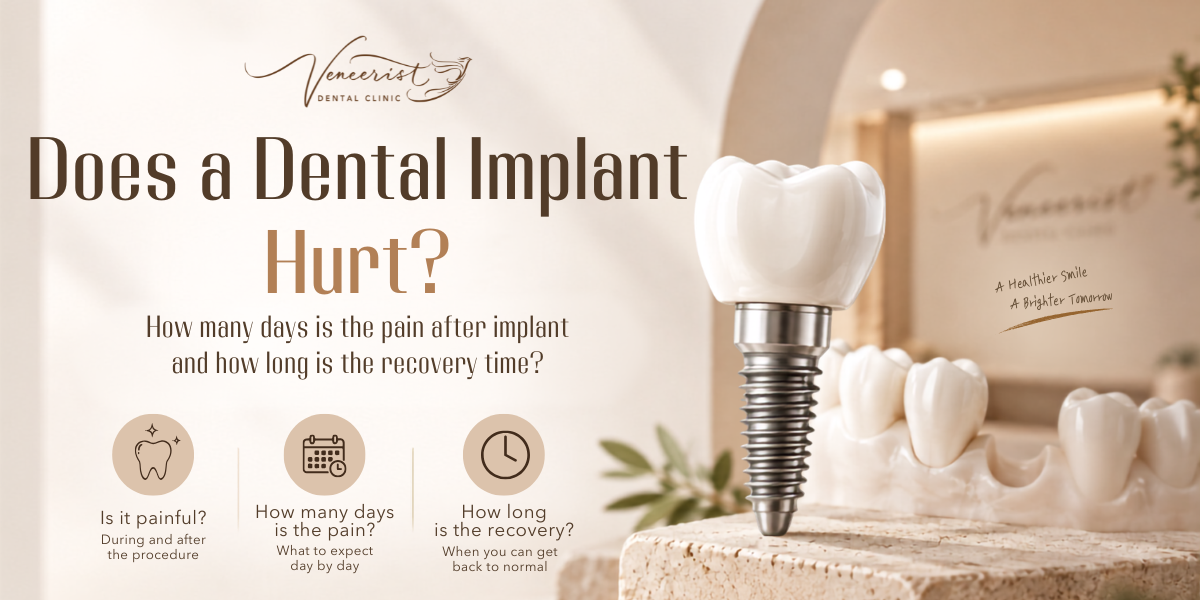
Do dental implants hurt? This is one of the most common concerns patients have before implant treatment. Local anaesthesia is used during implant placement to help control pain, while some soreness, tenderness, or swelling can occur after the procedure. The level of discomfort and recovery time can vary depending on the individual and the complexity of the treatment.
Do Dental Implants Hurt?
When people hear the words Dental Implant Surgery, it is natural to wonder how painful the procedure will be.
During dental implant placement, local anaesthesia is used to numb the treatment area and help control pain.
You may still be aware of pressure, vibration, or movement during the procedure, but you should not feel sharp pain in an area where the anaesthetic is working effectively.
If you experience pain or significant discomfort during the procedure, you should let your dentist know so that it can be assessed and managed appropriately.
What Happens After the Anaesthesia Wears Off?
Once the local anaesthesia begins to wear off, it is normal to experience some degree of soreness, tenderness, tightness, or swelling around the surgical area.
The amount of discomfort varies from person to person.
Some patients may experience relatively mild discomfort, while others may have more noticeable soreness or swelling, particularly when the surgery is more complex or additional procedures are performed at the same time.
Your dentist will provide post-operative instructions and any appropriate medication based on your individual treatment.
How Long Does Pain Last After a Dental Implant?
There is no exact number of days that applies to everyone.
Discomfort and swelling are generally expected during the early healing period and should gradually improve as the surgical area heals.
Rather than focusing only on:
“How many days will it hurt?”
it is more useful to pay attention to whether your symptoms are gradually improving.
If pain or swelling becomes noticeably worse instead of improving, or if you develop other unusual symptoms, you should contact the dental clinic for an assessment.
Why Do Some People Experience More Discomfort Than Others?
Every dental implant procedure is different.
The level of post-operative discomfort may be influenced by factors such as:
- The number of implants being placed
- The location of the implant
- Bone quantity and quality
- Complexity of the surgery
- Whether a tooth is extracted at the same time
- Whether Bone Grafting is required
- Whether gum or soft-tissue procedures are performed
- Your general health and individual healing response
- How the surgical area is cared for afterwards
This is why another person’s implant experience cannot necessarily predict how your own recovery will feel.
Will My Face Swell After Dental Implant Surgery?
Some swelling can occur.
Swelling is one of the body’s normal responses following surgery, although the amount varies between patients and procedures.
A straightforward single-implant case may have a different recovery experience from a case involving multiple implants, tooth extraction, Bone Grafting, or additional surgical procedures.
Following your dentist’s post-operative instructions and attending scheduled follow-up appointments are important parts of the recovery process.
How Long Do I Need to Rest After Dental Implant Surgery?
This depends on the procedure and your normal daily activities.
After a relatively straightforward implant procedure, some patients may be able to return to normal daily activities fairly quickly, although some tenderness or swelling may still be present.
More complex procedures — such as multiple implant placement, Bone Grafting, or other additional surgery — may require more recovery time.
For international patients travelling to Krabi for dental implant treatment, we recommend letting the clinic know your arrival and departure dates in advance. This allows sufficient time to be considered for examination, treatment, and any necessary follow-up appointments before you travel home.
Can I Eat After Dental Implant Surgery?
Yes, but during the early healing period, it is usually advisable to choose foods that are easy to eat and avoid unnecessary pressure on the surgical area.
Your dentist may recommend avoiding foods that are hard, sticky, or require heavy chewing, particularly around the area where the implant has just been placed.
When you can return to normal chewing depends on the implant location, the type of surgery performed, healing progress, and the restorative stage of your individual treatment.
Does Everyone Need a Bone Graft With a Dental Implant?
No.
Dental implants require an appropriate amount of bone for support. If there is insufficient bone at the missing-tooth site, the dentist may recommend Bone Grafting to improve the conditions for implant treatment.
In some cases, bone grafting can be performed at the same time as implant placement.
In other cases, the bone may need to be grafted first and allowed to heal before the implant can be placed at a later stage.
Whether Bone Grafting is necessary can only be determined after evaluating the individual site.
What Tests Are Needed Before Dental Implant Surgery?
Dental implant treatment begins with an assessment rather than simply scheduling the implant surgery immediately.
The dentist will evaluate your oral health, the missing-tooth area, gums, bite, and relevant medical history.
For implant treatment, a CBCT (Cone Beam Computed Tomography) scan may be used to evaluate the jawbone and important anatomical structures in three dimensions and assist with implant treatment planning.
If you have any medical conditions or regularly take medication, it is important to provide your dentist with a complete and accurate medical history before treatment.
When Should I Contact the Clinic After Implant Surgery?
Some soreness, swelling, or minor bleeding may occur following surgery according to the nature of the procedure.
However, you should contact the clinic if you experience symptoms that appear unusual or concerning, such as pain or swelling that becomes significantly worse, uncontrolled bleeding, fever, pus, or other unexpected symptoms.
If something does not feel right after treatment, you do not need to wait until your next scheduled appointment to ask for advice.
Summary — Do Dental Implants Hurt?
During dental implant placement, local anaesthesia is used to help control pain. After the anaesthesia wears off, some soreness, tenderness, or swelling can occur during the early recovery period.
However, both the level of discomfort and recovery time vary from person to person.
A straightforward single-implant procedure can be very different from a case involving tooth extraction, Bone Grafting, multiple implants, or additional surgical procedures.
So rather than asking only:
“How painful will a dental implant be?”
another important question is:
“What procedures will my particular case require?”
A proper examination, assessment of the bone, and individual treatment plan allow your dentist to explain the expected procedure, complexity, and recovery more accurately for your situation.
Dental Implants at Veneerist Dental Clinic, Krabi, Thailand 🤍