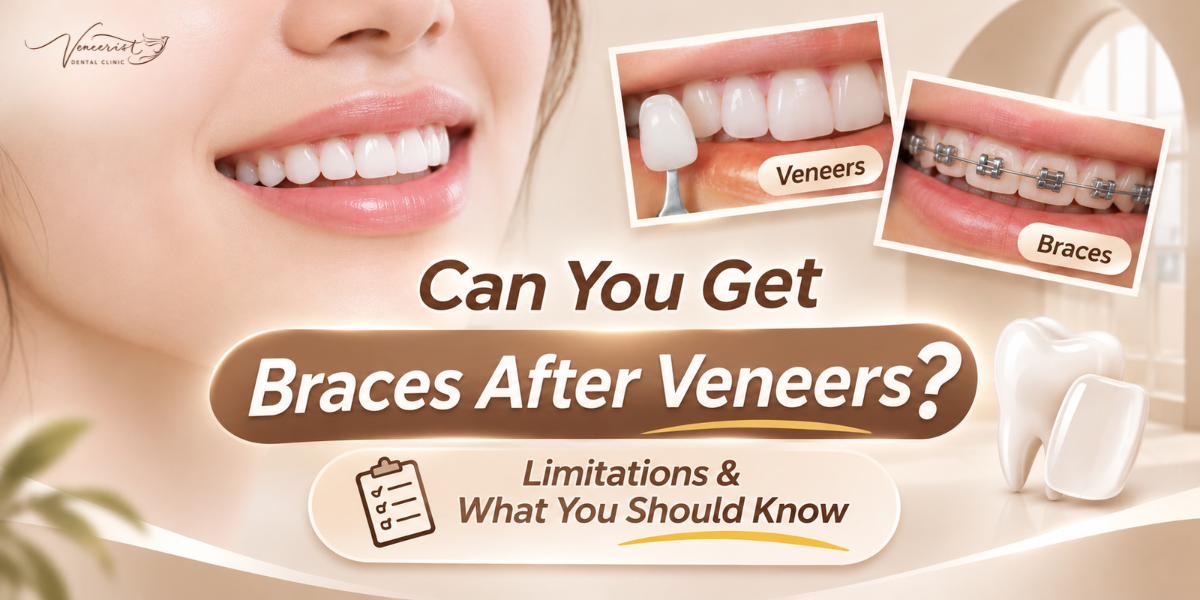
Can You Get Braces After Veneers? Should You Have Braces Before or After Veneers?
It is possible to have braces after getting dental veneers in many cases. However, orthodontic treatment on teeth with existing veneers involves additional considerations, including the bonding of orthodontic appliances, the risk of damaging the restorations, and whether the original veneer design will remain suitable once the teeth have moved.
At Veneerist Dental Clinic Krabi, our dentists recommend completing orthodontic treatment before having veneers if both treatments are already part of your dental treatment plan. This allows the shape, size and proportions of the veneers to be designed according to the final positions of the teeth.
However, this does not mean that everyone needs braces before getting veneers.
In many routine cases at our clinic, veneers can be placed without prior orthodontic treatment, provided that the condition of the teeth and bite allows treatment to proceed according to the dentist’s recommended plan. Depending on the original alignment and characteristics of the natural teeth, additional tooth preparation may be required in certain areas.
What Is the Difference Between Veneers and Braces?
Although both veneers and orthodontic treatment can improve the overall appearance of a smile, they have different purposes and treatment principles.
Dental veneers are restorations that cover the front surfaces of the teeth to improve their colour, shape, size and proportions.
Orthodontic treatment, on the other hand, moves teeth through a biological process involving the remodelling of bone and surrounding periodontal tissues, helping to improve tooth alignment and the relationship between the upper and lower teeth.
| Features | Dental Veneers | Orthodontic Treatment |
|---|---|---|
| Primary purpose | Improve tooth colour, shape, size and appearance | Improve tooth alignment and bite |
| Treatment principle | Restore the tooth surface using dental materials | Move teeth using orthodontic appliances |
| Root position | Does not move tooth roots | Can move teeth and their roots according to the treatment plan |
| Tooth colour and shape | Can improve colour and shape within clinical limitations | Does not directly change natural tooth colour or shape |
| Crowded or uneven teeth | Can improve the appearance of alignment in suitable cases | Can correct tooth positions according to clinical indications |
Veneers are therefore not a form of orthodontic treatment. However, in appropriately selected cases, veneers can create the appearance of a more evenly aligned smile without physically moving the teeth.
Can Teeth Still Move After Getting Veneers?
Natural teeth restored with veneers can generally be moved through orthodontic treatment, provided that the roots, supporting bone and periodontal tissues are healthy enough for orthodontic movement.
Veneers are bonded to the surfaces of natural teeth and do not anchor the roots to the jawbone.
When appropriate orthodontic forces are applied, the natural tooth and its bonded veneer can move together.
However, the main challenges involve more than tooth movement itself. They also include bonding orthodontic appliances to veneer surfaces, removing these appliances safely, and assessing whether the existing restorations remain suitable after the teeth have moved.
What Types of Orthodontic Treatment Are Possible After Veneers?
Patients with existing veneers may be suitable for fixed orthodontic appliances or clear aligners, depending on the condition of their teeth, the veneer material and the complexity of the proposed tooth movements.
1. Traditional Metal Braces
Traditional metal braces use brackets bonded to the tooth surfaces and orthodontic wires to control tooth movement.
When a tooth has a veneer, the dentist must select an appropriate surface preparation technique and bonding system according to the restorative material.
Ceramic and composite resin surfaces have different properties from natural enamel. Consequently, conventional bonding techniques used on natural teeth may not be suitable for every type of veneer.
Potential limitations include:
- Orthodontic brackets may become detached from veneer surfaces.
- Surface preparation may affect the original smoothness or gloss of the restoration.
- Veneers may become scratched, chipped, fractured or detached during appliance placement or removal.
- Some veneers may require polishing, repair or replacement after orthodontic treatment.
Metal braces can therefore be considered for patients with existing veneers, but careful planning is required when bonding and removing orthodontic appliances.
2. Clear Aligners
Clear aligners use a series of transparent, removable appliances to gradually move teeth according to an orthodontic treatment plan.
Although clear aligners do not use traditional metal brackets, this does not mean that they eliminate the risk of veneer damage.
Some clear aligner treatment plans require small composite resin attachments to be bonded to tooth surfaces. These attachments help control specific tooth movements.
If attachments need to be placed on veneers, appropriate surface preparation, bonding and attachment removal techniques must still be considered.
Existing veneers with compromised bonding or previous damage should also be assessed before starting clear aligner treatment.
The choice of orthodontic appliance should therefore depend not only on the desire to protect existing veneers, but also on the clinical requirements of tooth movement and bite correction.
What Are the Risks of Having Braces After Veneers?
Although orthodontic treatment after veneers is possible in many cases, patients should understand the potential limitations and risks before proceeding.
1. Damage to the Veneer Surface
Preparing veneer surfaces for orthodontic brackets or attachments, as well as removing residual adhesive afterwards, may affect the original smoothness, gloss or surface texture of the restoration.
The extent of potential damage depends on the restorative material, surface preparation method, bonding system and techniques used during appliance placement and removal.
2. Veneers May Chip, Fracture or Become Detached
Placing or removing orthodontic appliances may damage existing veneers, particularly if they already have cracks, compromised bonding or other structural problems.
A thorough assessment of all relevant veneers is therefore important before starting orthodontic treatment.
3. Existing Veneer Shapes May No Longer Suit the New Tooth Positions
Each veneer is designed according to the original tooth position, natural tooth shape, gum contour and bite at the time of treatment.
Once the teeth have moved, the original veneer shapes and proportions may no longer correspond to the new alignment.
For example, veneers originally designed to disguise the appearance of crowded or rotated teeth may have specific contours or thicknesses to compensate for the original tooth positions.
After orthodontic treatment, these restorations may no longer blend harmoniously with the newly aligned teeth.
4. Changes in the Bite May Affect Existing Veneers
Orthodontic treatment changes tooth positions and may alter the relationship between the upper and lower teeth.
Veneers originally designed according to the previous bite may therefore require reassessment or adjustment to ensure they remain suitable for normal function.
5. Some Veneers May Need to Be Replaced After Orthodontic Treatment
Some patients can retain their existing veneers after completing orthodontic treatment, whilst others may require adjustments, repairs or replacement restorations.
For this reason, patients who are already planning to have orthodontic treatment are generally advised to complete it before having definitive veneers.
This may help avoid unnecessary repeated treatment and additional costs.
Are There Different Orthodontic Considerations for Ceramic and Composite Veneers?
Ceramic veneers and composite veneers have different material properties, which influence surface preparation, orthodontic bonding and potential repair options.
| Features | Ceramic Veneers | Composite Veneers |
|---|---|---|
| Material | Dental ceramic | Composite resin |
| Orthodontic bonding | Requires surface preparation appropriate to the specific ceramic material | Requires surface preparation appropriate to the material and its condition |
| Potential damage | Loss of gloss, surface scratches, chipping or fractures | Surface scratches, wear or localised damage to the material |
| Repair options | Depends on the material and extent of damage; replacement may be necessary | Localised polishing or composite repair may be possible |
| Assessment before orthodontic treatment | Required | Required |
Regardless of the veneer material, existing restorations should be carefully assessed before orthodontic treatment begins.
Should You Have Braces Before or After Veneers?
For patients who intend to have both orthodontic treatment and veneers, our dentists at Veneerist Dental Clinic Krabi recommend completing orthodontic treatment before proceeding with definitive veneers.
Orthodontic treatment changes tooth positions, alignment and bite relationships. Designing veneers after these changes have been completed allows the dentist to consider the final shape, size, thickness and proportions of the restorations in relation to the newly aligned teeth.
Benefits of Completing Orthodontic Treatment Before Veneers
- Allows natural tooth positions to be improved before veneer design.
- Helps address tooth alignment and bite problems according to clinical indications.
- May reduce the amount of natural tooth structure that needs to be removed.
- Reduces the limitations associated with designing veneers around uneven tooth positions.
- Avoids the need to bond orthodontic appliances to definitive veneer surfaces.
- May reduce the likelihood of having to replace veneers because of subsequent changes in tooth alignment.
However, recommending orthodontic treatment first for patients who already intend to have braces does not mean that braces are a prerequisite for every veneer patient.
Can You Get Veneers Without Having Braces First?
Yes. Veneers can be placed without prior orthodontic treatment when the dentist determines that the tooth positions, natural tooth structure and bite are suitable for restorative treatment.
In many routine cases at Veneerist Dental Clinic Krabi, patients can proceed with veneers without having braces first, provided that treatment can be carried out according to the dentist’s recommended plan.
This may include patients with mild crowding, minor tooth rotations or uneven alignment that can be appropriately managed through restorative treatment.
By carefully designing the shape, size, thickness and proportions of the veneers, the dentist may be able to improve the overall appearance of tooth alignment without orthodontically moving the teeth.
However, patients should understand an important consideration before choosing this approach: veneers placed on unevenly positioned teeth may require more extensive tooth preparation in certain areas than veneers placed on teeth that have already been orthodontically aligned.
This is because the restorations must be designed around the limitations of the original natural tooth positions.
Veneers without braces can therefore be a suitable treatment option in selected cases. However, they are not appropriate for everyone and cannot replace orthodontic treatment when significant correction of root positions or bite relationships is required.
Why Might Veneers Without Braces Require More Tooth Preparation?
Tooth preparation is a clinical procedure used to create space and adjust the contours of natural teeth to accommodate veneer restorations.
When natural teeth are unevenly positioned, the amount of preparation required may vary between teeth and between different areas of the same tooth.
When Some Teeth Protrude Beyond Adjacent Teeth
If a tooth sits further forward than its neighbouring teeth, additional reduction of the protruding surface may be necessary to create space for the veneer and achieve a more harmonious front surface alignment.
When Teeth Are Crowded or Rotated
Crowded or rotated teeth may have certain areas that project further out than others.
Selective preparation of these areas may be required to allow the veneer to have an appropriate shape, thickness and contour.
When Some Teeth Sit Further Back
In certain cases, a veneer may need additional thickness in specific areas to improve the appearance of alignment with neighbouring teeth.
This must be carefully planned whilst considering the natural tooth shape, gum health and the ability to maintain good oral hygiene.
Attempting to avoid tooth preparation entirely when the original tooth positions are unsuitable may result in veneers that appear excessively thick, bulky or poorly contoured.
However, additional preparation does not necessarily mean that every tooth requires extensive reduction. The amount of preparation should be determined individually according to clinical requirements.
Preserving as much natural tooth structure as reasonably possible remains an important consideration. Natural tooth structure removed during preparation does not regenerate, and bonding to enamel is an important factor in adhesive restorative dentistry.
Braces Before Veneers vs Veneers Without Braces
| Features | Braces Before Veneers | Veneers Without Braces |
|---|---|---|
| Natural tooth positions | Improved through orthodontic treatment before veneer placement | Original natural tooth positions remain |
| Tooth preparation | May reduce the amount of tooth reduction required | Additional preparation may be required in certain areas |
| Veneer design | Based on the final orthodontically aligned tooth positions | Based on the limitations of the original tooth positions |
| Bite correction | Can address bite problems through orthodontic movement when indicated | Limited ability to correct tooth position and bite problems |
| Treatment duration | Requires an additional period of orthodontic treatment | Does not require waiting for orthodontic treatment to be completed |
| Treatment costs | Includes additional orthodontic treatment costs | No orthodontic treatment costs if braces are not required |
| Suitability | Patients with orthodontic indications or existing plans for braces | Patients whose teeth can be appropriately restored according to the dentist’s recommended treatment plan |
Both approaches have advantages and limitations.
The appropriate treatment option should be determined by considering natural tooth structure, oral health, tooth alignment, bite relationships, patient preferences and the amount of tooth preparation required.
When Might a Dentist Recommend Braces Before Veneers?
Although many patients with minor alignment irregularities can have veneers without braces, orthodontic treatment may be more appropriate in certain situations.
These may include:
- Significant crowding that would otherwise require excessive removal of natural tooth structure.
- Severely protruding or rotated teeth.
- Bite abnormalities that require orthodontic correction.
- Tooth positions that make it difficult to design veneers with appropriate thickness and contours.
- Situations where restorative treatment alone may compromise gum health or make oral hygiene more difficult.
- Patients who wish to correct the actual positions of their teeth and roots rather than simply improve the appearance of their smile.
If the dentist determines that veneers without braces would require excessive tooth reduction or would not adequately address functional and oral health requirements, orthodontic treatment may be recommended before veneer placement.
What Should You Do If You Already Have Veneers and Want Braces?
If you already have veneers and are considering orthodontic treatment, the first step is a comprehensive assessment of your oral health and existing restorations.
1. Assess Your Teeth and Gum Health
The dentist will assess whether tooth decay, gum inflammation, periodontal disease or other oral health problems need to be addressed before orthodontic treatment.
2. Examine Existing Veneers
The veneer material, marginal fit, bonding condition and any existing cracks, fractures or damage should be assessed.
Information about the original veneer material and previous dental treatment may also be helpful if available.
3. Analyse Tooth Alignment and Bite
Dental photographs, X-rays, study models or digital scans may be used when clinically indicated to evaluate tooth positions, roots, supporting bone and jaw relationships.
4. Select an Appropriate Orthodontic Appliance
The dentist will consider the most suitable appliance, bonding techniques and proposed tooth movements whilst accounting for the limitations of the existing veneers.
5. Plan Any Restorative Treatment Required After Orthodontics
Before starting treatment, patients should discuss whether their existing veneers may require adjustment, repair or replacement after orthodontic treatment.
Planning these possibilities in advance helps patients understand the overall treatment process, potential limitations and additional costs.
Can You Get Veneers Immediately After Finishing Braces?
After orthodontic treatment has been completed, the dentist should assess tooth alignment, bite relationships, gum health and the retention plan before proceeding with veneers.
Some patients may be able to begin veneer treatment planning soon after their braces have been removed, whilst others may need additional time for their gum tissues to recover or for other oral health concerns to be addressed.
The appropriate timing varies according to individual clinical circumstances and cannot be defined by a fixed waiting period for every patient.
Do You Still Need a Retainer After Getting Veneers?
Yes. Patients who have veneers after orthodontic treatment still need to wear their retainers according to their dentist’s recommended retention plan.
Veneers do not prevent teeth from moving or experiencing orthodontic relapse.
When veneers change the shape, size or thickness of the teeth, an existing retainer may no longer fit correctly.
The dentist should therefore assess whether the original retainer remains suitable or whether a new retainer is required to accommodate the final veneer contours.
Retention should ideally be planned before veneer treatment begins to avoid an unnecessary interruption in maintaining tooth positions.
Patients should not force an ill-fitting retainer onto their teeth or discontinue retainer wear without professional advice.
Frequently Asked Questions About Braces and Veneers
Can you get braces after veneers?
Yes, in many cases. However, the condition of the natural teeth, supporting tissues, veneer material and potential risks associated with orthodontic bonding must be assessed before treatment begins.
Do slightly crowded teeth need braces before veneers?
Not necessarily. If the dentist determines that the teeth can be appropriately restored with veneers, orthodontic treatment may not be required. However, additional tooth preparation may be necessary in certain areas.
Do veneers without braces require more tooth reduction?
This depends on the natural tooth positions, shapes and alignment.
Protruding, crowded or rotated teeth may require more preparation in certain areas than teeth that have already been appropriately aligned.
The amount of preparation should be determined individually whilst considering the preservation of natural tooth structure.
Do veneers need to be removed before getting braces?
Not in every case. Existing veneers may be retained during orthodontic treatment if they remain in good condition and do not interfere with the proposed tooth movements or treatment plan.
Can clear aligners damage veneers?
There is a potential risk, particularly when composite attachments need to be bonded to veneer surfaces.
The existing restorations, bonding techniques and proposed orthodontic treatment should therefore be assessed before proceeding.
Will all my veneers need to be replaced after braces?
Not necessarily. Existing veneers may be retained if they remain suitable for the final tooth positions and bite.
However, certain veneers may require adjustment, repair or replacement after orthodontic treatment.
If I am planning to have both braces and veneers, which should come first?
At Veneerist Dental Clinic Krabi, our dentists recommend completing orthodontic treatment before having definitive veneers.
This allows the restorations to be designed according to the final tooth positions and bite whilst avoiding the need to bond orthodontic appliances to definitive veneer surfaces.
Summary: Can You Get Braces After Veneers, and Are Braces Necessary Before Veneers?
Orthodontic treatment after veneers is possible in many cases. However, careful assessment is required to evaluate natural tooth structure, veneer materials, orthodontic bonding requirements and the potential risk of damage to existing restorations.
For patients planning to have both orthodontic treatment and veneers, our dentists recommend completing orthodontic treatment first. This allows veneer shapes and proportions to be designed according to the final tooth positions.
However, braces are not necessary for every veneer patient.
In many routine cases, veneers can be placed without prior orthodontic treatment, provided that treatment can proceed appropriately according to the dentist’s recommended plan.
The main consideration is that additional tooth preparation may be necessary in certain areas, depending on the original alignment of the natural teeth.
Ultimately, an appropriate treatment plan should balance smile aesthetics, preservation of natural tooth structure, gum health and long-term dental function.
Plan Your Smile at Veneerist Dental Clinic Krabi
If you are considering dental veneers but are unsure whether you need braces first, or if you already have veneers and are thinking about orthodontic treatment, you can arrange a dental consultation to explore suitable treatment options.
At Veneerist Dental Clinic Krabi, we approach smile design with consideration for both dental aesthetics and natural tooth health.
Our treatment planning takes into account tooth positions, natural tooth shapes, the amount of preparation required, gum health and bite relationships.
Because a beautiful smile is not simply about the colour and shape of your teeth, but also about how your restorations complement your oral health and everyday dental function.
Learn more about our dental services or arrange a consultation through our English website.
Veneerist Dental Clinic Krabi — Crafting Your Shine
Maharat Road, Pak Nam, Mueang Krabi, Krabi, Thailand
Opening hours: Monday–Sunday, 10 am–8 pm.
Advance appointments are recommended.