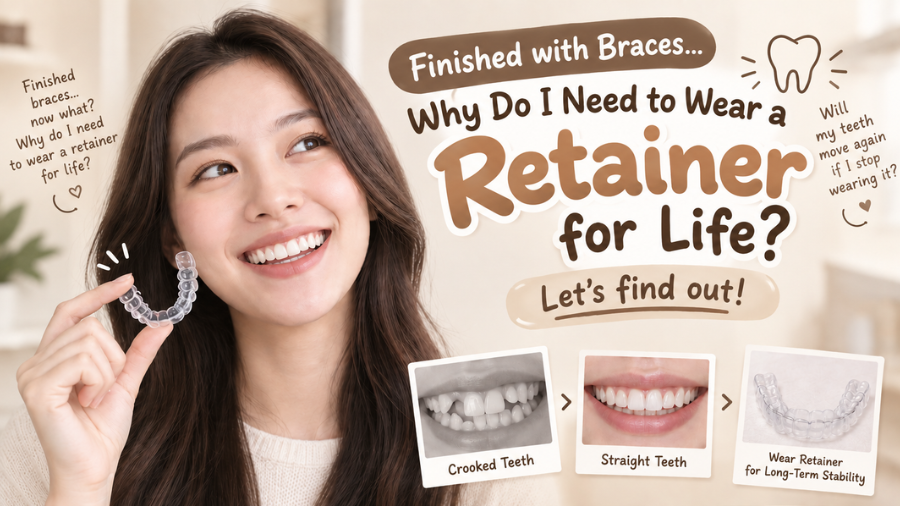
Most people who have had braces already know one thing: once your orthodontic treatment is finished, you need to wear a retainer.
But for how long?
Six months? One year? Five years?
And once your teeth look straight and seem stable, can you eventually stop wearing your retainer altogether?
There is another question many people may never have thought about: Why do we need a retainer in the first place? After spending months or years moving the teeth into their new positions, shouldn’t they simply stay there?
Not necessarily.
The day your braces come off does not mean your teeth will automatically remain in exactly the same positions forever.
After orthodontic treatment, the bone and tissues surrounding the teeth need time to adapt to their new positions. Even after this initial period, however, teeth can continue to change position throughout life.
This is why retainers are an important part of orthodontic treatment after braces.
So, when dentists talk about wearing a retainer “for life,” does that mean wearing it 24 hours a day forever? And what actually happens if you stop?
Let’s take a closer look.
First of All, Why Do You Need a Retainer?
Orthodontic treatment gradually moves teeth from their original positions into the positions planned by the orthodontist.
As the teeth move, changes also occur in the bone and supporting tissues around their roots.
Therefore, even though your teeth may look perfectly aligned on the day your braces are removed, the tissues surrounding them do not instantly become completely stable in their new positions.
A retainer helps maintain the position of your teeth after orthodontic treatment, particularly while the surrounding tissues are adapting.
A simple way to think about it is:
Braces move your teeth into their planned positions.
Retainers help keep them there afterward.
If My Teeth Become Stable, Why Do I Still Need a Retainer?
This is where many patients become confused.
If retainers are initially needed while the tissues around the teeth adapt, why might you still need one several years later?
Because our teeth are not permanently fixed in exactly the same positions throughout life.
Even people who have never had orthodontic treatment can experience changes in tooth position over time.
The teeth and surrounding oral structures are continually influenced by factors such as the bite, the lips and tongue, changes in the supporting tissues, and natural changes that occur as we age.
For this reason, long-term retainer wear is not only about preventing the teeth from immediately “moving back” after braces.
It also helps maintain the alignment achieved through orthodontic treatment over the long term.
How Long Do You Need to Wear a Retainer?
This is where the phrase “wear your retainer for life” can sound more intimidating than it actually is.
It does not necessarily mean wearing a removable retainer 24 hours a day for the rest of your life.
During the early period after braces are removed, your orthodontist may recommend wearing your retainer for longer periods each day because maintaining the new tooth positions is particularly important at this stage.
As the teeth become more stable, the wearing schedule may be reduced. For example, some patients may eventually be advised to wear their removable retainers mainly while sleeping.
The exact schedule can vary depending on the individual patient, the type of orthodontic treatment, and the orthodontist’s recommendation.
The important point is that you should not stop wearing your retainer simply because your teeth look straight and feel stable.
What Happens If You Stop Wearing Your Retainer?
Your teeth will not necessarily return to exactly the same positions they were in before orthodontic treatment.
However, tooth movement can occur after you stop wearing your retainer.
You may begin to notice small spaces developing, certain teeth rotating, or the front teeth becoming crowded again.
How much movement occurs varies from person to person, and there is no guarantee that teeth will remain perfectly aligned after retainer wear is discontinued.
This is one of the main reasons long-term retention is recommended for patients who want to maintain the results of their orthodontic treatment.
My Retainer Feels Tight After I Haven’t Worn It. What Does That Mean?
This is a common situation.
You forget to wear your retainer for a while, put it back in, and suddenly think:
“Why does this feel tighter than before?”
A retainer that feels tighter after a period of not wearing it may indicate that the teeth have undergone a small amount of movement.
If the retainer still fits and you only experience mild tightness, follow the instructions provided by your orthodontist.
However, if the retainer does not fit properly, cannot be fully seated, causes significant pain, or needs to be forced into place, do not force it onto your teeth.
It is better to have your teeth and retainer evaluated by a dentist or orthodontist to determine how much movement has occurred and what should be done next.
I Haven’t Worn My Retainer for Years. Can I Just Start Wearing the Old One Again?
If your old retainer no longer fits properly, do not force it into place.
After a long period without retainer wear, your teeth may have moved enough that the old retainer no longer matches their current positions.
Trying to bite down on or force an ill-fitting retainer onto the teeth may apply inappropriate forces or damage the retainer.
Your dentist or orthodontist should first assess the current position of your teeth and determine whether you need a new retainer or whether additional treatment should be considered.
Does One Retainer Last for the Rest of Your Life?
No.
Wearing a retainer long term does not mean using the same physical retainer forever.
Retainers can wear down, crack, become distorted, loosen, or stop fitting properly over time, depending on the type of retainer and how it is used and cared for.
If your retainer breaks, changes shape, feels unusually loose, or no longer fits as it normally does, it should be checked rather than waiting until noticeable tooth movement occurs.
The lifelong part is not necessarily the individual retainer itself.
It is the long-term maintenance of your tooth positions after orthodontic treatment.
What About Fixed and Removable Retainers?
There are different types of retainers, including removable retainers and fixed retainers, which are bonded behind the teeth.
Each type has different considerations for wear, cleaning, maintenance, and monitoring.
The appropriate type of retainer depends on the individual patient’s teeth and orthodontic treatment plan.
Regardless of the type, it is important to follow your orthodontist’s instructions and have the retainer checked if it becomes damaged, loose, or no longer fits properly.
Do You Still Need Dental Check-Ups After Your Braces Are Removed?
Yes.
After orthodontic treatment, follow-up appointments allow the dentist or orthodontist to evaluate the position of your teeth, your bite, and the condition and fit of your retainer.
Regular dental examinations are also important for maintaining your overall oral health.
If your teeth begin to move or your retainer no longer fits correctly, identifying the change early may make it easier to determine the appropriate next step.
So, rather than waiting until your retainer no longer fits at all, have it checked if you notice a significant change.
So, Why Do You Need to Wear a Retainer for Life?
Most people already know that you need to wear a retainer after braces.
What is less obvious is why—and for how long.
During the early period after orthodontic treatment, retainers help maintain the new positions of the teeth while the surrounding tissues adapt.
In the longer term, retainers help preserve the alignment achieved through orthodontic treatment because teeth can continue to change position throughout life.
And remember: “wearing a retainer for life” does not necessarily mean wearing it 24 hours a day forever.
The frequency of wear may change over time according to your orthodontist’s recommendations.
The important thing is not to decide on your own that your teeth are “stable enough” and stop wearing your retainer completely.
Because ultimately:
Braces may have an end date, but maintaining your tooth alignment does not end on the day your braces come off.
You invested time in moving your teeth into their planned positions. Your retainer is part of helping maintain that result after orthodontic treatment.