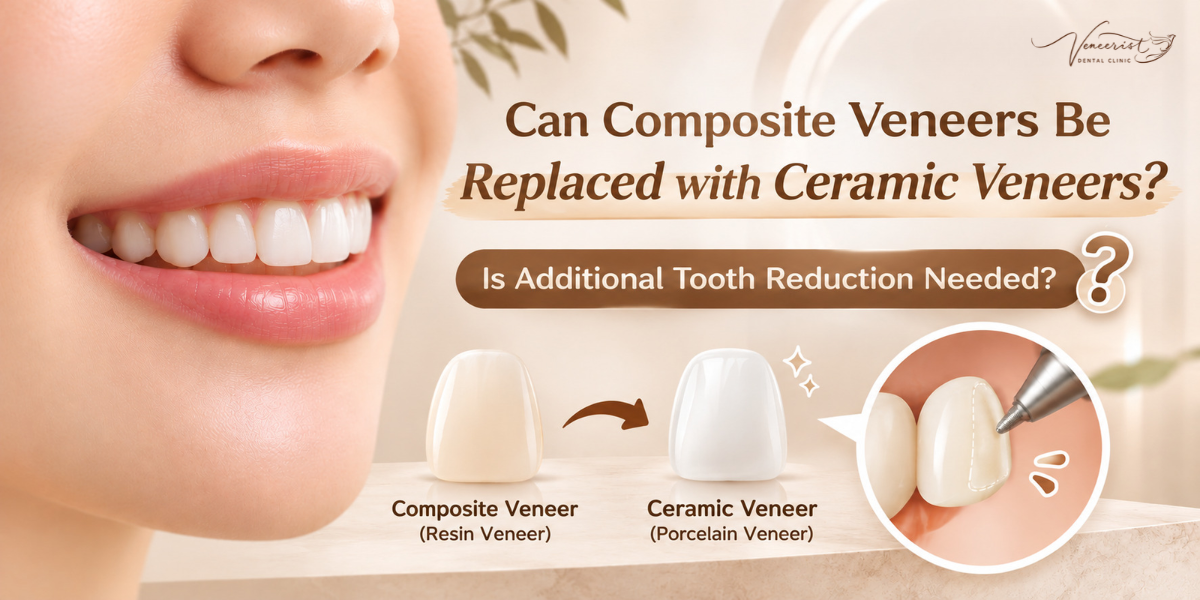
Switching from Composite to Ceramic Veneers: What You Should Know Before Treatment
Switching from composite to ceramic veneers is possible, provided that the underlying natural teeth and overall oral health are suitable for ceramic restorations. In most cases, the dentist will need to remove existing composite material as necessary, assess the remaining natural tooth structure and prepare the teeth appropriately for the new ceramic veneers.
Patients who already have composite veneers may consider switching to ceramic for various reasons, including discolouration, loss of surface gloss, wear, chipping or a desire for more refined aesthetic details and natural translucency.
However, replacing veneers involves more than simply changing the restorative material. It requires careful treatment planning that considers the condition of the underlying teeth, gum health, bite relationships and the amount of additional tooth preparation required.
Why Do Some Patients Switch from Composite to Ceramic Veneers?
Both composite and ceramic veneers can improve the colour, shape, size and proportions of the teeth. However, their material properties and long-term maintenance requirements differ.
1. Composite Veneers Have Become Discoloured
Composite resin can gradually develop surface stains or discolouration, particularly in patients who regularly consume coffee, tea, red wine or strongly coloured foods, or who smoke.
Professional polishing may help remove external stains in some cases. However, if discolouration has developed within the material itself, polishing alone may not fully restore its original colour.
Ceramic veneers generally offer greater colour stability and resistance to staining than composite resin, making them an alternative for patients who prioritise long-term colour consistency.
2. Composite Veneers Have Lost Their Surface Gloss
Over time, the surface of composite veneers may develop microscopic scratches and signs of wear, reducing their smoothness and natural gloss.
Professional polishing may improve the appearance of existing composite restorations when their condition remains suitable.
However, some patients may prefer ceramic veneers, which generally retain their surface smoothness and gloss well when appropriately maintained.
3. Existing Composite Veneers Are Chipped, Cracked or Worn
Everyday use, biting hard objects, teeth grinding and unfavourable bite relationships may contribute to the wear or damage of veneer restorations.
One advantage of composite veneers is that localised damage can often be repaired by adding or reshaping composite resin.
However, if existing restorations have extensive damage or frequently require repairs, switching to ceramic veneers may be considered.
It is important to identify the underlying cause of the damage before replacing the restorations. Ceramic veneers can also chip or fracture, particularly when excessive biting forces or teeth grinding remain unaddressed.
4. Patients Want More Refined, Natural-Looking Aesthetic Details
Dental ceramics offer optical properties that can be used to reproduce various characteristics of natural teeth.
These include:
- Incisal translucency at the tips of the teeth.
- Gradual colour transitions from the gumline towards the incisal edges.
- Natural surface texture and light reflection.
- Rounded contours and detailed tooth edges.
- Individual tooth shapes, sizes and proportions.
- Overall harmony of the smile.
Nevertheless, natural-looking veneers depend on more than the restorative material alone. Smile design, clinical techniques and the condition of the underlying natural teeth also influence the final appearance.
Well-designed composite veneers can also provide natural-looking results.
What Is the Difference Between Composite and Ceramic Veneers?
Understanding the properties of both materials can help patients make informed decisions before replacing their existing veneers.
| Features | Composite Veneers | Ceramic Veneers |
|---|---|---|
| Material | Tooth-coloured composite resin | Dental ceramic |
| Restoration technique | Can be sculpted directly onto the tooth surface | Generally fabricated outside the mouth as individual restorations |
| Colour stability | May discolour over time | Generally greater colour stability |
| Stain resistance | More susceptible to staining | Generally more resistant to staining |
| Surface gloss | May require periodic polishing | Generally retains surface gloss well |
| Translucency | Depends on the material and placement technique | Offers a range of optical and aesthetic properties |
| Repair options | Localised repairs are often possible | Repair options are more limited; replacement may be necessary |
| Tooth preparation | Depends on tooth condition and treatment plan | Requires consideration of ceramic thickness and bonding surfaces |
| Cost | Generally more affordable | Generally more expensive |
Both materials have advantages and limitations. The most appropriate option depends on the patient’s aesthetic preferences, natural tooth condition, treatment requirements and budget.
You can learn more about the ceramic and composite veneer treatments available at Veneerist, including their material characteristics and listed treatment fees.
Do Existing Composite Veneers Need to Be Completely Removed?
The dentist will generally assess and remove existing composite material as necessary before planning the new ceramic restorations.
Ceramic veneers must be designed according to the shape of the prepared teeth, appropriate material thickness, restoration margins and bite relationships.
Simply bonding ceramic veneers over the entire existing composite restoration without appropriate assessment or surface preparation is generally not a suitable approach.
Doing so may result in excessive restoration thickness, unsuitable tooth contours or limitations in adhesive bonding.
However, complete removal of every existing composite restoration is not necessarily required in all cases.
If certain areas of existing composite material remain clinically sound and compatible with the new restorative plan, the dentist may consider retaining them.
The priority is to remove existing material carefully whilst preserving as much natural tooth structure as reasonably possible.
Does Switching from Composite to Ceramic Veneers Require Additional Tooth Preparation?
Additional tooth preparation may be necessary, depending on the condition of the natural teeth after composite removal and the design requirements of the new ceramic veneers.
Having previously received no-preparation composite veneers does not necessarily mean that ceramic veneers can be placed without further tooth preparation.
Similarly, patients whose teeth were previously prepared for composite veneers will not necessarily require extensive additional tooth reduction on every tooth.
Factors influencing the amount of preparation include:
- The amount of remaining natural tooth structure.
- Previous tooth preparation.
- Natural tooth positions and alignment.
- The underlying natural tooth colour.
- Desired tooth shapes, sizes and proportions.
- Appropriate ceramic restoration thickness.
- Remaining enamel and available bonding surfaces.
- Bite relationships.
If Your Composite Veneers Were Previously Placed Without Tooth Preparation
If sufficient healthy enamel remains after removing the existing composite material, minimally invasive ceramic veneer treatment may be possible in suitable cases.
However, additional preparation may still be necessary if the natural teeth are prominent, protruding or have limited space for the new restorations.
The dentist must consider the required ceramic thickness and final restoration contours to avoid creating excessively bulky veneers.
If Your Teeth Were Previously Prepared for Composite Veneers
If the natural teeth were already prepared during previous treatment, the dentist will assess whether the existing preparation can accommodate the new ceramic restorations.
Further modification may only be required in selected areas.
However, if substantial natural tooth structure has already been lost, alternative restorative treatments may need to be considered.
As natural tooth structure removed during preparation cannot regenerate, tooth preservation remains an important consideration when replacing veneers.
Do You Need Braces Before Switching to Ceramic Veneers?
Orthodontic treatment is not necessary for every patient considering ceramic veneers.
The need for braces depends on natural tooth positions, bite relationships and the limitations of the proposed restorative design.
In many suitable cases at Veneerist Dental Clinic Krabi, patients can proceed with ceramic veneers without orthodontic treatment, provided that the treatment can be carried out according to the dentist’s recommended plan.
However, teeth that are crowded, rotated or significantly prominent may require additional preparation in certain areas.
If proceeding without orthodontic treatment would require excessive removal of natural tooth structure or leave significant bite problems unaddressed, the dentist may recommend orthodontic treatment first.
For patients who are already planning to have both orthodontic treatment and ceramic veneers, our dentists recommend completing orthodontic treatment before receiving definitive ceramic restorations.
This allows the veneers to be designed according to the final tooth positions and may help preserve more natural tooth structure.
Can You Still Have Ceramic Veneers If the Underlying Teeth Are Damaged?
After removing existing composite veneers, the dentist may identify dental problems that could not be fully assessed beforehand.
These may include:
- Tooth decay around the existing restoration margins.
- Large or deteriorated previous fillings.
- Loss of natural tooth structure from earlier dental treatment.
- Cracks or other structural damage.
- Insufficient remaining enamel for the originally planned bonding approach.
If tooth decay or defective restorations are identified, these concerns should be appropriately managed before proceeding with ceramic veneer treatment.
For teeth with substantial structural loss or damage, alternative restorations such as dental crowns may be more appropriate, depending on the clinical findings.
The suitability of ceramic veneers cannot therefore always be determined solely from the external appearance of existing composite restorations.
What Is the Process of Switching from Composite to Ceramic Veneers?
Replacing composite veneers involves additional considerations compared with receiving veneers for the first time.
The treatment process may include the following steps.
Step 1: Dental Examination and Assessment of Existing Veneers
The dentist evaluates the existing composite restorations, natural teeth, gum health, bite relationships and the reasons for replacing the veneers.
Clinical photographs and dental X-rays may be taken when indicated to support treatment planning.
Step 2: Smile Design and Treatment Planning
The dentist discusses the patient’s preferences regarding tooth colour, shape, length, proportions and overall smile appearance.
If the patient is satisfied with certain aspects of the existing composite veneers, these features may be used as references when designing the new ceramic restorations.
Step 3: Removal of Existing Composite Material
Existing composite resin is carefully removed as necessary, with consideration for preserving natural tooth structure.
The dentist then reassesses the underlying teeth and remaining bonding surfaces to confirm or modify the original treatment plan.
Step 4: Tooth Preparation for Ceramic Veneers
The natural tooth surfaces are prepared as required to provide appropriate space and contours for the new ceramic restorations.
The amount of preparation may differ between individual teeth, depending on their original condition and the planned smile design.
Step 5: Dental Impressions or Digital Scans
Impressions or digital scans are taken to record the shape of the prepared teeth for the fabrication of the ceramic veneers.
Temporary veneers may be provided where appropriate to protect prepared tooth surfaces and maintain the appearance of the smile whilst the definitive restorations are being fabricated.
Step 6: Ceramic Veneer Try-In and Bonding
Once the ceramic veneers are ready, the dentist assesses their fit, colour, shape, proportions and overall harmony with the patient’s smile.
When the restorations are considered clinically suitable, they are bonded using an appropriate dental adhesive system.
Restoration margins and bite relationships are also assessed.
Step 7: Follow-Up and Aftercare
Follow-up appointments may be recommended to assess gum health, bite relationships, restoration condition and comfort during everyday use.
Patients receive individual advice on maintaining their veneers and long-term oral health.
How Long Does Switching from Composite to Ceramic Veneers Take?
Treatment duration depends on several factors, including the number of veneers being replaced, the condition of the existing restorations, the underlying natural teeth, the complexity of the smile design and ceramic fabrication time.
If the natural teeth are suitable and no additional dental treatment is required, the overall process may be similar to conventional ceramic veneer treatment, with the additional step of removing existing composite material.
However, if tooth decay, gum disease or structural damage is identified, additional treatment may be necessary before definitive ceramic veneers can be placed.
Patients travelling to Krabi for dental treatment should ideally arrange a preliminary consultation before their trip, particularly if their available treatment period is limited.
How Much Does It Cost to Replace Composite Veneers with Ceramic Veneers?
The cost of replacing composite veneers may differ from the cost of receiving ceramic veneers for the first time.
Additional considerations may include the complexity of removing existing composite material, the condition of the underlying teeth and any necessary restorative treatment before ceramic veneer placement.
The overall treatment cost may depend on:
- The number of veneers being replaced.
- The complexity of composite removal.
- The condition of the underlying natural teeth.
- Additional dental treatment requirements.
- The proposed smile design and ceramic restorations.
Patients can review the listed veneer treatment fees at Veneerist Dental Clinic Krabi for preliminary information.
An individual treatment estimate should be provided following a dental examination and assessment of the existing veneers.
Do All Composite Veneers Need to Be Replaced at the Same Time?
Not necessarily. Patients may choose to replace individual veneers that have problems or consider replacing several veneers together when clinically appropriate.
However, combining ceramic and existing composite veneers in visible areas of the smile requires careful aesthetic planning.
Composite resin and ceramic have different properties in terms of colour, translucency, light reflection and long-term surface changes.
Although the restorations may initially appear similar, differences may become more noticeable over time.
For patients who prioritise long-term aesthetic consistency, using the same restorative material across selected visible teeth may be considered when appropriate.
Nevertheless, clinically sound veneers should not be replaced unnecessarily simply to achieve material uniformity without considering the potential impact on natural tooth structure.
Should You Replace Composite Veneers That Are Still in Good Condition?
If existing composite veneers remain well bonded, have suitable margins, show no signs of underlying tooth decay, function appropriately and continue to meet the patient’s aesthetic expectations, replacement with ceramic veneers may not be necessary.
For minor concerns, alternative treatments may include:
- Professional cleaning and polishing.
- Repairing localised chips.
- Adding composite resin to modify selected contours.
- Replacing only restorations that have problems.
- Addressing underlying causes of restoration damage.
Switching to ceramic veneers should be based on clinical suitability, patient preferences and the properties of the restorative materials rather than simply because ceramic veneers are more expensive.
Can You Start with Composite Veneers and Switch to Ceramic Veneers Later?
This approach may be considered in suitable cases, particularly for patients who are not currently ready for ceramic veneer treatment but wish to improve the appearance of their teeth with composite resin.
However, patients who intend to switch to ceramic veneers in the future should discuss this possibility with their dentist before starting composite treatment.
This allows the dentist to consider long-term restorative planning and preservation of natural tooth structure from the beginning.
Starting with composite veneers and later switching to ceramic involves multiple courses of treatment and may result in higher overall costs than choosing ceramic veneers initially.
Furthermore, removing existing composite resin and adhesive material may involve a risk of additional natural tooth structure loss, even when performed carefully.
If ceramic veneers are already the patient’s preferred long-term treatment and the natural teeth are suitable, proceeding directly with ceramic veneers may help avoid unnecessary restorative procedures.
How to Care for Your New Ceramic Veneers
Although ceramic veneers generally provide good colour stability and stain resistance, they still require regular care and maintenance.
Recommended aftercare includes:
- Brushing twice daily with a soft-bristled toothbrush and fluoride toothpaste.
- Cleaning between the teeth regularly using dental floss or appropriate interdental cleaning aids.
- Avoiding biting ice, bones and other hard objects.
- Avoiding using teeth to open packaging or tear objects.
- Wearing a protective night guard if recommended by the dentist.
- Attending regular dental examinations and professional cleaning appointments.
If you notice chipping, cracking, movement of a veneer, unusual food trapping, persistent bad breath, tooth sensitivity or discomfort when biting, arrange a dental examination to identify the cause.
Frequently Asked Questions About Switching from Composite to Ceramic Veneers
Can composite veneers be replaced with ceramic veneers?
Yes, provided that the underlying natural teeth and overall oral health are suitable. The existing restorations must be assessed, and composite material removed as necessary before planning the new ceramic veneers.
Do teeth always need additional preparation when switching to ceramic veneers?
Not necessarily. The amount of additional preparation depends on the natural tooth condition after composite removal, tooth alignment and the thickness required for the new ceramic restorations.
Will my natural teeth return to their original condition after composite veneers are removed?
This cannot be guaranteed. It depends on previous tooth preparation, the amount of remaining natural tooth structure and any changes that have occurred during the period of restoration use.
Even when composite veneers were initially placed without tooth reduction, removing composite resin and adhesive material may affect the natural enamel surface.
Will ceramic veneers remain the same colour forever?
Ceramic generally has better colour stability and stain resistance than composite resin. However, the overall appearance of the smile may still change over time.
Surface deposits, restoration margins, bonding materials, underlying natural tooth colour and changes in neighbouring teeth may influence the overall appearance.
Can veneers originally placed at another dental clinic be replaced?
Patients can arrange an assessment of existing veneers placed at another dental clinic.
The dentist will evaluate the restorations, natural tooth condition and suitability of the proposed replacement treatment.
Previous dental records, photographs or information about the original restorative materials may be helpful.
Will ceramic veneers last longer than composite veneers?
Ceramic veneers generally offer favourable colour stability and surface wear resistance.
However, the actual service life of any veneer depends on the condition of the underlying tooth, adhesive bonding, bite relationships, everyday habits and long-term maintenance.
Ceramic veneers are not permanent restorations and may eventually require repair or replacement.
Summary: Is Switching from Composite to Ceramic Veneers Possible?
Switching from composite to ceramic veneers is possible when the underlying natural teeth and overall oral health are suitable for the proposed restoration.
Treatment involves assessment of existing veneers, appropriate removal of composite material and careful preparation of the natural teeth for the new ceramic restorations.
Ceramic veneers offer an alternative for patients who prioritise colour stability, surface gloss and refined optical characteristics.
However, existing composite veneers that remain clinically sound and aesthetically satisfactory do not necessarily need to be replaced.
The most appropriate treatment plan should balance natural tooth preservation, gum health, bite relationships, long-term function and individual aesthetic preferences.
Plan Your Veneer Replacement at Veneerist Dental Clinic Krabi
If you already have composite veneers and are considering switching to ceramic veneers, or are unsure whether your existing restorations should be repaired or replaced, a dental consultation can help you understand the available treatment options.
At Veneerist Dental Clinic Krabi, we consider the condition of your natural teeth beneath existing restorations, the amount of preparation required, suitable restorative materials and the individual characteristics of your smile.
Our approach to ceramic and composite veneers takes into account both dental aesthetics and oral health.
Because replacing veneers is more than changing materials. It is an opportunity to reassess the balance between the appearance, health and function of your smile.
Visit our English website to learn more about our dental services and arrange a consultation.
Veneerist Dental Clinic Krabi — Crafting Your Shine
Maharat Road, Pak Nam, Mueang Krabi, Krabi, Thailand
Opening hours: Monday–Sunday, 10 am–8 pm.
Advance appointments are recommended.