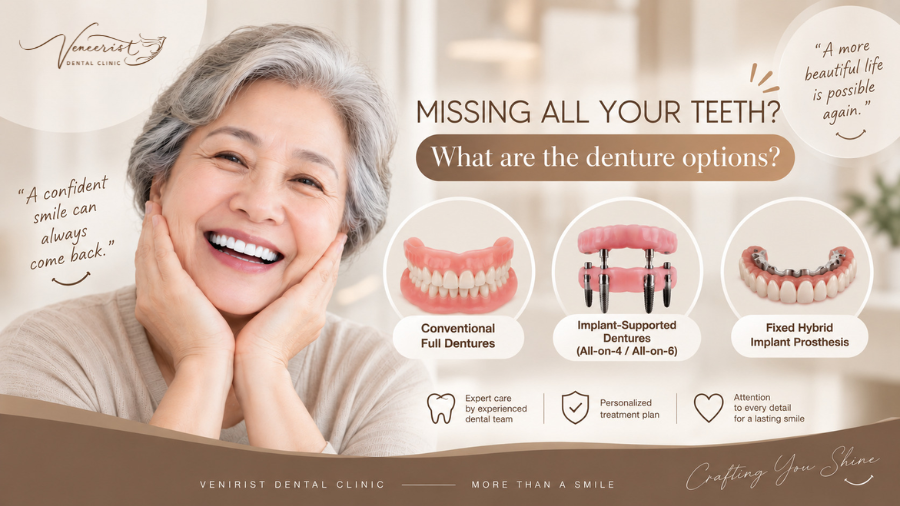
When all teeth are missing, there is more than one way to restore the smile and chewing function. The most appropriate treatment plan depends on several factors, including the amount and location of remaining bone, the bite, chewing forces, oral health, general health, ability to maintain oral hygiene, and the patient’s budget.
When the bone and available space are suitable, restoring teeth individually with a Single Crown on a Single Implant wherever possible can offer advantages in terms of cleaning, force distribution, and future maintenance. If a problem develops with one tooth or implant, it may often be possible to manage that specific area without having to remove or replace a larger group of restorations.
For the posterior teeth, many treatment plans can provide functional teeth up to the First Molar, without necessarily replacing the Second Molar in every case. This depends on the patient’s bite, chewing forces, and individual jaw condition.
However, it is not always possible to place one implant for every missing tooth. This is particularly true in the anterior region, where significant bone loss may occur after teeth have been missing for a long period of time. In some cases, there may not be enough bone to place an implant in every position, making an Implant-Supported Bridge a more appropriate option.
For this reason, evaluation with CBCT imaging and a clinical oral examination is an important step before selecting a treatment plan.
7 Treatment Options for Patients With Full-Mouth Tooth Loss
Option 1: Anterior Implant-Supported Bridges + Posterior Single Crowns on Implants
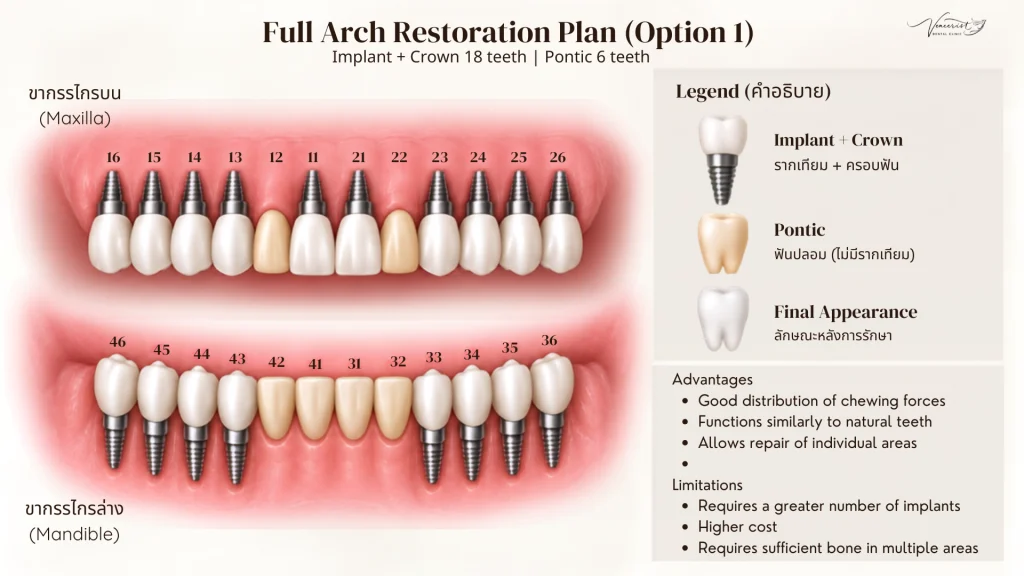
This approach aims to keep as many teeth individually restored as possible, depending on the available bone.
In the anterior region, where bone volume may be limited, the treatment can be designed using two 3-unit Implant-Supported Bridges instead of placing an implant for every missing front tooth.
In the posterior region, when sufficient bone is available, a Single Crown on a Single Implant can be used—meaning one tooth is supported by one dental implant.
Advantages
- Posterior teeth remain individually separated, making them easier to clean.
- Floss and interdental cleaning can be performed in a way that is more similar to natural teeth.
- Allows chewing forces to be distributed more independently.
- If one tooth develops a problem, it may often be possible to repair or replace only that specific area.
- A problem affecting one position does not necessarily require removal of a large group of restorations.
- Provides a maintenance approach that is among the closest to having individual natural teeth.
Limitations
- Requires a relatively large number of dental implants.
- Sufficient bone is required in multiple locations.
- Bone grafting may be necessary in some areas.
- Generally costs more than treatment plans using fewer implants.
- May require more treatment stages and a longer overall treatment process.
When the bone conditions are suitable and the patient can maintain good oral hygiene, this type of treatment plan can provide considerable flexibility for long-term maintenance and repair.
Option 2: Multiple Implant-Supported Bridges
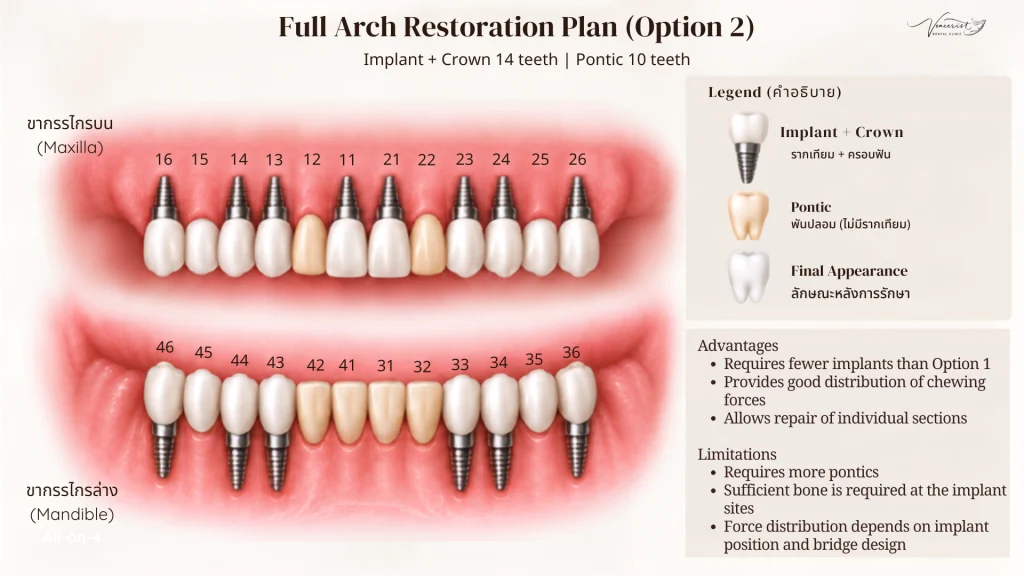
This approach reduces the number of implants compared with Option 1 by connecting several teeth together as separate Implant-Supported Bridges.
An example treatment plan may include:
- Upper jaw: 4 bridges, approximately 3 units each
- Lower jaw: 3 bridges, approximately 3 units each
Advantages
- Requires fewer implants than Option 1.
- Can reduce treatment costs.
- The restorations are still divided into several sections rather than connected as one full-arch prosthesis.
- If one bridge develops a problem, it may generally be possible to manage that particular section.
- Dividing the restoration into smaller sections may provide more flexibility for future maintenance than a single Full-Arch fixed prosthesis.
Limitations
- Cleaning underneath the bridges is more difficult than cleaning individual Single Crowns.
- Additional cleaning tools such as Super Floss, Interdental Brushes, or a Water Flosser may be required.
- If an implant or restoration within one bridge develops a problem, the entire bridge section may be affected.
- Implant positioning and bite design require careful planning.
This option provides a balance between the maintenance advantages of Single Crowns and the benefit of using fewer dental implants.
Option 3: Upper All-on-6 + Lower All-on-4
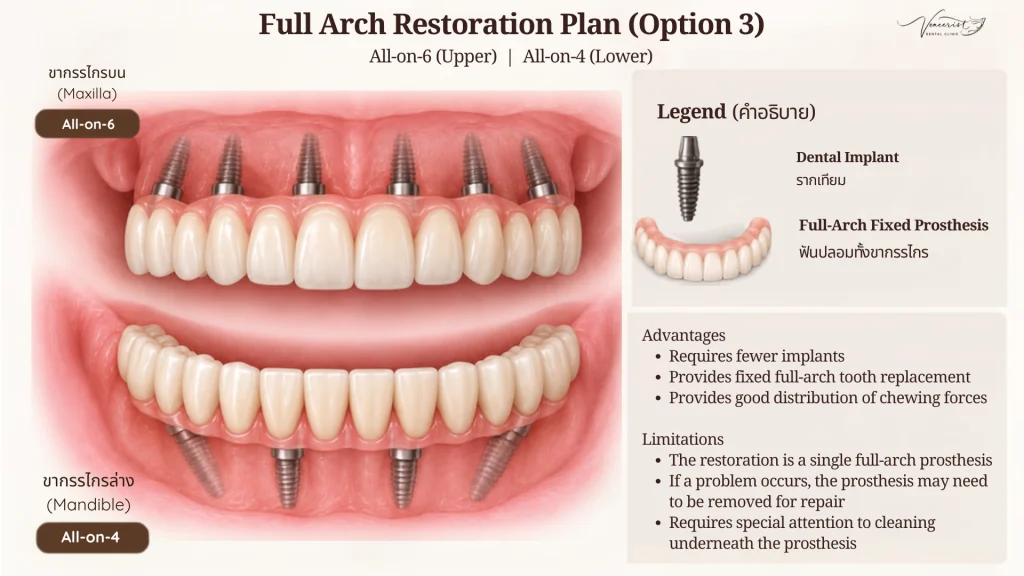
This option uses fixed full-arch prostheses, with the upper jaw supported by approximately 6 dental implants and the lower jaw by approximately 4 implants.
Advantages of Upper All-on-6
- Provides more implant support points.
- May help distribute forces more effectively than All-on-4 in selected cases.
- Offers greater flexibility in prosthetic design when bone volume and implant positions are suitable.
- If one implant develops a problem, there may be situations where the treatment can be redesigned using the remaining implants.
However, this does not mean that if one or two implants are lost in an All-on-6 treatment, the existing prosthesis can always continue to be used. The position of the affected implant, the number and distribution of the remaining implants, force distribution, and the design of the new prosthesis must all be reassessed.
For the lower All-on-4, fewer implants are used, which may reduce treatment costs and may help avoid certain anatomical areas in selected cases.
However, because there are only 4 implant support points, losing one implant can significantly affect the original treatment design. Additional or replacement implant treatment may be necessary, and the existing prosthesis may need to be modified or remade depending on the individual situation.
Option 4: Upper All-on-4 + Lower All-on-4
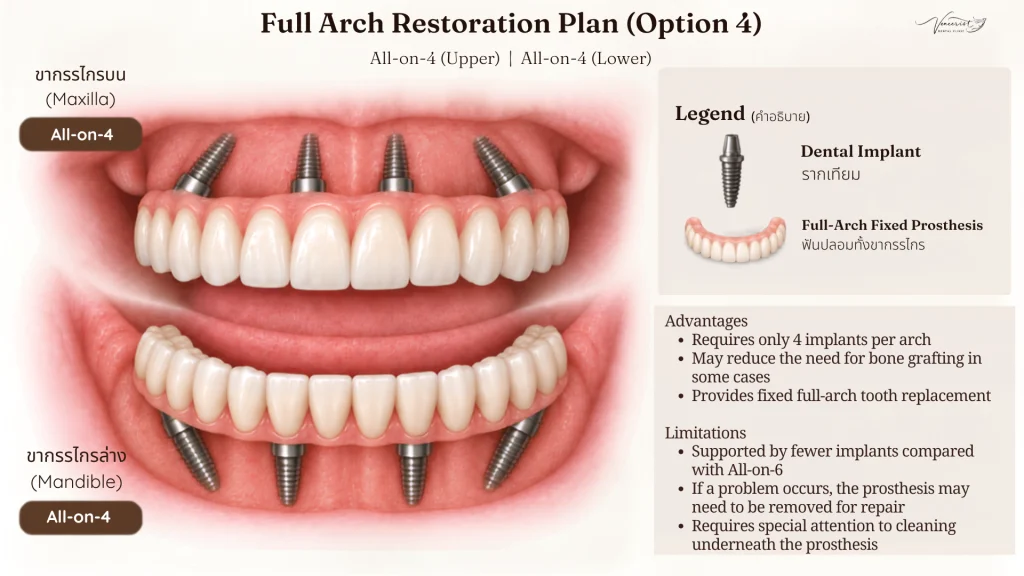
This treatment uses approximately 4 dental implants in each jaw to support fixed full-arch prostheses.
Advantages
- Uses fewer implants than All-on-6.
- Generally has a lower treatment cost.
- May be suitable for selected patients with limited posterior bone.
- Can restore a complete dental arch using a relatively small number of implants.
- The prosthesis is fixed, so the patient does not routinely remove it at home.
Limitations
- There are only 4 implant support points per arch.
- Each implant therefore plays an important role in supporting the overall system.
- If one implant develops a problem, the impact on the entire system may be greater than with some All-on-6 designs.
- Cleaning underneath the prosthesis requires appropriate techniques and cleaning tools.
- If part of the prosthesis fractures or becomes damaged, the entire prosthesis may need to be removed for repair.
- Long-term follow-up, bite assessment, screw checks, and maintenance are required.
The main difference from Option 3 is that the upper jaw uses 4 implants instead of 6. This reduces the number of implants and may lower the treatment cost, but it also provides fewer implant support points within the system.
Option 5: Upper All-on-6 + Lower All-on-6
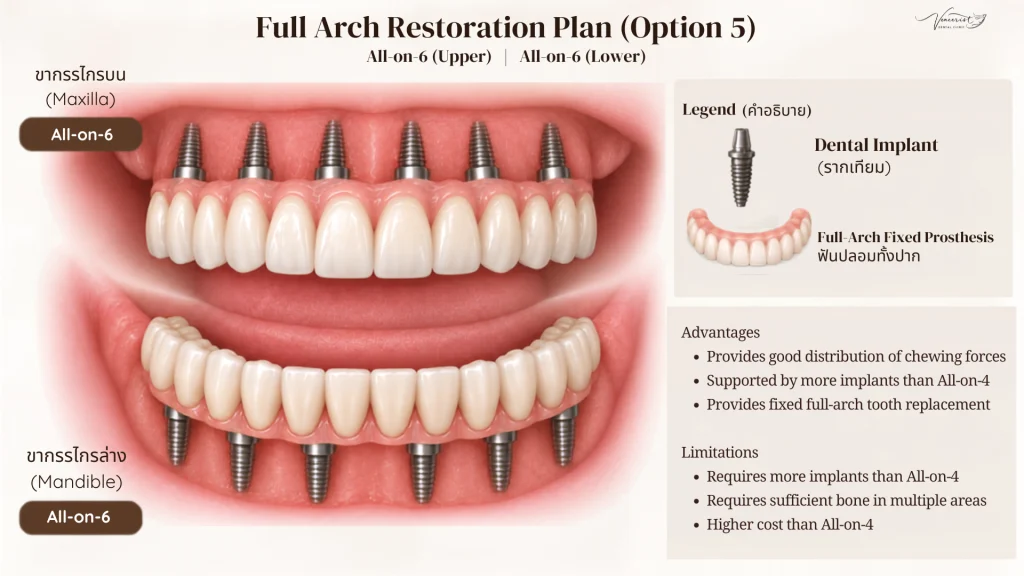
This option uses approximately 6 dental implants in each jaw to support fixed full-arch prostheses.
Advantages
- Provides more implant support points than All-on-4.
- May help distribute chewing forces effectively when implant positions and bone quality are suitable.
- Provides greater flexibility in implant positioning and prosthetic design.
- In certain situations, if one implant develops a problem, there may be more management options than in a system that originally relies on only 4 implants.
- May be suitable for patients who want fixed teeth and have sufficient bone.
Limitations
- Requires more dental implants.
- Generally costs more than All-on-4.
- It does not mean that All-on-6 is better than All-on-4 for every patient.
- If the available bone is not suitable, placing additional implants may require bone grafting or other procedures.
- It remains a large Full-Arch Prosthesis, so cleaning and repair are not as straightforward as with individual Single Crowns.
Compared with Options 3 and 4, this treatment provides the greatest number of implant support points among these All-on-X options, but this comes with additional implants, treatment procedures, and costs.
Option 6: Implant-Supported Overdenture on 4
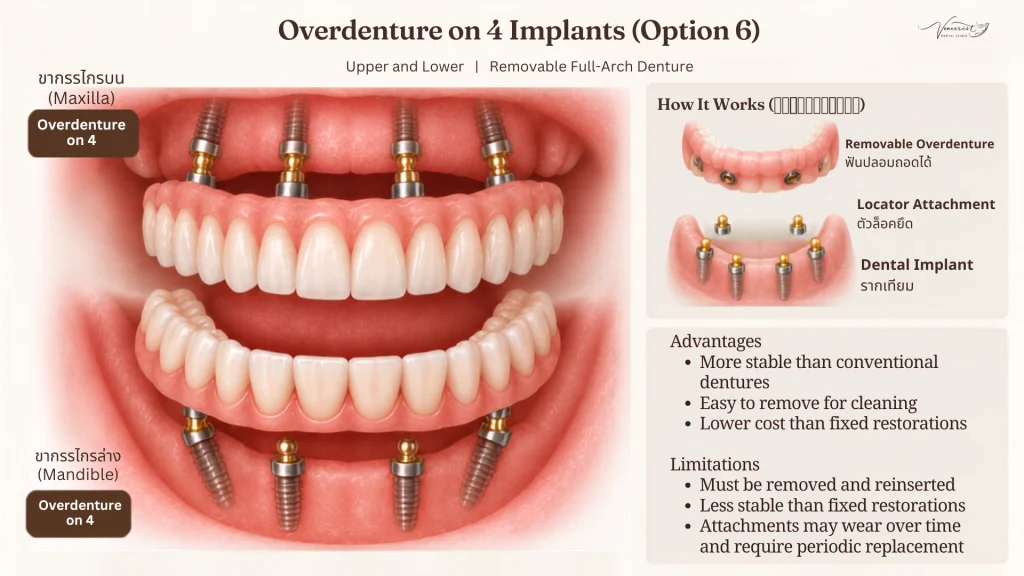
An Implant-Supported Overdenture on 4 is a removable denture retained by approximately 4 dental implants.
The patient can remove the denture at home for cleaning. When it is placed back into the mouth, the denture connects to attachments on the dental implants to improve retention and stability.
Advantages
- More stable and secure than a Complete Denture without implant support.
- Helps reduce denture movement during speaking and chewing.
- Uses fewer implants than many fixed implant-supported treatment options.
- Generally costs less than a Full-Arch Fixed Prosthesis.
- Can be removed for easier cleaning.
- Repairs and adjustments can often be relatively straightforward.
Limitations
- It is not fixed and must be removed regularly for cleaning.
- Attachment components can wear over time.
- Retentive components such as Locator inserts or Clips may require periodic replacement.
- The denture base may require Relining as the gums and underlying bone change.
- Ongoing maintenance is required throughout its service life.
This option may be suitable for patients who want greater stability than a conventional removable denture but either do not want or are not suitable candidates for a fixed full-arch restoration.
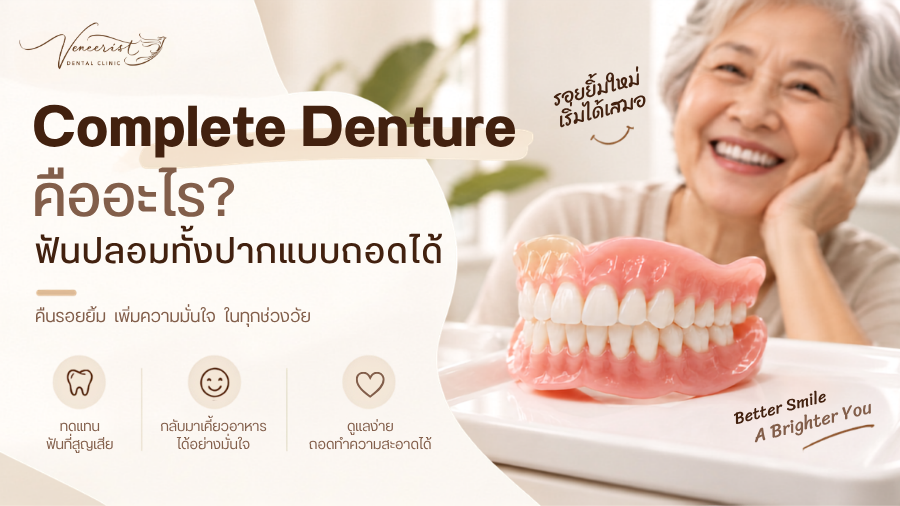
Option 7: Upper and Lower Complete Dentures Without Implant Support
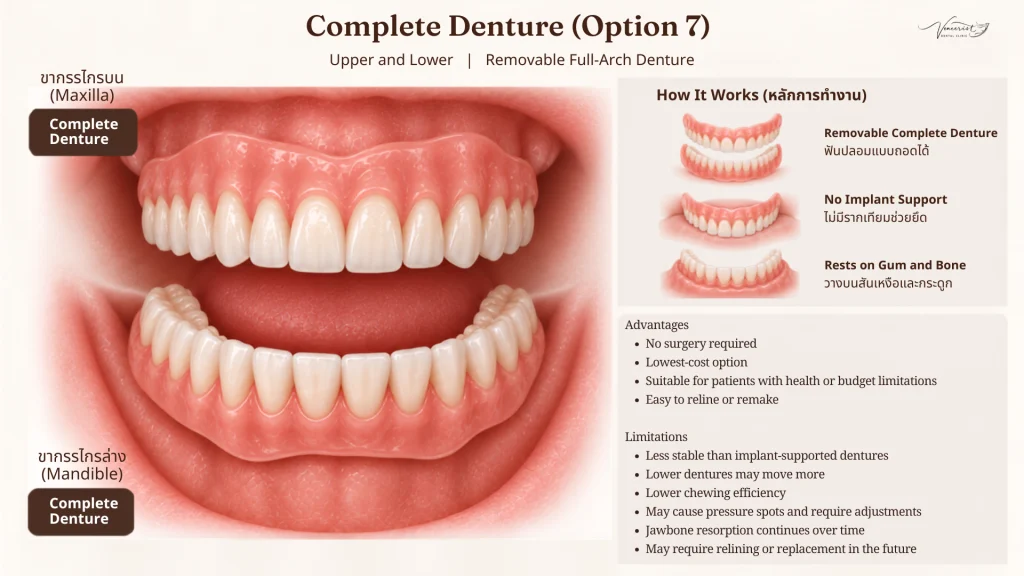
A Complete Denture is a traditional removable denture that replaces all teeth without using dental implants for additional retention.
Advantages
- No dental implant surgery is required.
- Generally the lowest-cost option among the treatment approaches discussed.
- May be suitable for patients with health limitations, budget considerations, or those who do not wish to undergo implant surgery.
- The denture can generally be adjusted, relined, or remade more easily than an implant-supported prosthesis.
Limitations
- Less stable and retentive than implant-supported dentures.
- Lower Complete Dentures, in particular, may move more than upper dentures.
- Chewing efficiency is generally lower than with implant-supported restorations.
- Pressure spots and soreness may occur and require adjustments.
- Jawbone resorption continues over time after tooth loss.
- As the bone and gums change, the denture may require Relining or replacement.
Which Option Is Best?
There is no single treatment option that is best for every patient.
When the available bone, bite, and budget are suitable, dividing the restoration into Single Crowns and smaller Implant-Supported Bridges can offer significant advantages in terms of cleaning, future repairs, and managing problems in individual areas.
For patients with limited bone, or those who want to reduce the number of implants and overall treatment cost, All-on-4, All-on-6, or an Implant-Supported Overdenture may be more appropriate.
Before choosing a treatment plan, patients should therefore undergo a clinical oral examination, bite assessment, and CBCT imaging to evaluate the amount and quality of available bone.
The dentist can then determine the appropriate number and positions of dental implants, as well as the type of implant-supported restoration that best suits each individual patient.