
“How many appointments do I need for a dental implant?”
“Can an implant be placed immediately after tooth extraction?”
“How long after implant placement do I have to wait before getting my final tooth?”
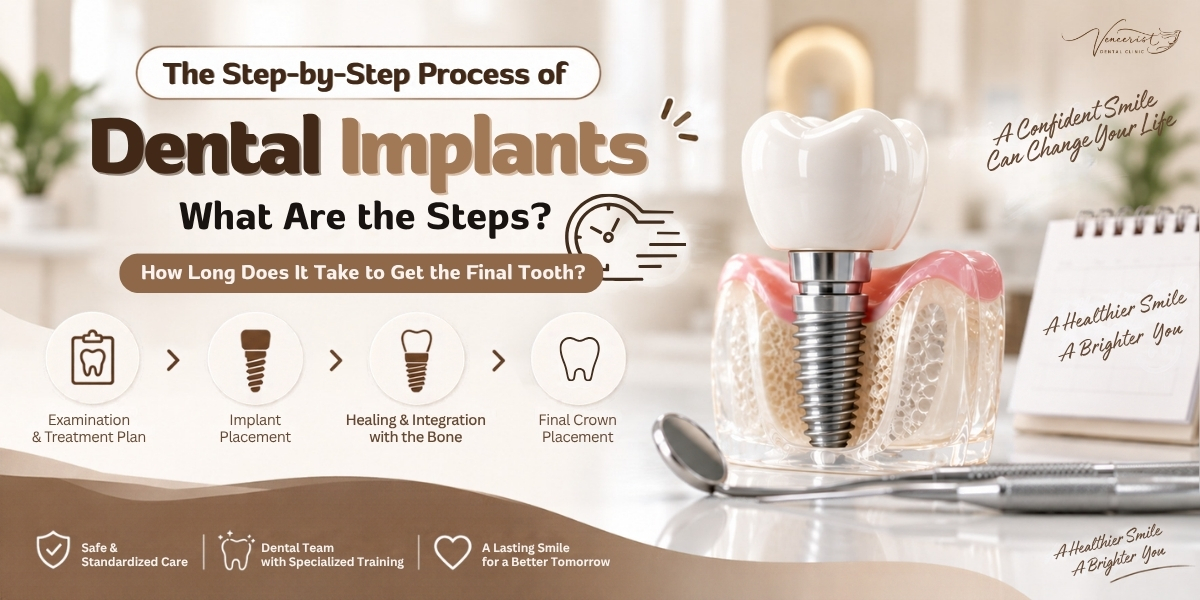
The dental implant procedure involves much more than simply placing an implant into the jawbone and adding a crown.
Before implant placement, the dentist needs to evaluate your oral health, bone, gums and soft tissues, neighboring teeth, and bite. The dentist also needs to plan the implant position, direction, size, and implant system or brand according to the individual case.
Some patients can proceed to implant placement relatively quickly. Others may first require tooth extraction, healing time, bone grafting, soft tissue grafting, or additional dental treatment.
For this reason, even two patients who each need only one dental implant may have very different treatment steps and timelines.
Visit 1: Examination, X-Rays and Before-Treatment Records
The first stage of dental implant treatment at Veneerist Dental Clinic includes an oral examination, review of relevant medical and dental history, and assessment of the missing-tooth area.
For implant treatment at Veneerist, X-rays are taken in every case as part of the diagnostic and treatment-planning process.
We also take before-treatment photographs. These images provide clinical records for the dentist and Dental Laboratory to use during treatment planning and can later be compared with the final result.
The photographs are therefore not simply for documenting the case. They form part of the information used throughout the treatment process.
CBCT: 3D Assessment Before Implant Placement
Dental implant planning requires detailed information about the area where the implant will be placed.
A CBCT scan provides a three-dimensional view that allows the dentist to assess factors such as the height, width, and position of the available bone, as well as important anatomical structures nearby.
However, successful implant planning is not only about the bone.
The dentist also evaluates the gums and soft tissues around the future implant site, as some patients may require additional bone or soft tissue management as part of their treatment.
Implant Size, Position and Brand Are Planned Individually
There is no single implant size, position, or implant system that is appropriate for every patient.
After reviewing the clinical examination, X-rays, and CBCT, the dentist plans several details, including:
- Implant position
- Implant angle and direction
- Appropriate implant width and length
- Available bone volume and anatomy
- Gum and soft tissue conditions
- Position of neighboring teeth
- Bite and chewing forces
- The planned final crown
- The implant system or brand suitable for the treatment plan
This means that two patients missing the same tooth do not necessarily require the same implant size, implant brand, or exact implant position and angle.
The dentist plans these details according to the anatomy and restorative requirements of each individual case.
Oral Health May Need to Be Treated Before Implant Placement
Before implant placement, the dentist also evaluates the condition of the rest of the mouth.
If other problems are identified, additional treatment may be recommended before or as part of the implant treatment plan.
This may include:
- Dental scaling and cleaning
- Fillings
- Treatment of decay or other problems in neighboring teeth
- Other dental treatment identified during the examination
For example, if a tooth next to the future implant site has decay, the dentist may recommend treating that tooth as part of preparing the mouth for implant treatment.
Dental implant planning therefore considers not only the empty space but also the implant, neighboring teeth, gums, bite, and overall oral health.
What If the Tooth Still Needs to Be Extracted?
Some patients still have a tooth in the area where an implant is planned, but the tooth can no longer be maintained and needs to be extracted.
What happens after extraction can vary considerably between patients.
Scenario 1: Extraction and Immediate Implant Placement
If the dentist determines that there is sufficient suitable bone, the implant can achieve appropriate stability, and the condition of the site is suitable, it may be possible to extract the tooth and place the implant during the same appointment.
This is known as Immediate Implant Placement.
However, placing an implant immediately after extraction does not automatically mean that the final Ceramic Crown can be placed and used with full biting forces immediately.
The stability of the implant and the healing process still need to be considered.
Scenario 2: Extraction Followed by Healing Before Implant Placement
If the bone or surrounding tissues are not suitable for immediate implant placement, the dentist may recommend allowing the extraction site to heal first.
In some cases, this may involve a healing period of approximately 2–3 months before the area is evaluated again.
If the bone and tissues are then suitable, implant placement can proceed according to the treatment plan.
Scenario 3: Extraction → Healing → Grafting → Healing → Implant Placement
In other cases, after extraction and initial healing, there may still be insufficient bone or soft tissue for the planned implant.
The dentist may recommend a Bone Graft, Soft Tissue Graft, or both, depending on what is required.
After grafting, another healing period of approximately 2–3 months—or longer depending on the procedure and individual healing— may be required before the area is reassessed for implant placement.
The exact sequence and timing are determined by the dentist according to the individual case.
What Are Bone Grafting and Soft Tissue Grafting?
A Bone Graft may be used when additional bone volume is required for the planned implant position.
A Soft Tissue Graft may be considered when the gum or soft tissue around the implant site requires additional volume or modification according to the treatment plan.
Not every patient requires either procedure.
Some patients may require only a Bone Graft, some may require soft tissue management, while others may require both.
Importantly, grafting does not always have to be performed as a completely separate treatment stage.
In selected cases, Bone Grafting or soft tissue management may be performed at the same time as Implant Placement. In other cases, grafting must be completed first and allowed to heal before the implant can be placed.
This is another reason why dental implant timelines can vary significantly between patients.
Implant Placement
Once the bone, soft tissues, and overall oral condition are suitable, the patient can proceed to Implant Placement.
The dentist places the implant according to the position, direction, dimensions, and implant system planned from the clinical examination, X-rays, and CBCT.
In some Veneerist cases, if the CBCT assessment shows that the bone and oral condition are suitable and the required implant is available, CBCT planning and Implant Placement may be possible on the same day.
However, this is not appropriate for every patient and can only be determined after clinical assessment.
How Long Do You Wait After Dental Implant Placement?
After Implant Placement, the treatment enters the healing and osseointegration phase.
This allows the surgical area to heal and the implant to develop sufficient stability within the surrounding bone before the final restoration is made.
In the usual Veneerist workflow, this healing period is approximately 2–3 months.
However, this should be considered an approximate timeframe rather than a guarantee.
The actual healing period may vary depending on factors such as:
- Bone condition
- Implant position
- Implant stability
- Whether Bone Grafting was performed
- Whether a Soft Tissue procedure was required
- Individual healing response
The dentist will assess the implant before proceeding to the final restorative stage.
Does Implant Placement Mean You Get Your Final Tooth Immediately?
Not necessarily.
It is important to distinguish between Immediate Implant Placement and receiving a tooth immediately.
Immediate Implant Placement refers to placing an implant at the time of tooth extraction in suitable cases.
Placing a temporary or final restoration immediately involves a different set of clinical considerations.
Therefore:
Immediate Implant Placement ≠ Immediate Final Ceramic Crown
Whether any temporary restoration can be provided and when the final crown can be placed depend on implant stability, bone condition, bite, tooth position, and the overall treatment plan.
After Healing: Impression or Scan for the Final Crown
Once the healing period is complete, the dentist will evaluate whether the implant is ready for restoration.
If it is, the next stage involves taking an impression or digital records for the implant crown.
These records are sent to the Dental Laboratory to produce the final restoration.
At Veneerist, the final restoration for a single implant is a Ceramic Crown.
How Long Does the Ceramic Crown Take?
After the necessary impression or records have been sent to the Dental Laboratory, production of the Ceramic Crown takes approximately 7–10 days.
When the crown is ready, the patient returns to the clinic.
The dentist evaluates details such as:
- Fit
- Shape
- Color
- Bite
- Relationship with the neighboring teeth
- Other clinical details relevant to the restoration
Once the restoration is appropriate, the Ceramic Crown can be placed on the implant according to the treatment plan.
After-Treatment Photographs
After the Ceramic Crown has been placed, after-treatment photographs are taken.
These can be compared with the before-treatment photographs taken at the beginning of the case and provide a record of the changes throughout treatment.
The photographs also provide useful clinical documentation for the dentist and treatment team.
Follow-Up One Month After the Ceramic Crown
Placing the Ceramic Crown is not the end of long-term implant care.
At Veneerist, a follow-up appointment is generally scheduled approximately one month after the final crown is placed.
At this visit, the dentist can evaluate how the implant restoration is functioning after the patient has begun using it.
The review may include the implant area, tissues around the restoration, bite, crown, and other relevant clinical details.
After this stage, the implant should continue to receive regular long-term dental maintenance according to the dentist’s recommendations.
Dental Implant Procedure Timeline at Veneerist
A simplified treatment sequence may look like this:
Book an Appointment in Advance
↓
Visit 1 — Consultation + Examination + X-Rays + Before Photos
Oral examination → X-rays → Before-treatment photographs
↓
CBCT + Implant Planning
3D bone assessment → Soft tissue evaluation → Plan implant position and direction → Select appropriate implant size and system/brand
↓
Oral Preparation — If Required
Scaling and cleaning → Fillings or treatment of neighboring teeth → Other required dental treatment
↓
Tooth Extraction — If Required
From this point, the treatment pathway may differ:
Path A
Extraction → Suitable bone and site conditions → Immediate Implant Placement
Path B
Extraction → Healing approximately 2–3 months → Reassessment → Implant Placement
Path C
Extraction → Healing approximately 2–3 months → Bone Graft / Soft Tissue Graft → Further healing approximately 2–3 months or as advised → Reassessment → Implant Placement
↓
Implant Placement
Bone Graft / Soft Tissue Management may also be performed at this stage in selected cases
↓
Healing + Osseointegration — usually approximately 2–3 months
↓
Implant Assessment + Impression / Records for Crown
↓
Dental Laboratory: Ceramic Crown — approximately 7–10 days
↓
Final Ceramic Crown
Check restoration → Place crown → Check bite → After-treatment photographs
↓
Follow-Up — approximately 1 month after the final crown
↓
Long-Term Maintenance
How Long Does the Dental Implant Procedure Take?
There is no single treatment duration that applies to every patient.
A patient with suitable bone and soft tissues who does not require grafting may have a considerably shorter treatment timeline than someone who first needs an extraction, healing, Bone Grafting, Soft Tissue Grafting, or a combination of these procedures.
After Implant Placement, the usual Veneerist workflow includes approximately 2–3 months of healing before the implant is assessed for the final restoration.
Once the implant is ready, production of the Ceramic Crown takes approximately 7–10 days.
However, these figures describe individual stages—not the total treatment duration for every patient.
The most accurate timeline can only be established after the dentist has assessed the bone, soft tissues, neighboring teeth, bite, implant site, and any additional treatment required.
How Many Dental Visits Are Needed for an Implant?
The number of visits also varies according to the treatment plan.
A straightforward case without extraction, grafting, or additional dental treatment may require fewer appointments than a case involving several preparatory and surgical stages.
Additional visits may be needed for:
- Oral preparation
- Tooth extraction
- Bone Grafting
- Soft Tissue Grafting
- Implant Placement
- Healing assessment
- Impression or digital records
- Final Ceramic Crown
- One-month follow-up
For travelling or international patients, this is particularly important because the treatment may need to be divided into different stages or trips depending on the case.
Please Book Your Appointment in Advance
If you are planning dental implant treatment at Veneerist Dental Clinic, we recommend booking your appointment in advance so the team can arrange your initial examination, X-rays, CBCT, and preliminary treatment schedule.
This is particularly important for patients travelling from another province or from overseas.
You can provide your arrival and departure dates in advance to help the team plan the initial appointment schedule around your time in Krabi.
If you already have previous dental X-rays, dental records, or information about previous implant treatment, you may also provide these as preliminary information.
However, previous records do not replace the diagnostic process required for the new treatment.
For implant planning at Veneerist, X-rays are taken in every case, and CBCT is used to evaluate the implant site and plan the treatment.
Information sent before your appointment can help with preliminary planning, but the final implant position, implant size, implant system or brand, number of visits, and treatment timeline can only be confirmed after the dentist has completed the necessary clinical and radiographic assessment.
Summary : Dental Implant Procedure and Treatment Time
The dental implant procedure does not follow exactly the same timeline for every patient.
Treatment begins with an oral examination, X-rays, CBCT, and before-treatment photographs. The dentist then evaluates the bone, soft tissues, neighboring teeth, bite, and planned final restoration before determining the appropriate implant position, direction, size, and implant system.
Some patients may need scaling, fillings, or treatment of neighboring teeth before implant surgery.
If a tooth needs to be extracted, the implant may sometimes be placed immediately. In other cases, the extraction site may need approximately 2–3 months to heal before implant placement.
If additional bone or soft tissue is required, Bone Grafting, Soft Tissue Grafting, or both may become part of the treatment plan, potentially adding further healing time.
After Implant Placement, the usual healing period at Veneerist is approximately 2–3 months before the implant is assessed for the restorative phase.
Once the implant is ready, an impression or digital record is taken and the Dental Laboratory produces the Ceramic Crown in approximately 7–10 days.
After the crown is placed, after-treatment photographs are taken, followed by a review approximately one month later.
For this reason, two people receiving one dental implant may still require very different numbers of visits and very different overall treatment times.
The appropriate timeline should be based on the patient’s actual clinical condition rather than a fixed number of weeks or months.
FAQ : Dental Implant Procedure and Timeline
Does every dental implant patient need X-rays?
At Veneerist, X-rays are part of the assessment for every implant case. CBCT is also used to evaluate the implant site and plan the implant position.
Can a dental implant be placed immediately after extraction?
In selected cases, yes. There must be suitable bone and site conditions, and the dentist must be able to achieve appropriate implant stability. It is not suitable for every patient.
If an implant cannot be placed immediately after extraction, how long do I need to wait?
In some cases, approximately 2–3 months may be allowed for healing before the site is reassessed. The actual timing depends on the bone, soft tissues, healing, and the dentist’s assessment.
Can I still get an implant if I do not have enough bone?
Possibly. Some cases may require Bone Grafting before or at the same time as Implant Placement. The appropriate approach depends on the amount and location of available bone.
Does everyone need a Soft Tissue Graft?
No. Soft tissue procedures are considered only when the dentist determines that the tissues around the planned implant site require additional management.
Will grafting make the treatment longer?
It can. Some grafting procedures can be performed at the same time as Implant Placement, while others require a separate healing period before the implant can be placed.
Can I choose the implant size and brand myself?
Implant selection is part of clinical treatment planning. The dentist considers CBCT findings, available bone, implant position, neighboring teeth, bite, and the planned restoration when selecting an appropriate implant size and system.
How long after Implant Placement will I get my Ceramic Crown?
In the usual Veneerist workflow, healing is approximately 2–3 months before the implant is assessed for restoration. The actual timing may vary by case.
How long does it take to make the Ceramic Crown?
After the final impression or records are sent to the Dental Laboratory, Ceramic Crown production takes approximately 7–10 days.
Is treatment finished once the Ceramic Crown is placed?
The final crown completes the restorative stage, but follow-up and long-term maintenance are still important. At Veneerist, a follow-up is generally scheduled approximately one month after crown placement.
If you are considering a dental implant at Veneerist Dental Clinic in Krabi, please book your appointment in advance for an oral examination, X-rays, CBCT, and individual treatment planning.
If you are travelling to Krabi, you can share your arrival and departure dates, previous dental X-rays, and relevant dental records in advance to help with preliminary scheduling.
The final treatment plan—including whether extraction, Bone Grafting, or Soft Tissue Grafting is required, as well as the implant position, size, implant system or brand, number of visits, and overall treatment timeline—will be confirmed after the dentist has completed the necessary clinical examination, X-rays, and CBCT assessment.
Because every implant case is different, the treatment timeline cannot be confirmed from the number of missing teeth alone. Planning needs to consider the condition of the bone, soft tissues, neighboring teeth, bite, and the final restoration.
Booking in advance allows our team to arrange the initial appointments and provide a preliminary schedule, particularly for patients travelling from overseas or other parts of Thailand.
The final treatment plan and exact timeline will always be based on the dentist’s assessment of your individual case.