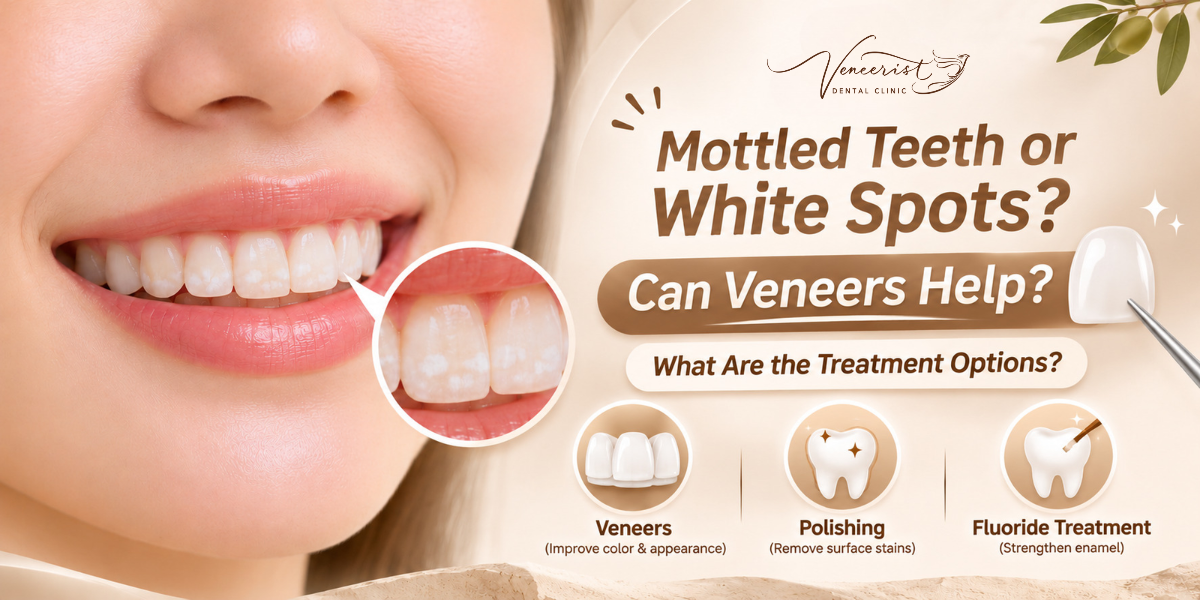
Dental Fluorosis and White Spots on Teeth: Can Veneers Help? What Are the Treatment Options?
Dental fluorosis and white spots on teeth can be treated with dental veneers in suitable cases. However, veneers are not necessary for everyone. White spots and uneven tooth colour can develop for several reasons, and the most appropriate treatment depends on the underlying cause, severity and condition of the natural enamel.
Some cases may benefit from professional teeth whitening, enamel microabrasion or localised composite bonding. In more pronounced cases involving deeper discolouration, brown stains or irregular enamel surfaces, dental veneers may be considered.
The priority is to identify the cause of the discolouration before selecting a treatment that improves the appearance of the smile whilst preserving as much natural tooth structure as possible.
What Is Dental Fluorosis?
Dental fluorosis is a developmental enamel condition caused by excessive fluoride intake during the period when teeth are forming within the jawbone, before they erupt into the mouth.
Fluoride plays an important role in preventing tooth decay when used appropriately. However, excessive fluoride intake during tooth development can interfere with the normal mineralisation of dental enamel.
Once the teeth erupt, dental fluorosis may appear as:
- Fine white lines across the enamel.
- Small, chalky-white spots.
- Diffuse white patches.
- Uneven tooth colour.
- Yellow or brown discolouration.
- Surface irregularities or enamel pitting in more severe cases.
Dental fluorosis often affects several teeth and may appear relatively symmetrical across teeth that developed during the same period.
Unlike ordinary surface stains, fluorosis involves changes within the enamel structure. It cannot be completely removed through regular brushing or professional dental cleaning alone.
Are White Spots on Teeth Always Caused by Dental Fluorosis?
Not necessarily. Although several enamel conditions may look similar, white spots on teeth can develop for different reasons.
Identifying the underlying cause is essential because each condition may require a different treatment approach.
1. Dental Fluorosis
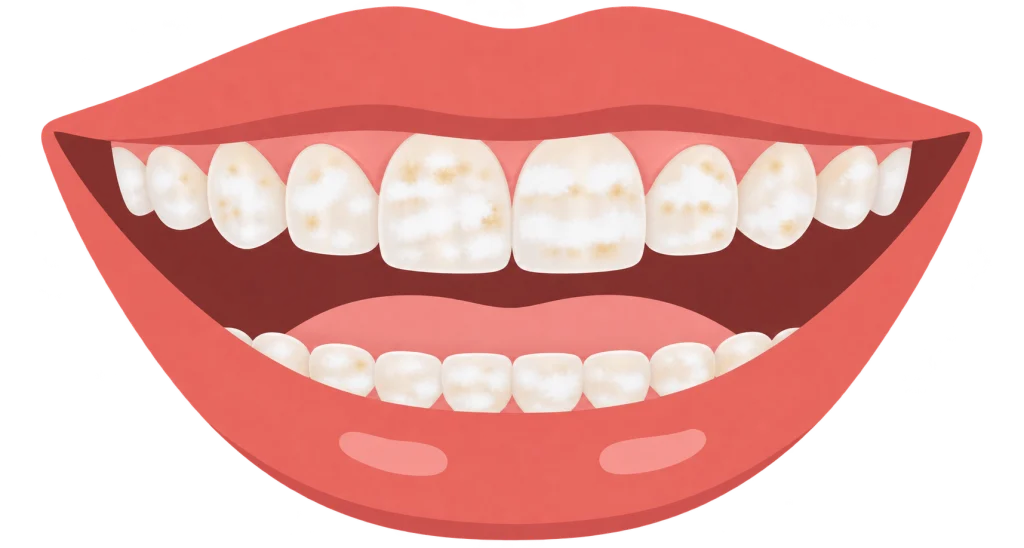
Dental fluorosis develops as a result of excessive fluoride intake whilst the teeth are forming.
It may appear as fine white lines, diffuse cloudy patches or more pronounced areas of brown discolouration.
The condition develops before the affected teeth erupt. Appropriate use of fluoride toothpaste in adulthood does not cause dental fluorosis in fully developed teeth.
2. Enamel Demineralisation
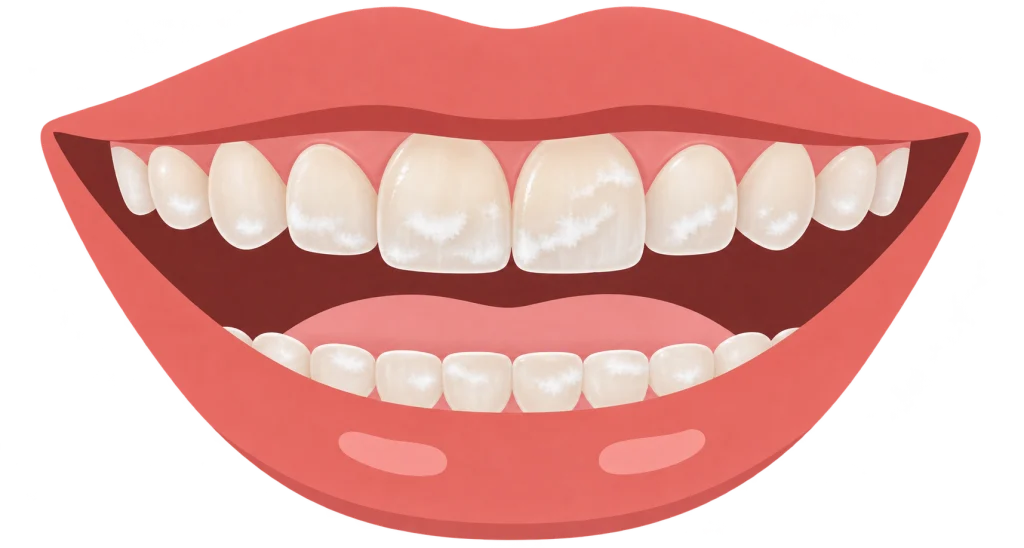
Enamel demineralisation occurs when acids produced by bacteria within dental plaque cause the enamel to lose minerals.
In its early stages, this process may appear as chalky-white areas on the tooth surface, commonly referred to as white spot lesions.
These lesions may represent an early stage of tooth decay before a cavity develops.
Without appropriate management, active lesions may progress into more advanced tooth decay.
3. White Spots During or After Orthodontic Treatment
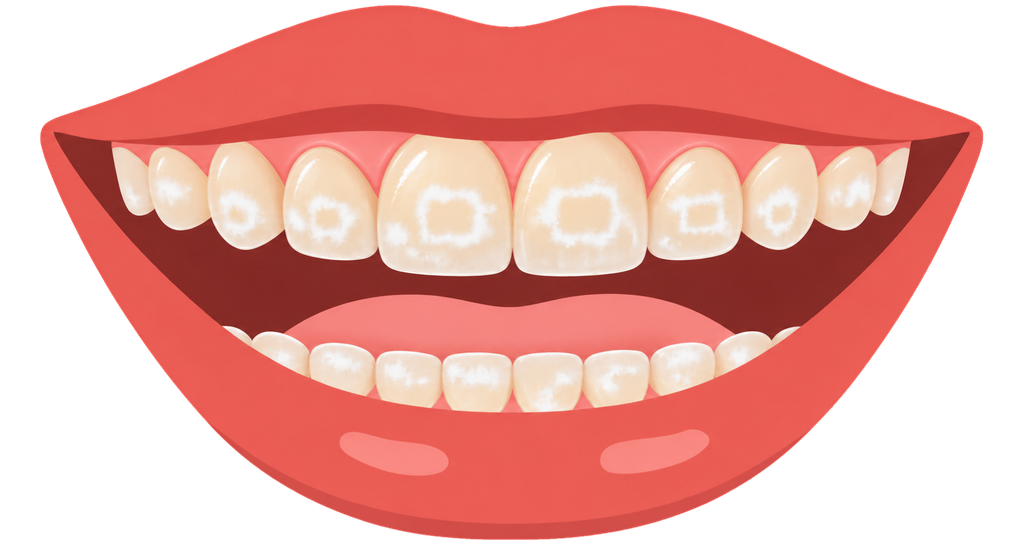
Patients undergoing orthodontic treatment with fixed braces may develop white spots around the areas where brackets are attached.
These areas can be more difficult to clean, allowing plaque to accumulate around the orthodontic appliances.
White spots associated with orthodontic treatment are generally related to enamel demineralisation rather than dental fluorosis.
Management should therefore focus on controlling plaque, assessing tooth decay risk and supporting enamel health before considering cosmetic treatment.
4. Developmental Enamel Defects
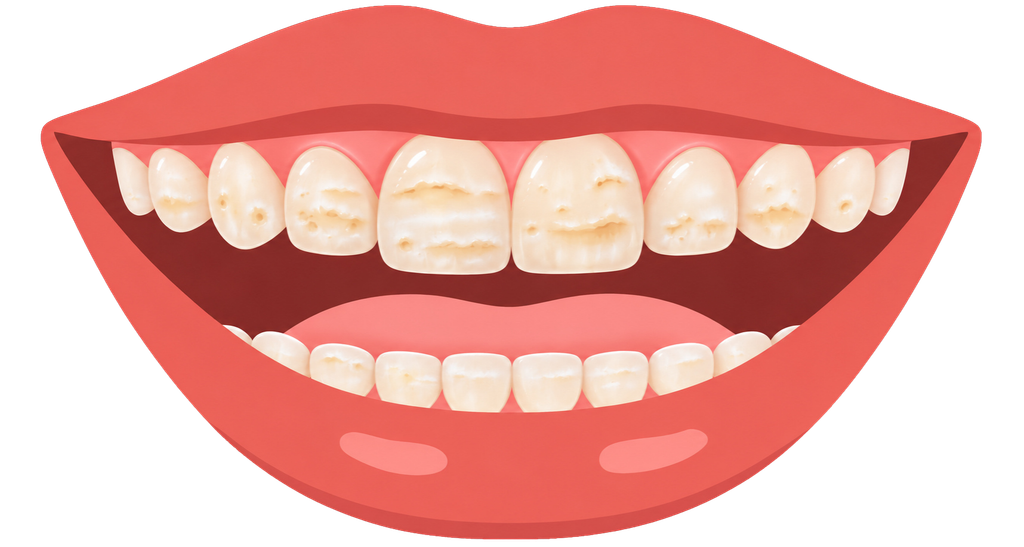
Some individuals develop enamel abnormalities whilst their teeth are forming.
These conditions may include:
- Enamel hypoplasia.
- Enamel hypomineralisation.
- Molar incisor hypomineralisation (MIH).
- Enamel defects associated with previous trauma or infection affecting primary teeth.
Developmental enamel defects may appear as white, yellow or brown patches. In some cases, the affected teeth may also have surface irregularities, increased sensitivity or a greater tendency towards enamel breakdown.
For this reason, white spots should not automatically be diagnosed as dental fluorosis based on appearance alone.
What Is the Difference Between Dental Fluorosis and Early Tooth Decay?
Although dental fluorosis and white spot lesions associated with early tooth decay can appear similar, they differ in their causes, development and treatment requirements.
| Features | Dental Fluorosis | White Spot Lesions from Demineralisation |
|---|---|---|
| Cause | Excessive fluoride intake during tooth development | Mineral loss caused by acids produced by dental plaque bacteria |
| Time of development | Before tooth eruption | After tooth eruption |
| Distribution | Often affects several teeth in a relatively symmetrical pattern | Frequently localised to areas of plaque accumulation |
| Appearance | White lines, diffuse patches or brown discolouration | Chalky-white areas, often near the gumline or orthodontic brackets |
| Disease progression | Not a tooth decay process in itself | Active lesions may progress into cavities |
| Treatment approach | Depends on severity and aesthetic concerns | Requires management of the decay process before cosmetic treatment |
A dental examination is recommended to distinguish between these conditions and determine the most appropriate treatment.
How Severe Can Dental Fluorosis Be?
The appearance of dental fluorosis varies according to its severity. For general understanding, it can be described in three broad categories.
Mild Dental Fluorosis
Mild fluorosis commonly appears as fine white lines or small white patches on the enamel.
The overall tooth shape and surface structure are generally preserved.
In some cases, the white markings may only become noticeable when viewed closely or when the teeth are dry.
Treatment may not be necessary if the teeth remain healthy and the individual is comfortable with their appearance.
Moderate Dental Fluorosis
Moderate fluorosis may involve more extensive areas of white discolouration, sometimes accompanied by yellow or brown staining.
Uneven tooth colour may become more noticeable during smiling or speaking.
Treatment options depend on the depth of the discolouration, enamel condition and the patient’s aesthetic preferences.
Severe Dental Fluorosis
Severe fluorosis may involve extensive brown discolouration, enamel pitting and irregular tooth surfaces.
In some cases, there may also be a loss of enamel structure.
Depending on the amount and quality of the remaining natural tooth structure, restorative treatments such as composite bonding, dental veneers or crowns may be considered.
Is Dental Fluorosis Harmful? Does It Always Require Treatment?
Mild dental fluorosis is primarily an aesthetic concern and does not necessarily require treatment.
If the teeth remain structurally sound, function normally and do not cause aesthetic concerns, monitoring and routine dental care may be sufficient.
However, severe fluorosis involving enamel pitting or structural defects may require further assessment to determine whether restorative treatment is appropriate.
White spot lesions caused by enamel demineralisation require a different approach. Active lesions should be assessed and managed to prevent further progression of tooth decay, rather than being treated solely as a cosmetic concern.
Can Teeth Whitening Improve Dental Fluorosis and White Spots?
Teeth whitening may improve the overall appearance of teeth affected by mild dental fluorosis in selected cases.
By lightening the surrounding natural tooth colour, whitening may reduce the visual contrast between unaffected enamel and existing white patches.
However, teeth whitening does not reverse developmental changes within the enamel or eliminate every type of discolouration.
Its effectiveness depends on the severity, depth and characteristics of the affected areas.
Why Do White Spots Sometimes Become More Noticeable After Teeth Whitening?
During and immediately after teeth whitening, temporary tooth dehydration may make existing white spots appear more prominent.
As the teeth gradually regain moisture from saliva, their appearance may become more uniform.
However, this does not necessarily mean that the original white spots will disappear completely.
The dentist may recommend reassessing the tooth colour once it has stabilised before deciding whether additional aesthetic treatment is required.
Patients interested in improving their overall tooth colour can explore the professional teeth whitening options available at Veneerist Dental Clinic Krabi.
What Are the Treatment Options for Dental Fluorosis and White Spots on Teeth?
Treatment does not always need to involve dental veneers.
Where clinically appropriate, conservative approaches that preserve natural tooth structure should be considered before more extensive restorative procedures.
1. Enamel Remineralisation
Remineralisation may be appropriate for certain white spot lesions caused by enamel mineral loss, particularly early-stage tooth decay where the tooth surface has not developed a cavity.
Management may include:
- Improving daily oral hygiene.
- Using fluoride products as recommended by the dentist.
- Reducing the frequency of sugary foods and drinks.
- Receiving professional preventive dental care.
The primary objective is to arrest or slow the progression of early tooth decay and support enamel mineral recovery.
Although the appearance of some white spot lesions may improve, complete disappearance cannot be guaranteed.
Remineralisation does not directly reverse the developmental enamel changes associated with dental fluorosis.
2. Teeth Whitening
Teeth whitening may help reduce the visual contrast between the surrounding tooth colour and existing fluorosis-related discolouration.
One advantage is that whitening does not require mechanical tooth reduction.
However, whitening alone may not be sufficient when discolouration extends deeper into the enamel, when dark brown stains are present or when there are significant surface irregularities.
Temporary tooth sensitivity may also occur following whitening treatment.
3. Enamel Microabrasion
Enamel microabrasion is a conservative dental technique that combines a controlled chemical agent with an abrasive material to remove a thin superficial layer of enamel.
It may be suitable for certain shallow enamel stains or superficial developmental discolouration.
However, if the affected areas extend deeper into the enamel, microabrasion may not completely improve their appearance.
Although it is considered a conservative approach compared with more extensive restorative treatments, microabrasion still involves the irreversible removal of a small amount of natural enamel.
It should therefore only be performed following appropriate clinical assessment.
4. Localised Composite Bonding
Composite bonding involves applying tooth-coloured resin to selected areas of a tooth to mask discolouration or restore minor surface defects.
It may be appropriate when the affected area is relatively localised and does not require coverage of the entire front surface of the tooth.
This approach may allow the dentist to preserve more natural tooth structure than a full veneer restoration.
However, composite resin may discolour, wear or lose its surface gloss over time. Periodic polishing, repair or replacement may be required.
5. Dental Veneers
Dental veneers are restorations that cover the front surfaces of teeth to improve their colour, shape, size and proportions.
Veneers may be considered for patients with more extensive discolouration, noticeable enamel irregularities or aesthetic concerns that cannot be adequately addressed through more conservative treatments.
They may also be suitable for individuals who wish to improve tooth colour and shape together.
Both composite and ceramic veneers have distinct material properties, advantages and limitations.
Patients can learn more about the ceramic and composite veneer treatments available at Veneerist before deciding which restorative option may be appropriate.
6. Dental Crowns
In severe cases involving substantial structural damage, extensive enamel defects or insufficient tooth structure for suitable veneer bonding, dental crowns may be considered.
Unlike veneers, crowns generally cover the entire visible portion of a tooth and require more extensive tooth preparation.
Crowns should therefore not be selected simply to conceal minor white spots or superficial discolouration on otherwise structurally sound teeth.
Their suitability should be based on the overall restorative needs of the affected tooth.
Comparing Treatment Options for Dental Fluorosis and White Spots
| Treatment | Potential Indications | Tooth Preparation | Limitations |
|---|---|---|---|
| Remineralisation | Early-stage, non-cavitated tooth decay | No mechanical tooth reduction | White spots may remain visible |
| Teeth Whitening | Selected cases of mild fluorosis | No mechanical tooth reduction | Does not reverse structural enamel changes |
| Enamel Microabrasion | Superficial enamel discolouration | Controlled removal of superficial enamel | Limited effectiveness for deeper defects |
| Composite Bonding | Localised discolouration or surface defects | Minimal or selective preparation when required | May stain, wear or require maintenance |
| Composite Veneers | More extensive discolouration or shape modification | Depends on individual tooth condition | May require polishing or repairs over time |
| Ceramic Veneers | Pronounced discolouration and broader aesthetic concerns | Depends on underlying tooth colour, shape and structure | May require additional preparation and higher treatment costs |
| Dental Crowns | Significant structural damage | Generally more extensive than veneers | Not appropriate for minor cosmetic defects alone |
In selected cases, the dentist may recommend combining different treatment approaches to achieve an appropriate balance between aesthetic improvement and natural tooth preservation.
When Are Ceramic Veneers Suitable for Dental Fluorosis?
Ceramic veneers may be considered when patients have:
- Extensive white or brown enamel discolouration.
- Noticeably uneven tooth colour.
- Aesthetic concerns that cannot be adequately addressed through conservative treatment.
- Irregular tooth shapes or enamel surfaces.
- A desire to improve tooth colour, shape and proportions together.
- Sufficient natural tooth structure and suitable bonding surfaces.
- Appropriate gum health and bite relationships.
Any active tooth decay, gum disease or significant bite-related concerns should be assessed and managed before definitive veneer treatment.
The presence of dental fluorosis alone does not automatically make a person suitable for ceramic veneers.
Can Ceramic Veneers Completely Mask Dental Fluorosis?
Ceramic veneers can help mask various types of tooth discolouration. However, their ability to conceal fluorosis depends on several interacting factors.
Successful aesthetic planning involves more than simply selecting a lighter veneer shade.
Underlying Natural Tooth Colour
Ceramic veneers have varying levels of translucency, meaning that the colour of the natural tooth beneath the restoration can influence the final appearance.
When natural teeth have dark brown stains or significant colour differences between individual teeth, additional consideration must be given to masking the underlying discolouration.
Ceramic Translucency and Opacity
Highly translucent ceramic can reproduce the depth and optical characteristics of natural enamel.
However, its ability to mask significant underlying discolouration may be limited.
More opaque ceramic materials may provide greater masking ability, but excessive opacity can make the restorations appear flat or artificially white if not appropriately designed.
A balance between translucency and opacity is therefore essential when planning ceramic veneers for discoloured teeth.
Ceramic Restoration Thickness
The thickness of a ceramic veneer influences its optical properties and ability to mask underlying tooth colour.
In cases involving significant discolouration, additional space may be required for an appropriately designed restoration.
However, increasing ceramic thickness without considering the available space may result in excessively bulky tooth contours or unfavourable relationships with the gums and opposing teeth.
Resin Cement Shade
The shade of the adhesive resin cement used to bond ceramic veneers can influence the final restoration colour, particularly when the ceramic is thin and translucent.
Nevertheless, cement shade alone may not be sufficient to compensate for severe underlying tooth discolouration.
The final appearance depends on the combined optical properties of the natural tooth, ceramic restoration and bonding materials.
Does Dental Fluorosis Require More Tooth Preparation for Veneers?
Not necessarily.
The amount of tooth preparation required depends on the severity of the enamel discolouration, underlying tooth colour, original tooth shape, enamel quality and proposed restoration thickness.
For teeth with mild discolouration and suitable natural contours, limited preparation may be possible.
However, if the natural teeth have pronounced brown staining, significant colour variations or insufficient space for appropriately designed ceramic restorations, additional preparation may be necessary in selected areas.
Severe dental fluorosis may also affect enamel structure and bonding characteristics. The dentist must therefore assess the quality of the remaining enamel before determining the most suitable adhesive and restorative approach.
The objective is not to remove natural tooth structure until every area of discolouration disappears.
Instead, treatment should focus on achieving appropriate restoration contours, managing underlying tooth colour and preserving as much healthy natural tooth structure as reasonably possible.
Will Ceramic Veneers for Dental Fluorosis Look Natural?
A natural-looking result may be achievable with appropriate treatment planning and ceramic restoration design.
The appearance of natural teeth involves more than colour alone. Important aesthetic characteristics include:
- Gradual colour transitions from the gumline towards the incisal edge.
- Appropriate incisal translucency.
- Natural surface texture.
- Individual tooth proportions and contours.
- The way the teeth reflect and transmit light.
- Harmony with neighbouring teeth and facial features.
For teeth affected by dental fluorosis, the challenge is to mask unwanted discolouration whilst maintaining the optical depth and visual characteristics associated with natural teeth.
This is why selecting the whitest available ceramic shade is not necessarily the best approach.
The choice of ceramic material, restoration thickness, translucency and surface details should be tailored to the individual patient.
Do All Teeth Affected by Dental Fluorosis Need Veneers?
No. The number of teeth requiring treatment depends on the distribution of the discolouration, its severity and the teeth visible when smiling.
If only one or two teeth are affected, localised treatment may be appropriate.
However, creating a natural-looking ceramic veneer that matches adjacent untreated teeth can require careful shade selection and aesthetic planning.
When several teeth are affected, each restoration may need to be individually designed according to the underlying natural tooth colour and structural condition.
The number of veneers should not be determined solely by the desire for a whiter smile.
Instead, treatment should be based on clinical suitability, aesthetic harmony and the preservation of healthy teeth.
What Is the Process of Planning Treatment for Dental Fluorosis?
Step 1: Identifying the Underlying Cause
The dentist assesses the patient’s dental history, the location and distribution of the discolouration, enamel surface characteristics and tooth decay risk.
This helps distinguish dental fluorosis from other enamel conditions.
Step 2: Assessing the Severity and Tooth Structure
The dentist evaluates the underlying tooth colour, enamel quality, structural integrity, gum health and bite relationships.
Clinical photographs and dental X-rays may be taken when indicated to support diagnosis and treatment planning.
Step 3: Discussing Suitable Treatment Options
The dentist explains the available approaches, including their potential benefits, limitations, maintenance requirements and the amount of natural tooth preparation that may be necessary.
The most appropriate option is determined according to the clinical findings and the patient’s preferences.
Step 4: Shade Selection and Smile Design
If veneers are selected, the dentist considers the natural tooth colour, desired shade, tooth proportions and ceramic optical properties.
The objective is to develop a smile design that balances colour consistency, natural appearance and appropriate dental function.
Step 5: Treatment and Follow-Up
Treatment is carried out according to the agreed clinical plan.
Follow-up appointments may be recommended to assess oral health, aesthetic outcomes, restoration condition and long-term maintenance requirements.
How Much Does Dental Fluorosis Treatment Cost?
The cost of treating dental fluorosis and white spots depends on the selected treatment, the number of affected teeth, the severity of the discolouration and any additional restorative procedures required.
Patients with mild cosmetic concerns may not require extensive restorative treatment.
Those with more pronounced discolouration or structural enamel defects may require a more comprehensive treatment plan.
Patients considering veneers can review the published ceramic and composite veneer treatment fees at Veneerist Dental Clinic Krabi.
An individual treatment estimate can be determined following a dental examination and discussion of suitable treatment options.
For international patients travelling to Krabi, arranging a preliminary consultation before travelling may also help with treatment scheduling.
How to Care for Teeth Affected by Dental Fluorosis or White Spots
Although dental fluorosis develops during tooth formation, maintaining good oral health remains important throughout life.
Recommended dental care includes:
- Brushing twice daily using a soft-bristled toothbrush and an age-appropriate fluoride toothpaste.
- Avoiding excessive brushing pressure.
- Cleaning between the teeth daily using dental floss or appropriate interdental cleaning aids.
- Reducing the frequency of sugary foods and drinks.
- Avoiding abrasive powders, acidic substances and unverified home remedies intended to remove enamel stains.
- Attending regular dental examinations and professional cleaning appointments.
If white spots become larger, the enamel surface begins to deteriorate or tooth sensitivity develops, a dental examination is recommended.
These changes may indicate an active enamel condition that requires professional assessment rather than cosmetic treatment alone.
Frequently Asked Questions About Dental Fluorosis and White Spots on Teeth
Can dental fluorosis disappear naturally?
Dental fluorosis involves developmental changes within the enamel that occur before the teeth erupt.
These structural changes do not naturally reverse after tooth development is complete.
However, appropriate aesthetic or restorative treatment may improve the appearance of the affected teeth.
Does fluoride toothpaste cause dental fluorosis?
Dental fluorosis develops when excessive fluoride is ingested during tooth development.
In young children, swallowing excessive amounts of fluoride toothpaste may contribute to overall fluoride intake.
Appropriate use of fluoride toothpaste in adulthood does not cause fluorosis in fully developed teeth and remains beneficial for preventing tooth decay.
Can professional dental cleaning remove white spots?
Professional cleaning can remove plaque, calculus and certain external surface stains.
However, it cannot directly remove developmental discolouration or structural changes within the enamel.
The treatment required depends on the underlying cause of the white spots.
Can teeth whitening completely remove white spots?
Not always.
Teeth whitening may improve overall tooth colour and reduce the contrast of certain white patches, but it cannot eliminate every type of enamel discolouration.
White spots may appear temporarily more noticeable immediately after whitening, particularly due to tooth dehydration.
Can enamel microabrasion treat dental fluorosis without veneers?
Enamel microabrasion may improve superficial fluorosis-related discolouration in selected cases.
However, its effectiveness depends on the location and depth of the affected enamel.
Deeper discolouration or significant structural defects may require alternative treatment.
Can composite veneers be used to treat dental fluorosis?
Yes, composite veneers may be suitable for selected cases.
Composite resin can help mask discolouration and improve tooth contours.
However, its masking ability, colour stability, surface wear and long-term maintenance requirements should be considered when selecting the most appropriate material.
Can ceramic veneers for dental fluorosis look natural?
Ceramic veneers can be designed to reproduce various optical characteristics of natural teeth.
Careful planning of the underlying tooth colour, ceramic thickness, translucency, opacity and surface details is particularly important when treating fluorosis.
Individual outcomes depend on the clinical condition and restorative treatment plan.
If I have a white spot on only one tooth, do I need a veneer?
Not necessarily.
A small, localised white spot may be suitable for a more conservative treatment approach, depending on its cause and depth.
A dental examination is recommended before deciding whether a full veneer restoration is necessary.
Is dental fluorosis contagious?
No. Dental fluorosis is a developmental enamel condition and is not contagious.
It cannot be transmitted between individuals.
Summary: Are Veneers Necessary for Dental Fluorosis and White Spots?
Dental fluorosis and white spots on teeth can develop for several reasons, and the most appropriate treatment depends on their underlying cause.
Mild discolouration may be managed through conservative approaches such as teeth whitening, enamel microabrasion or localised composite bonding when clinically appropriate.
White spot lesions associated with early tooth decay require appropriate preventive and disease management before cosmetic treatment is considered.
For more extensive discolouration, enamel irregularities or broader aesthetic concerns, composite or ceramic veneers may provide a suitable restorative option.
However, the most appropriate treatment is not necessarily the one that provides the greatest degree of colour masking.
It should be an approach that meets the patient’s individual needs whilst considering natural tooth preservation, oral health, dental function and long-term maintenance.
Dental Fluorosis and Veneer Consultations at Veneerist Dental Clinic Krabi
If you have white spots, brown stains or uneven tooth colour and are unsure whether teeth whitening, composite bonding or dental veneers may be appropriate, a professional dental consultation can help you understand your options.
At Veneerist Dental Clinic Krabi, we consider the condition of your natural teeth, underlying tooth colour, enamel quality and individual aesthetic preferences when planning restorative treatment.
Our approach to ceramic and composite veneers focuses on the balance between natural-looking aesthetics, appropriate treatment planning and oral health.
Because improving a smile is not simply about making teeth whiter. It is about understanding the individual characteristics of each smile and selecting an appropriate treatment for each patient.
Visit our official English website to learn more about our clinic and arrange a dental consultation.
Veneerist Dental Clinic Krabi — Crafting Your Shine
Maharat Road, Pak Nam, Mueang Krabi, Krabi, Thailand
Advance appointments are recommended.