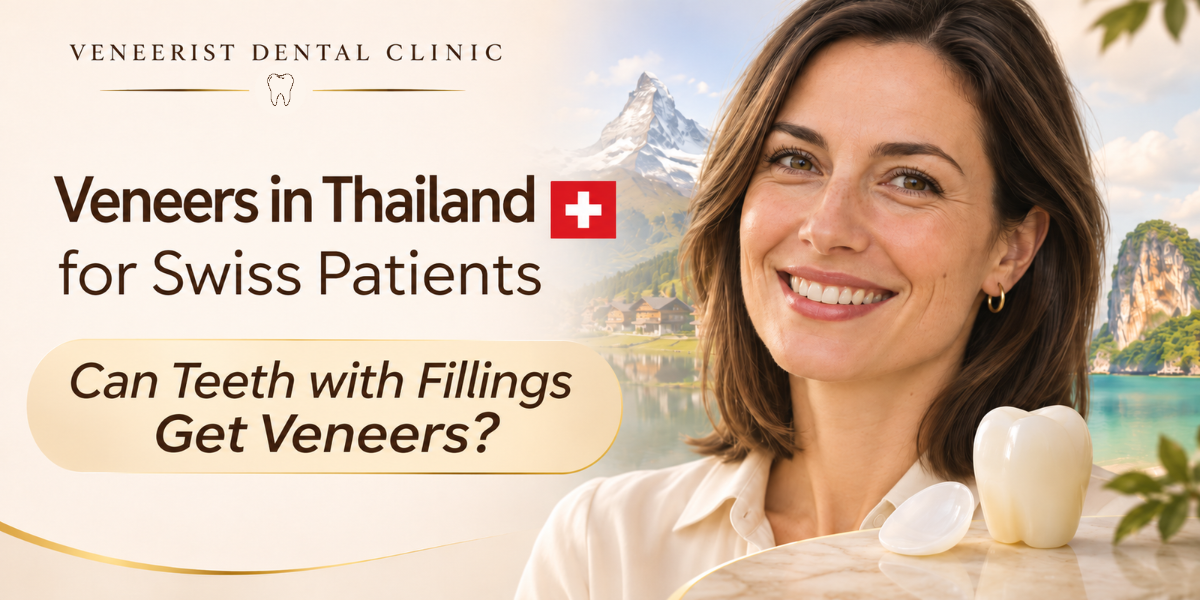
Dental Veneers in Thailand for Swiss Patients: Can You Get Veneers on Teeth with Fillings or Crowns?
For people living in Switzerland who are considering ceramic veneers in Thailand, one important question is whether teeth that have already been treated with fillings or dental crowns can still be suitable for veneers.
The answer is that teeth with existing fillings may be suitable for ceramic veneers in certain circumstances. However, this depends on the size and position of the fillings, the amount of healthy natural tooth structure remaining, and the overall condition of the teeth.
Teeth that already have dental crowns require a different approach. Rather than simply placing veneers over existing crowns, a dentist will usually need to assess whether the crowns should be retained, repaired or replaced.
This guide explains how previous dental restorations can affect veneer treatment, what distinguishes veneers from crowns, and what Swiss residents should know before considering cosmetic dental treatment in Thailand.
1. Can You Get Ceramic Veneers on Teeth with Fillings?
Having a dental filling does not automatically mean that a tooth is unsuitable for veneers.
If a tooth has a relatively small filling and sufficient healthy natural tooth structure remains, ceramic veneers may still be an option, provided the tooth and surrounding gums are in suitable condition.
However, a dentist will need to assess several factors, including:
- The size of the existing filling.
- The location of the filling, particularly on the front surface of the tooth.
- The amount of natural enamel remaining.
- The condition of the filling and its margins.
- The way the upper and lower teeth meet when biting.
- Any decay, cracks or other structural concerns.
For example, a front tooth with a small, stable composite filling may still have enough suitable tooth structure to support a ceramic veneer.
On the other hand, a tooth with a large filling or significant loss of natural structure may require a different restorative approach.
The important point is that suitability for veneers depends on the overall condition of the tooth, not simply on whether a filling is present.
2. Why Do Existing Fillings Affect Veneer Bonding?
Ceramic veneers are thin, custom-made restorations that are bonded to the front surfaces of teeth using dental adhesive systems.
Bonding to healthy natural enamel generally provides a more predictable adhesive foundation than bonding to some other dental surfaces.
When a tooth has previously been restored, the surface involved in veneer bonding may include a combination of enamel, dentine and existing restorative materials.
Each surface has different properties and may require a different preparation or bonding technique.
For example, if a front tooth has a composite resin filling in the area where a veneer would be bonded, the dentist may need to assess whether that filling is sound or whether it should be adjusted or replaced before treatment.
The presence of a filling does not necessarily mean that a veneer will fail. However, it is an important factor when assessing bonding conditions and long-term treatment suitability.
3. Can Veneers Be Placed Over Existing Dental Crowns?
This is different from placing veneers on teeth with fillings because dental crowns and dental veneers are two distinct types of restoration.
A ceramic veneer usually covers the front surface of a tooth, while a dental crown covers the prepared tooth more extensively.
If a tooth already has a crown, its visible outer surface is made from the crown material rather than natural tooth enamel.
For this reason, placing a conventional ceramic veneer over an existing crown is not the standard approach to cosmetic veneer treatment.
Although certain techniques may be used to repair or modify the surface of an existing crown in selected circumstances, these procedures are different from bonding a veneer to natural tooth structure.
If the aim is to change the colour or shape of an already crowned tooth, the dentist may recommend replacing the existing crown instead.
However, this does not mean that every existing crown needs to be removed.
If a crown remains clinically sound and fits appropriately within the overall treatment plan, it may be possible to retain it.
4. When Might a Dental Crown Be More Suitable Than a Ceramic Veneer?
Although veneers and crowns can both improve the appearance of teeth, they serve different restorative purposes.
Ceramic veneers are generally considered when the main aim is to improve the appearance of the front surfaces of teeth that still have suitable natural structure.
Dental crowns may be considered when a tooth requires more extensive restoration or protection.
| Tooth Condition | Possible Treatment Consideration |
|---|---|
| Small filling with sufficient healthy tooth structure | Ceramic veneers may be considered |
| Large existing filling | Veneers, crowns or another restoration may need assessment |
| Fractured tooth or substantial loss of tooth structure | A crown or another protective restoration may be appropriate |
| Existing crown in good clinical condition | The crown may be retained |
| Damaged or unsuitable existing crown | Repair or replacement may be considered |
These examples are intended as general guidance rather than a diagnosis.
The most appropriate treatment depends on the remaining tooth structure, gum health, bite, any previous root canal treatment and other clinical findings.
A dental examination is essential before deciding whether veneers or crowns are suitable.
5. Can Ceramic Veneers Match Existing Crowns on Your Front Teeth?
Some people already have one or more crowns on their front teeth but would like to improve the appearance of the neighbouring natural teeth.
For example, the two upper central incisors may have existing ceramic crowns, while the surrounding teeth remain natural.
If ceramic veneers are being considered for the neighbouring teeth, the dentist will need to assess how the new restorations might look alongside the existing crowns.
Several details are important:
- Tooth colour and shade.
- Translucency and the way light passes through the materials.
- Surface texture and reflection.
- Tooth shape and proportions.
- The condition and appearance of the existing crowns.
In some cases, it may be possible to retain the existing crowns and place veneers on selected neighbouring teeth.
In other situations, replacing one or more existing crowns may be considered if the patient wishes to achieve a more coordinated appearance.
However, using ceramic materials does not guarantee an identical shade or light reflection across different restorations.
A personalised assessment of the entire smile is therefore more important than choosing the number of veneers alone.
6. What Dental Records Should Swiss Patients Bring to Thailand?
For people travelling from Zurich, Geneva, Basel, Bern or elsewhere in Switzerland, previous dental records may be useful when planning ceramic veneer treatment in Thailand.
This is particularly relevant if you have already received fillings, crowns, root canal treatment or other restorative dental work.
Useful information may include:
- Records of previous fillings, especially on front teeth.
- Details of existing crowns and their materials, if available.
- Information about previous root canal treatment.
- Dental X-rays or relevant clinical reports.
- A history of fractured teeth or repairs to previous restorations.
- Information about teeth grinding or bite-related problems.
Switzerland has several national languages, including German, French and Italian.
If your dental records are written in one of these languages, you may wish to ask your previous dental practice whether an English summary is available.
However, you do not necessarily need every historical record before arranging a consultation.
Your dentist in Thailand will still need to examine your current oral health and may recommend additional investigations when clinically appropriate.
Previous records can support treatment planning, but they cannot replace a current dental assessment.
7. What If You Do Not Know Which Materials Were Used in Your Previous Dental Treatment?
It is common for patients to be unsure which materials were used in dental work carried out several years earlier.
This may be particularly relevant if you have changed dentists or moved between countries.
If you cannot identify the original filling or crown material, start by sharing whatever information you remember.
For example:
- Approximately when was the treatment completed?
- Which teeth were treated?
- Was the tooth previously painful or root canal treated?
- Have you experienced any problems with the restoration?
- Has the restoration ever been repaired or replaced?
The dentist can assess the visible restoration, surrounding tooth structure and other clinical findings.
Dental X-rays may be useful in selected cases, although an X-ray alone cannot reliably identify every type of restorative material.
An existing crown should not be removed simply because its material is unknown.
Any decision to repair or replace a restoration should be based on appropriate clinical indications and the patient’s treatment goals.
8. Ceramic Veneer Consultations at Veneerist Dental Clinic Krabi
For Swiss residents considering ceramic veneers in Krabi, Thailand, Veneerist Dental Clinic offers dental consultations and individualised treatment planning.
At Veneerist, smile planning begins with an assessment of oral health and the suitability of the proposed treatment.
For patients who already have fillings or dental crowns, the dentist will consider the condition of those restorations alongside the remaining natural tooth structure.
Depending on the clinical findings, treatment may involve ceramic veneers, retaining existing restorations, replacing an unsuitable crown or considering another restorative option.
Not every tooth requires a veneer, and an appropriate smile treatment plan may involve more than one type of dental restoration.
International visitors can contact our team in English to discuss their concerns and arrange an initial appointment.
A definitive treatment plan can only be confirmed after an appropriate clinical examination.
Conclusion: Can You Have Ceramic Veneers in Thailand If You Already Have Fillings or Crowns?
If you live in Switzerland and are considering ceramic veneers in Thailand, having previous dental work does not necessarily prevent you from improving your smile.
However, the most suitable approach depends on the condition of each individual tooth.
Teeth with fillings may be suitable for ceramic veneers when sufficient healthy tooth structure remains and the clinical conditions are appropriate.
Teeth with existing crowns generally require a different approach. Rather than placing veneers over crowns, the dentist may recommend retaining, repairing or replacing the existing restorations.
Bringing relevant dental records from Switzerland and arranging a thorough examination can help you better understand your treatment options, their limitations and the most appropriate approach for your oral health.
Contact Veneerist Dental Clinic Krabi
Considering ceramic veneers or looking for advice about teeth with existing fillings or crowns?
Contact Veneerist Dental Clinic to arrange a consultation.
Maharat Road, Krabi Town, Thailand
Veneerist Dental Clinic Location
Disclaimer: The suitability of dental veneers and crowns depends on individual oral health, remaining tooth structure and a dentist’s clinical assessment. Treatment outcomes and requirements vary between patients.
FAQ — Frequently Asked Questions
1. Can you get ceramic veneers on teeth with fillings?
Yes, in some cases. Suitability depends on the size and location of the filling, the amount of natural enamel remaining and the overall condition of the tooth. A dental examination is required.
2. Can you put veneers over existing crowns?
Placing conventional ceramic veneers over existing crowns is not generally the standard treatment approach. Depending on the condition of the crown and the desired result, a dentist may recommend retaining, repairing or replacing it.
3. Are veneers or crowns better for teeth with large fillings?
This depends on the remaining tooth structure, the existing restoration and the bite. Teeth with extensive structural loss may require a crown or another restorative option rather than a veneer.
4. Can I get veneers on neighbouring teeth if I already have two front crowns?
Possibly. The dentist will need to assess the condition of the crowns and whether the colour, shape and translucency of the proposed veneers can be coordinated with them.
5. Should I bring my dental records from Switzerland?
If available, previous dental records, X-rays and information about fillings or crowns can be helpful. However, a current clinical examination will still be necessary.
6. What if I do not know what material my existing crown is made from?
You can still arrange a dental consultation. The dentist can examine the restoration and determine whether additional information or investigations are required.
7. Can I get several ceramic veneers if multiple teeth already have fillings?
This may be possible in selected cases. Each tooth must be assessed individually to determine whether a veneer or another restoration is appropriate.