If you have lost many or all of your teeth, you may have heard about an Overdenture, sometimes described as a removable denture supported or retained by dental implants. But what is an overdenture, exactly? Is it fixed or removable, and what role do the dental implants play?
The most important thing to understand is that an Overdenture is still a removable denture. You can remove and replace it yourself. The difference is that dental implants are used to help retain and stabilize the denture during everyday use.
What Is an Overdenture?
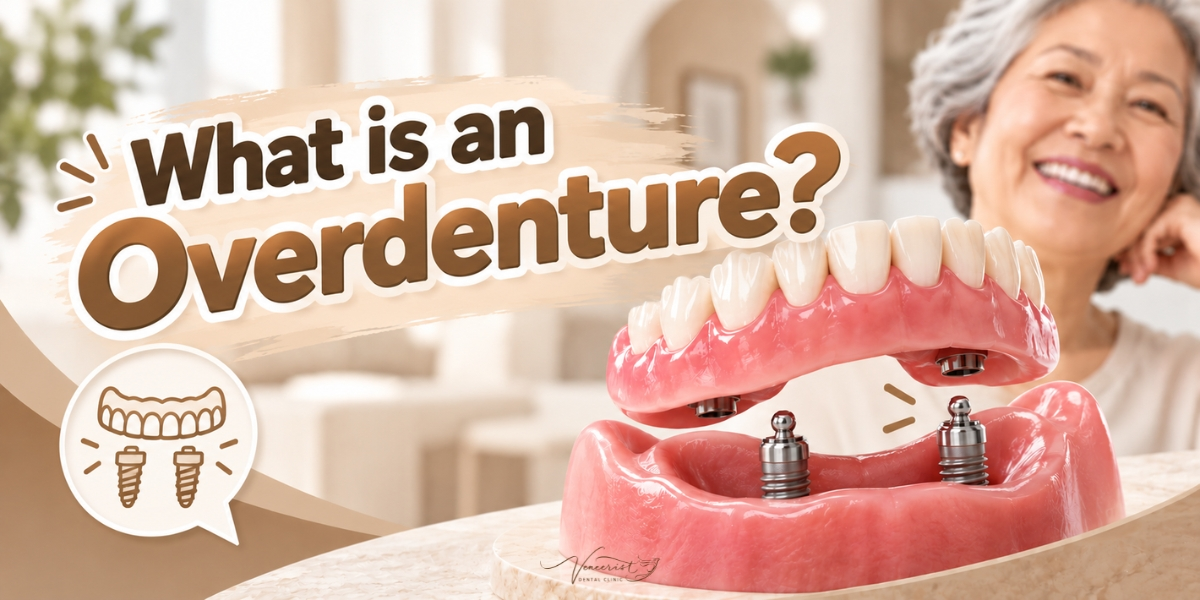
An Overdenture is a removable dental prosthesis that uses dental implants to provide additional retention and stability.
Dental implants are placed in the jawbone and connected to the denture through an attachment system. When the denture is placed in the mouth, these attachments help hold it in position and reduce unwanted movement.
However, even though dental implants are involved, an Overdenture is not a fixed set of teeth.
The patient can still remove the denture for cleaning and place it back in the mouth independently.
In simple terms:
Overdenture = Removable Denture + Dental Implants for Retention
How Does an Overdenture Work?
An Overdenture works through a combination of dental implants, the removable denture, and an attachment system.
The dental implants are placed in the jawbone and act as anchoring points. The denture is designed with corresponding components that connect to the implant attachments.
When the denture is inserted, the attachment system helps keep it in position and provides additional stability compared with a removable denture without implant retention.
Different attachment systems and designs may be used depending on the individual treatment plan.
What Are the Main Parts of an Overdenture?
An Overdenture generally involves three main components.
1. Dental Implants
Dental implants are placed in the jawbone and provide anchoring points for the denture.
2. Attachment System
The attachment system connects the implants to the removable denture. Different types of attachments may be selected depending on the design and treatment plan.
3. Removable Denture
This is the part that replaces the missing teeth. The patient can remove it for cleaning and place it back in the mouth.
These components need to be planned to work together appropriately for each individual case.
Is an Overdenture Fixed or Removable?
This is one of the most common areas of confusion.
Because an Overdenture uses dental implants, some patients assume that the teeth are permanently fixed to the implants.
However, an Overdenture is removable.
The implants help retain and stabilize the denture, but the patient can still remove it independently.
Being removable also allows the patient to clean the denture itself as well as the gums, oral tissues, and areas around the dental implants.
How Many Dental Implants Are Needed for an Overdenture?
There is no single number of implants that is appropriate for every Overdenture case.
The number and position of implants depend on several factors, including which jaw is being treated, the amount and location of available bone, the denture design, attachment system, bite, and individual oral condition.
For this reason, the number of implants should be determined after a dental examination and appropriate treatment planning rather than assuming that every Overdenture requires the same number.
In some cases, a 3D dental X-ray (CBCT) may be used to assess the available bone and important anatomical structures before implant placement is planned.
Who May Be Suitable for an Overdenture?
An Overdenture may be considered for people who have lost many or all of their teeth and would like a removable denture with additional implant retention and stability.
However, not everyone with missing teeth will automatically be suitable for this treatment.
Before dental implant treatment, the dentist needs to evaluate the gums, jawbone, bite, oral condition, general health, and other factors that may influence treatment.
The most appropriate tooth-replacement option should therefore be selected according to the individual patient rather than simply choosing a particular type of denture.
Does an Overdenture Need to Be Removed for Cleaning?
Yes. Because an Overdenture is a removable denture, both the denture and the mouth require regular cleaning.
Patients need to clean the denture as well as the gums and areas around the dental implants.
Having dental implants does not eliminate the need for oral hygiene. Plaque and food debris can still accumulate around the implants, oral tissues, and denture components.
Specific instructions for removing, cleaning, and maintaining an Overdenture may vary according to the denture and attachment system used.
Summary : What Is an Overdenture?
An Overdenture is a removable denture that uses dental implants to provide additional retention and stability.
Although dental implants are used, the denture is still designed so that the patient can remove and replace it independently.
The number and position of implants, attachment system, and Overdenture design can vary from person to person. A dental examination, assessment of the jawbone and bite, and individual treatment planning are therefore important before treatment begins.
If you have lost many or all of your teeth and are considering an Overdenture, you can consult with our dental team at Veneerist Dental Clinic in Krabi to assess your oral condition, jawbone, and suitable tooth-replacement options.