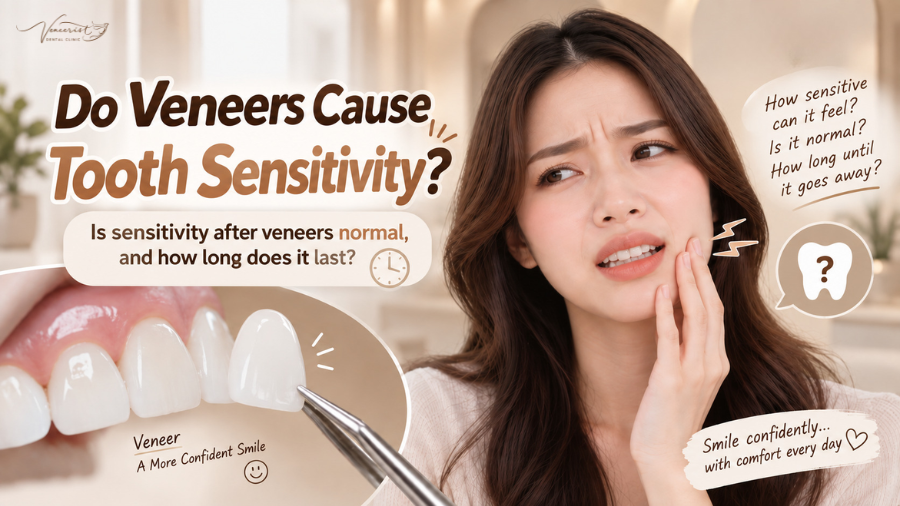
“Will my teeth become sensitive after getting veneers?” is a common concern for people considering Ceramic Veneers.
Because veneer treatment may involve preparing the tooth surface, some patients worry that their teeth will become sensitive to cold drinks, sweet foods, or even remain sensitive permanently after treatment.
The answer is that temporary tooth sensitivity can occur in some people after veneer treatment, particularly during the early stages following treatment.
However, everyone responds differently. Some people experience little or no sensitivity, while others may notice that certain teeth are temporarily more sensitive to cold or other stimuli.
The important thing is to understand the difference between temporary tooth sensitivity that can occur after treatment and actual tooth pain that should be evaluated by a dentist.
Why Can Teeth Feel Sensitive After Veneers?
Natural teeth consist of several layers. Enamel forms the outer surface, while dentin and the dental pulp are located deeper inside the tooth.
When placing Ceramic Veneers, the dentist may need to prepare the tooth surface according to the condition of each individual tooth and the planned restoration.
After tooth preparation and the other procedures involved in veneer treatment, some teeth may temporarily become more sensitive to external stimuli.
You may notice sensitivity when exposed to:
- Cold foods or drinks
- Hot drinks
- Sweet foods
- Air
- Certain stimuli around the treated teeth
However, this does not mean that everyone who gets veneers will experience sensitivity.
The response can vary from person to person and even from one tooth to another.
Can Teeth Be Sensitive While Wearing Temporary Veneers?
Yes, this can happen.
While waiting for the final Ceramic Veneers, patients may wear Temporary Veneers to protect the prepared teeth and allow them to continue with their daily activities while the final restorations are being fabricated by the Dental Laboratory.
During this period, some teeth may be more sensitive to temperature or other stimuli than usual.
Temporary Veneers are made from different materials and do not have exactly the same properties or fit as the final Ceramic Veneers. Therefore, the way your teeth feel while wearing temporary restorations may not necessarily reflect how they will feel once the final veneers have been bonded.
If you experience mild, short-lasting sensitivity to certain stimuli, you can discuss it with your dentist and continue to monitor the symptoms as advised.
However, if you develop significant pain, increasing discomfort, or other unusual symptoms, you should contact the clinic so that the dentist can evaluate the cause.
Can Teeth Still Feel Sensitive After the Final Ceramic Veneers Are Bonded?
Yes, in some people.
After the final Ceramic Veneers are bonded, the teeth and surrounding tissues have recently undergone dental treatment. Some teeth may therefore remain temporarily sensitive to cold or other stimuli during the initial period.
Some patients may experience almost no sensitivity, while others may notice it more.
Several factors can influence this, including:
The condition of the teeth before treatment
Teeth that were already sensitive, worn, previously filled, or otherwise different in condition may respond differently after treatment.
The amount of tooth preparation
Not every tooth requires exactly the same amount of preparation. This depends on its original shape, position, and the design of the final restoration.
The bite
Different teeth receive different amounts of force during biting and chewing. If a particular area is receiving more force than expected, it may feel uncomfortable during function.
The response of each individual tooth
Even within the same patient, one tooth may respond differently from another.
For this reason, it is not unusual for different teeth to feel slightly different during the initial period after treatment.
How Long Does Tooth Sensitivity Last After Veneers?
There is no single number of days that applies to everyone.
Some people may experience sensitivity only for a short period after treatment, while others may take longer to adjust depending on the original condition of their teeth and the treatment performed.
Rather than focusing only on:
“How many days have my teeth been sensitive?”
it is also important to consider:
“Is the sensitivity gradually improving, or is it becoming worse?”
Temporary sensitivity to cold or other stimuli that gradually decreases is different from symptoms that become more intense or develop into actual pain.
If the sensitivity is not improving, feels unusual, or is interfering with your daily life, you do not need to wait for a specific number of days before contacting your dentist for an evaluation.
Are Tooth Sensitivity and Tooth Pain After Veneers the Same Thing?
No.
Tooth sensitivity is usually triggered by something such as a cold drink, air, or certain foods. You may experience a brief sharp or “zinging” sensation that settles after the stimulus is removed.
This type of sensitivity can occur temporarily in some patients following veneer treatment.
However, significant tooth pain—especially pain that occurs without a trigger—should not simply be considered a normal part of getting veneers.
You should contact your dentist if you experience symptoms such as:
- Pain that starts without any obvious trigger
- Throbbing pain
- Pain that disturbs your sleep
- Pain that lingers after exposure to hot or cold temperatures
- Significant pain when biting or chewing
- Symptoms that are becoming worse rather than gradually improving
These symptoms do not automatically mean that there is a serious problem, but they should be evaluated to determine the cause.
Does Sensitivity After Veneers Mean I Need Root Canal Treatment?
Not necessarily.
Experiencing sensitivity after veneer treatment does not automatically mean that the dental pulp or nerve inside the tooth has been damaged, nor does it mean that the tooth requires Root Canal Treatment.
Teeth can temporarily become more sensitive following dental treatment for several reasons.
However, if the symptoms change from brief sensitivity to persistent or spontaneous pain, or if other concerning symptoms develop, the dentist may need to perform additional tests to evaluate the health of the dental pulp and identify the cause.
Therefore, sensitivity alone is not enough to determine whether Root Canal Treatment is necessary.
What If It Hurts When I Bite After Getting Veneers?
Another sensation that patients may sometimes confuse with tooth sensitivity is discomfort or pain when biting.
After Ceramic Veneers are bonded, the dentist checks the bite. However, once you return to normal eating and chewing, you may notice that a particular tooth or area feels different.
For example, you may feel that:
“One tooth touches before the others.”
“It hurts when I bite on one particular tooth.”
or
“My bite feels different from before.”
If this happens, you should let your dentist know so that your bite can be checked again.
Discomfort when biting may be related to the way forces are being distributed across the teeth and should not automatically be considered ordinary tooth sensitivity.
Will My Teeth Be Sensitive Forever After Veneers?
Veneer treatment does not mean that your teeth will necessarily remain sensitive permanently.
Some people experience no sensitivity at all, while others may temporarily notice increased sensitivity to cold or other stimuli following treatment.
What matters is how the symptoms develop over time.
Sensitivity that gradually decreases is different from sensitivity that remains unchanged, becomes more severe, or develops into actual pain.
If the sensitivity does not improve, interferes with your daily activities, or is accompanied by pain, there is no need to simply tolerate it or wait for a long period. Your dentist can evaluate the teeth and determine whether anything needs attention.
Summary: Do Veneers Cause Tooth Sensitivity?
Temporary tooth sensitivity can occur in some patients after Ceramic Veneer treatment, particularly after tooth preparation, while wearing Temporary Veneers, or during the initial period after the final restorations have been bonded.
Some people may experience almost no sensitivity, while others may temporarily notice increased sensitivity to cold, air, or certain stimuli.
The important distinction is between sensitivity and pain.
Brief sensitivity triggered by cold or other stimuli that gradually improves can occur after treatment. However, spontaneous pain, throbbing pain, pain that disturbs your sleep, lingering pain after hot or cold stimuli, or significant pain when biting should be evaluated by a dentist.
At Veneerist Dental Clinic in Krabi, Thailand, Ceramic Veneer treatment is planned individually by considering the condition of each tooth, the bite, and the overall treatment plan. Follow-up and adjustments can also be performed when appropriate, with consideration given not only to the appearance of the smile but also to function and the health of the natural teeth.