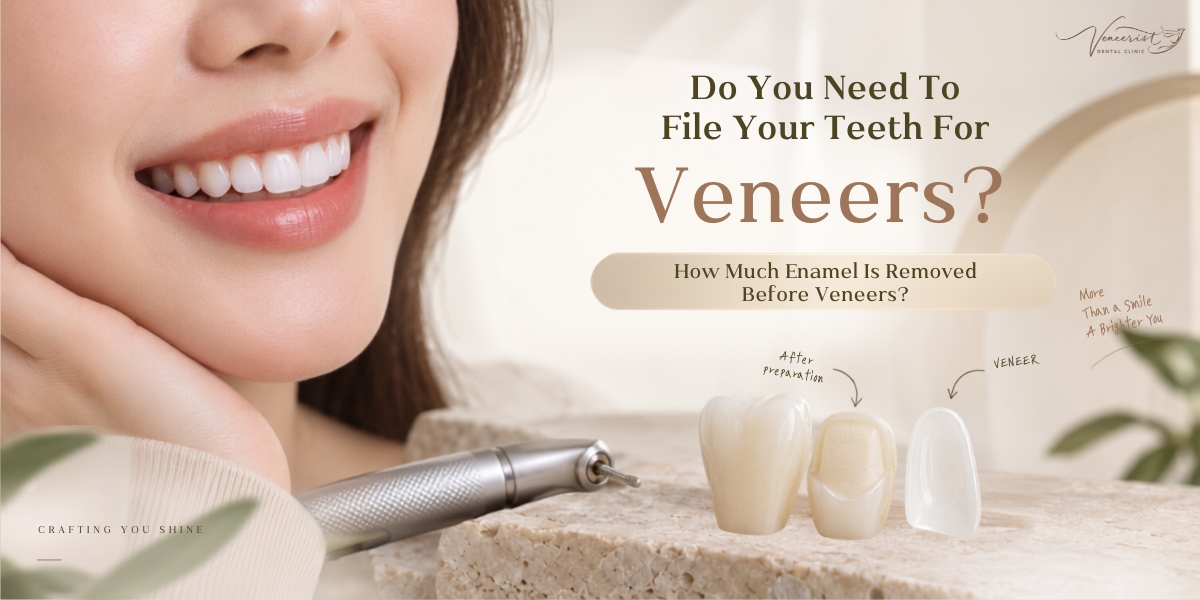
Do you need to shave your teeth before getting veneers? For Ceramic Veneers at Veneerist, tooth preparation is part of the treatment process, but the amount varies from person to person — and even from tooth to tooth. It depends on your existing tooth position, shape, shade, alignment, bite, and individual Smile Design.
Do You Need to Shave Your Teeth for Veneers?
One of the most common concerns patients have before getting Ceramic Veneers is:
“Will my teeth need to be shaved?”
“How much tooth structure will be removed?”
“Will my natural teeth become very small?”
Based on the Ceramic Veneer cases we treat at Veneerist, the straightforward answer is: yes, some tooth preparation is required.
However, “tooth preparation” does not mean that every tooth needs to be significantly reduced, nor does it mean that the same amount is removed from every tooth.
Some teeth may require only minor preparation, while others may need more adjustment depending on their original position, shape, and the desired final result.
The goal is to prepare each tooth appropriately for the individual case, creating sufficient space for the Ceramic Veneer while allowing the final shape, proportions, and alignment to blend naturally with the overall smile.
Why Is Tooth Preparation Needed for Ceramic Veneers?
Although Ceramic Veneers are thin restorations, they still require appropriate space on the tooth surface.
If a veneer is simply added over the existing tooth without sufficient space, the final tooth may appear too thick, bulky, or out of proportion in certain cases.
Preparing the tooth surface allows the dentist to create appropriate space for the ceramic and provides greater control over the shape, size, position, and final appearance of the restored tooth.
The amount of preparation depends on several factors, including:
- The position and alignment of the teeth
- Existing tooth shape and size
- Natural tooth shade and desired veneer shade
- The required thickness of the ceramic
- The bite
- The number of teeth being treated
- The final Smile Design
For this reason, there is no single answer to “How many millimetres need to be shaved for veneers?” that applies to every patient.
Can Each Tooth Require a Different Amount of Preparation?
Yes.
Even when several Ceramic Veneers are being placed at the same time, the existing condition and position of each tooth can be different.
A tooth that is already in a favourable position may require relatively little adjustment, while a tooth that is protruding, rotated, tilted, or significantly crowded may require more preparation to achieve the shape and position established in the final design.
Tooth preparation is therefore considered individually for each tooth, rather than removing the same amount from every tooth.
Will My Teeth Be Shaved Down to Tiny Pegs?
This is one of the biggest concerns patients have after seeing dramatic tooth-preparation photos online.
However, images showing teeth reduced to very small shapes should not automatically be assumed to represent Ceramic Veneer preparation.
The preparation required for a Veneer and a Dental Crown can differ significantly because the restorations have different designs and purposes.
For Ceramic Veneers, the dentist evaluates the existing tooth and the intended final shape to determine which areas need adjustment and how much preparation is appropriate.
Can I Get Veneers If My Teeth Are Severely Crowded?
In some cases, yes, but a more detailed assessment is required.
When teeth are significantly crowded, rotated, tilted, or positioned far outside the desired dental arch, creating the planned result with Ceramic Veneers may require more tooth preparation than in a case where the teeth are already relatively well aligned.
If a tooth requires substantial adjustment, the preparation may approach or involve the inner tissues of the tooth. In certain cases, the dentist may therefore recommend Root Canal Treatment before the final restoration is completed.
Importantly, this does not mean that everyone who gets veneers needs Root Canal Treatment.
It is considered only for individual teeth when clinically necessary based on their existing condition and the amount of correction required.
For more complex tooth positions, the dentist may also discuss orthodontic treatment before veneers as an alternative. Moving the teeth into a more favourable position first may allow a different restorative approach and help preserve more natural tooth structure.
What About No-Prep Veneers?
You may have come across the term “No-Prep Veneers”, particularly online or on social media.
In dentistry, very minimal or virtually no tooth preparation may be possible in selected situations where the existing tooth shape and position are suitable. However, this approach is not appropriate for every smile or every tooth.
For the Ceramic Veneer cases treated at Veneerist, we prepare the tooth surface according to the individual requirements of each case.
We therefore prefer not to create the expectation that veneers can always be completed “without shaving the teeth.”
Rather than focusing only on prep versus no-prep, the more important question is:
How much preparation is appropriate for this particular tooth to achieve the planned result?
How Does Smile Design Help With Veneer Treatment?
Before starting Ceramic Veneer treatment at Veneerist, we collect the necessary clinical information, which may include photographs, X-rays when appropriate, and dental impressions or an intraoral scan.
This information is used together with our Dental Laboratory to create a 3D Smile Design before treatment begins.
The 3D design helps establish the planned tooth shape, size, proportions, alignment, and details of the Ceramic Veneers before the final restorations are produced.
It also allows the dentist to visualise the intended smile in advance and assess how much each tooth may need to change from its original position and shape.
So rather than beginning with the question:
“How much tooth should be shaved?”
we first consider:
“What should the final tooth position, shape, and smile look like?”
The preparation of each tooth can then be determined according to the Smile Design and the Ceramic Veneers that will be created for that individual patient.
Does Less Tooth Preparation Always Mean Better?
Preserving as much healthy natural tooth structure as reasonably possible is important. However, there also needs to be sufficient space for the Ceramic Veneer.
If too little space is created in a case that requires a significant change in tooth shape or position, the ceramic may need to become thicker, or the final contour may not match the intended design.
At the same time, removing more tooth structure than necessary is not the goal either.
The key is therefore appropriate preparation rather than simply the least possible preparation — while preserving natural tooth structure as much as the individual treatment plan allows.
Summary — Veneers Require Tooth Preparation, but the Amount Varies
For Ceramic Veneers at Veneerist, we want to be transparent with our patients: tooth preparation is part of the treatment process.
However, this does not mean every patient requires extensive tooth reduction or that every tooth is prepared by the same amount.
Teeth that are already in a favourable position may require less preparation, while teeth that are protruding, rotated, tilted, or significantly crowded may require more. In certain cases where clinically necessary, Root Canal Treatment or other dental treatment may also form part of the overall treatment plan.
Rather than promising “no tooth shaving,” our approach is to carefully assess the teeth, create the 3D Smile Design, and determine the appropriate amount of preparation for each individual tooth.
The final treatment should consider not only aesthetics, but also the health of the teeth, the bite, function, and long-term result.
Ceramic Veneers at Veneerist Dental Clinic, Krabi 🤍