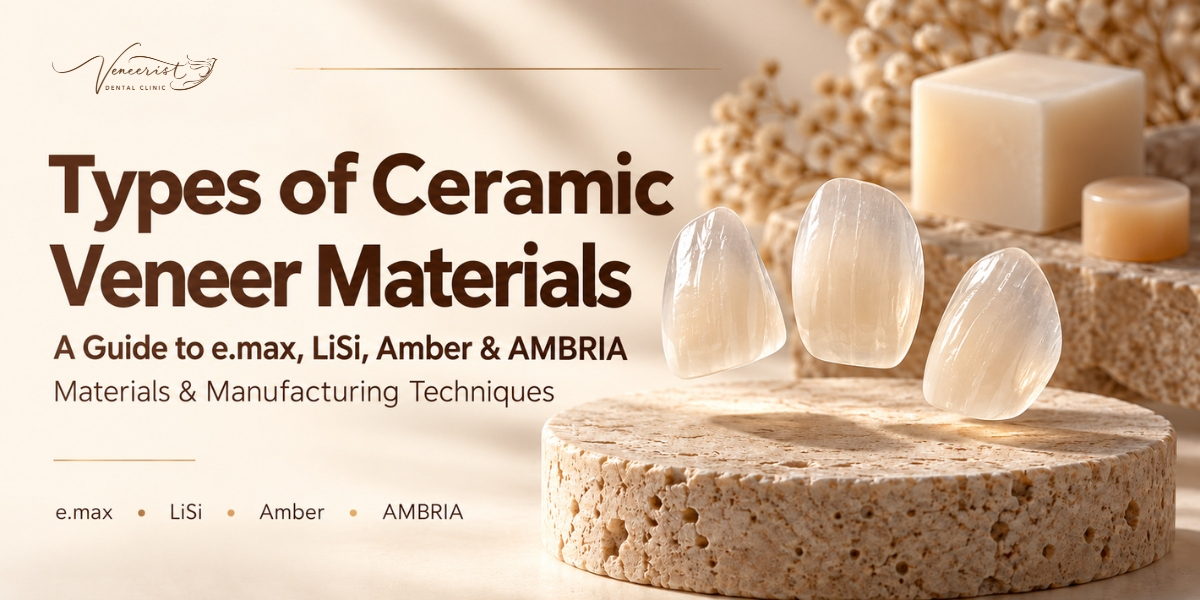
When considering ceramic veneers, many patients are familiar with names such as IPS e.max or have heard that certain ceramics offer greater translucency, while others are designed to provide higher mechanical strength.
However, ceramic veneers are not made from a single type of material, and no one ceramic is universally suitable for every patient.
Selecting the appropriate ceramic veneer material requires careful consideration of the patient’s existing tooth structure, bite, functional requirements, original tooth shade, restoration thickness, and desired final appearance.
This article explores the different types of ceramic veneer materials, commonly used ceramic systems, and fabrication techniques involved in creating natural-looking dental restorations.
What Are Ceramic Veneers?
Ceramic veneers are thin dental restorations designed to be bonded to the front surfaces of teeth to improve their shape, proportions, size, or colour according to an individual treatment plan.
Dental ceramics can reproduce optical characteristics similar to natural teeth, including translucency, light reflection, and varying degrees of opacity.
However, the final appearance and clinical performance of ceramic veneers depend on more than the ceramic material itself.
Other important factors include tooth preparation, veneer thickness, bonding techniques, resin cement shade, and the technical expertise involved in designing and fabricating the restorations.
1. Feldspathic Porcelain — Aesthetic Detail and Natural Translucency
Feldspathic porcelain has been used in aesthetic dentistry for many years, particularly for veneers requiring detailed colour characterisation and translucency.
Key Characteristics
- Allows detailed control of colour and translucency.
- Can reproduce subtle optical features of natural enamel.
- May be fabricated in thin sections in selected cases.
- Supports detailed characterisation of the incisal edges.
Limitations
Feldspathic porcelain generally has lower mechanical strength than lithium disilicate ceramics.
Its suitability depends on the available tooth structure, restoration thickness, bonding conditions, and functional forces.
It may not be appropriate for every patient, particularly those with heavy biting forces or significant bruxism.
2. Lithium Disilicate — Balancing Strength and Aesthetics
Lithium disilicate is a glass-ceramic material widely used in aesthetic and restorative dentistry, including veneers, crowns, and selected indirect restorations.
Its crystalline structure provides improved mechanical strength compared with conventional feldspathic porcelain, while still allowing different levels of translucency.
Key Characteristics
- Relatively high mechanical strength among dental glass-ceramics.
- Available in different translucency and opacity levels.
- Compatible with appropriate adhesive resin bonding protocols.
- Suitable for several types of dental restorations.
Nevertheless, a stronger ceramic does not guarantee that a veneer will never chip, fracture, or debond.
Long-term performance also depends on restoration design, occlusion, bonding, and patient habits.
3. IPS e.max — A Widely Used Dental Ceramic System
IPS e.max is a family of dental ceramic products developed by Ivoclar.
Different products within the IPS e.max family may have different compositions and manufacturing processes.
For ceramic veneers, two commonly recognised options are IPS e.max Press and IPS e.max CAD.
IPS e.max Press
IPS e.max Press is a lithium disilicate glass-ceramic designed for heat-pressing.
The ceramic is formed using heat and pressure within a prepared investment mould.
IPS e.max CAD
IPS e.max CAD is a lithium disilicate glass-ceramic designed for CAD/CAM fabrication.
The restoration is digitally designed and milled from a ceramic block, followed by a crystallisation process according to the manufacturer’s instructions.
Both systems can be used in aesthetic restorative dentistry, but their manufacturing processes and material characteristics are not identical.
The choice depends on the clinical requirements and restoration design.
4. LiSi — Another Lithium Silicate Ceramic Option
The term LiSi appears in several dental ceramic product names, including GC Initial LiSi Press and GC Initial LiSi Block.
These materials belong to lithium silicate or lithium disilicate-based ceramic systems developed for restorative dentistry.
They are designed to provide a combination of mechanical properties and aesthetic characteristics.
However, products containing the term LiSi should not automatically be assumed to have identical compositions, properties, or fabrication requirements.
The specific manufacturer’s instructions, clinical indications, and minimum thickness requirements must always be considered.
5. Amber — Ceramic Systems for Aesthetic Restorations
Amber is a family of dental ceramic products developed by HASS.
The range includes different systems, such as Amber Press and Amber Mill, designed for different fabrication processes.
Depending on the specific product, these ceramics may be considered for restorations requiring control over colour, translucency, and anatomical form.
The suitability of each product depends on its exact composition, indications, fabrication requirements, and the patient’s clinical condition.
6. VITA AMBRIA — Zirconia-Reinforced Lithium Disilicate Glass-Ceramic
VITA AMBRIA is a dental ceramic developed by VITA Zahnfabrik in Germany.
It is classified as a zirconia-reinforced lithium disilicate glass-ceramic and is designed for heat-pressing techniques.
The material combines mechanical strength with aesthetic characteristics suitable for selected restorative applications.
Key Characteristics
- Zirconia-reinforced lithium disilicate glass-ceramic structure.
- Different translucency options for aesthetic restorations.
- Designed for heat-pressed fabrication.
- Allows additional colour and surface characterisation using compatible techniques.
Is VITA AMBRIA Suitable for Veneers?
VITA AMBRIA may be considered for ceramic veneers when the clinical case meets the manufacturer’s indications.
Its suitability depends on the original tooth shade, restoration thickness, available tooth structure, occlusion, and functional loading.
It is important to note that VITA AMBRIA and HASS Amber are different ceramic products, despite their similar names.
7. eZneer, Supreme and Supra — Additional Ceramic Options
In addition to widely recognised systems such as IPS e.max, LiSi, Amber, and VITA AMBRIA, other commercial products or ceramic systems may be used in aesthetic dentistry, including eZneer, Supreme, and Supra.
However, a commercial name alone does not provide sufficient information about a material’s composition or clinical performance.
Important details to verify include:
- Full product name and manufacturer.
- Ceramic classification and composition.
- Indications for veneer restorations.
- Compatible fabrication techniques.
- Manufacturer-recommended minimum thickness.
- Surface treatment and bonding protocols.
For meaningful comparisons, the exact product and version should be identified rather than relying solely on commercial names.
8. Heat-Pressed Ceramics vs CAD/CAM — What Is the Difference?
The fabrication technique is another important consideration in ceramic veneer treatment.
Heat-Pressed Ceramics
Heat-pressing involves forming a ceramic restoration using heat and pressure within a prepared mould.
This technique is commonly associated with systems such as IPS e.max Press, Amber Press, and VITA AMBRIA.
After pressing, restorations may undergo contour refinement, staining, glazing, or additional characterisation according to the treatment plan.
CAD/CAM Ceramics
CAD/CAM stands for Computer-Aided Design and Computer-Aided Manufacturing.
The restoration is digitally designed and manufactured using computer-controlled equipment, such as milling machines.
Depending on the ceramic system, additional firing or crystallisation procedures may be required after milling.
Which Technique Is Better?
Neither Press nor CAD/CAM is universally superior.
The quality of the final restoration depends on the selected ceramic, accuracy of the design, manufacturing process, finishing procedures, and bonding protocol.
Both techniques can produce suitable restorations when used according to their clinical indications.
9. Monolithic vs Layered Ceramic Veneers
Another important distinction is the structural design of the restoration.
Monolithic Veneers
A monolithic veneer is primarily fabricated from a single ceramic structure.
Surface staining, glazing, or other finishing techniques may be applied to create the desired appearance.
One potential advantage is reducing the need for additional veneering porcelain layers that may be susceptible to chipping in certain restoration designs.
Layered Veneers
Layered restorations involve the application of additional ceramic layers to create specific colour and optical characteristics.
This technique allows dental technicians to develop detailed aesthetic effects, particularly in areas requiring translucency or incisal characterisation.
However, the suitability of layered restorations depends on the ceramic system, available thickness, and clinical design.
Monolithic and layered describe restoration construction, not the ceramic material itself.
They should not be confused with Press or CAD/CAM, which describe fabrication techniques.
10. Why Does the Original Tooth Shade Matter?
One of the most important factors in ceramic veneer planning is the original tooth shade.
For example, a patient with naturally light-yellow teeth and another patient with significantly darkened teeth may require different ceramic approaches, even when both desire the same final shade.
Highly translucent ceramics allow more of the underlying tooth colour to influence the final appearance.
Therefore, the dentist must consider:
- Original tooth shade.
- Desired final shade.
- Veneer thickness.
- Ceramic translucency and opacity.
- Resin cement shade.
- Harmony with adjacent natural teeth.
Selecting the most translucent ceramic does not necessarily produce the most suitable aesthetic result in every case.
11. Why Are Bite and Function Important?
Ceramic veneers are not designed solely to improve the appearance of teeth.
They must also function appropriately within the patient’s bite.
The dentist evaluates how the upper and lower teeth contact each other, jaw movements, chewing forces, and habits that may place additional stress on the restorations.
These may include teeth grinding, clenching, or biting hard objects.
In some cases, adjustments to the treatment plan or alternative restorative approaches may be necessary before proceeding with veneers.
Balancing aesthetics with functional requirements is an essential part of ceramic veneer planning.
12. How Does Veneerist Select Ceramic Veneer Materials?
At Veneerist Dental Clinic in Krabi, Thailand, we believe that ceramic veneer treatment should be planned individually rather than relying on one material or fabrication technique for every patient.
Our clinic works with a variety of ceramic materials and fabrication systems, including IPS e.max, LiSi, Amber, VITA AMBRIA, eZneer, Supreme, and Supra, depending on the requirements of each treatment plan.
Our dentist evaluates several important factors:
1. Bite & Occlusion
How the upper and lower teeth come together and function during jaw movements.
2. Functional Requirements
Chewing forces, biting patterns, and habits that may influence restoration design.
3. Original Tooth Shade
The existing colour of the teeth and any limitations related to masking or colour correction.
4. Desired Final Shade
The preferred colour, translucency, and overall aesthetic characteristics of the final smile.
5. Tooth Structure
The amount of available tooth structure, enamel condition, and suitability for adhesive bonding.
6. Fabrication Technique
Whether Press, CAD/CAM, or additional ceramic layering techniques are appropriate for the selected restoration.
Our goal is to select ceramic materials and restoration designs that suit each patient’s dental condition, aesthetic expectations, and functional needs.
Frequently Asked Questions About Ceramic Veneer Materials
Is IPS e.max the best material for veneers?
IPS e.max is a widely used ceramic system in aesthetic dentistry, but it is not automatically the best choice for every patient.
The most appropriate material depends on the clinical situation, restoration design, and treatment objectives.
Are pressed veneers more natural-looking than CAD/CAM veneers?
Both techniques can produce aesthetically pleasing restorations.
The final appearance depends on the ceramic material, design, colour selection, restoration thickness, and finishing procedures.
Can ceramic veneers have translucent incisal edges?
Yes. Incisal translucency can be incorporated into ceramic veneer designs in many cases to reproduce optical characteristics similar to natural teeth.
However, the appropriate level of translucency depends on the original tooth shade, ceramic material, restoration thickness, and overall smile design.
Maximum translucency is not necessarily the most suitable choice for every patient.
Can ceramic veneers chip or fracture?
Yes. Ceramic veneers may chip, fracture, or debond despite the mechanical strength of certain ceramic materials.
Factors that may influence their long-term performance include:
- Bite and occlusion.
- Chewing forces and functional loading.
- Teeth grinding or clenching (bruxism).
- Biting hard objects.
- Restoration thickness and design.
- Bonding procedures and the condition of the underlying tooth structure.
- Oral hygiene and regular dental maintenance.
Patients who grind or clench their teeth may be advised to wear a custom-made night guard, depending on the dentist’s assessment.
Is the strongest ceramic always the best choice?
Not necessarily.
Mechanical strength is only one of several important properties to consider when selecting a ceramic veneer material.
Different ceramics offer varying levels of translucency, opacity, aesthetic characterisation, and minimum thickness requirements.
The most suitable material should provide an appropriate balance between aesthetics, functional performance, and the patient’s individual dental condition.
Can patients choose their preferred ceramic brand?
Patients are welcome to discuss specific ceramic materials they are interested in, such as IPS e.max, LiSi, Amber, or VITA AMBRIA.
However, the dentist must first assess whether the requested material is clinically appropriate for the patient’s teeth, bite, and treatment objectives.
At Veneerist, we encourage patients to share their aesthetic preferences and expectations so that the material selection and restoration design can be discussed as part of their individual treatment plan.
Conclusion: The Right Ceramic Veneer Material Is About More Than the Brand
Ceramic veneers can be fabricated from a variety of dental ceramics, ranging from feldspathic porcelain to lithium disilicate and other advanced glass-ceramic systems.
Well-known products such as IPS e.max, LiSi, Amber, and VITA AMBRIA offer different material characteristics and fabrication options.
Additional considerations include heat-pressed versus CAD/CAM manufacturing, as well as monolithic and layered restoration designs.
Although ceramic brands and fabrication techniques are important, the selection process should also consider the patient’s original tooth shade, desired final colour, available tooth structure, bite, and functional requirements.
The most suitable ceramic veneer is not simply the one made from the most recognised material, but the one carefully selected and designed for the individual patient’s dental condition and functional needs.
Ceramic Veneer Consultation at Veneerist Dental Clinic
At Veneerist Dental Clinic in Krabi, Thailand, we focus on personalised smile design and individual treatment planning.
Our approach considers natural aesthetics, tooth proportions, ceramic translucency, functional requirements, and the patient’s desired smile characteristics.
Rather than selecting one ceramic material for every case, our dentist evaluates the clinical conditions and recommends suitable materials and fabrication techniques.
If you are considering ceramic veneers and would like to understand which material may be appropriate for your teeth, we welcome you to arrange a consultation with our dental team.
Veneerist Dental Clinic — Krabi, Thailand
Website: https://veneeristdental.com/en/
LINE: @veneerist
WhatsApp / Phone: +66 63 969 8989
Material selection, treatment procedures, and clinical outcomes depend on each patient’s oral condition and the dentist’s professional assessment.