My Two Front Teeth Look Too Big – Can Veneers Make Them Smaller?
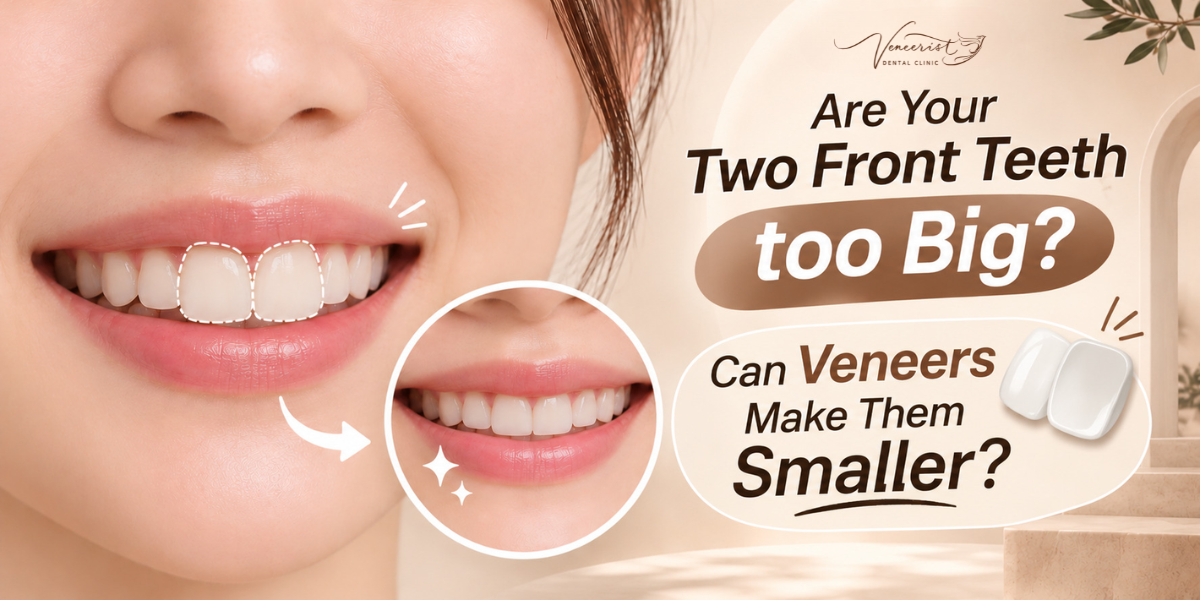
If your two front teeth look too big, dental veneers may help improve their appearance and proportions in certain cases. However, veneers cannot automatically make natural teeth physically smaller. As veneers are restorations bonded to the surface of teeth, reducing the actual size of a tooth may involve removing a small amount of natural tooth structure. Whether this is appropriate depends on the individual tooth, its position and your overall oral health.
Some people feel that their two upper front teeth are too wide, too long, too square or more prominent than the teeth beside them. However, teeth that appear large are not necessarily abnormally sized.
Understanding why your front teeth look prominent is an important first step before considering veneers or any other cosmetic dental treatment.
Important note: This article is intended for general dental education only. It cannot diagnose an individual dental concern or determine which treatment is suitable for you. Tooth shape, enamel thickness, bite alignment and oral health vary from person to person. An accurate diagnosis and personalised treatment recommendation can only be made following a clinical examination by a dentist.
Is It Normal for Your Two Front Teeth to Be Bigger Than the Others?
The two upper front teeth are known as the maxillary central incisors. They play an important role in biting, speaking and the overall appearance of your smile.
These teeth are naturally larger and wider than the lateral incisors immediately beside them. It is therefore completely normal for the two central front teeth to stand out.
However, several factors may make them appear disproportionately large:
- The front teeth are relatively wide compared with their length.
- They have a square or broad shape.
- They appear longer than the neighbouring teeth.
- The lateral incisors are naturally small.
- The front teeth are tilted or positioned further forwards.
- Differences in gum levels make certain teeth look longer or shorter.
- The visible tooth proportions do not appear balanced with the rest of the smile.
Having prominent front teeth does not necessarily indicate a dental abnormality.
The important distinction is whether the teeth are genuinely larger than expected or simply appear larger because of their shape, position or relationship with neighbouring teeth.
Why Do My Two Front Teeth Look So Big?
1. Naturally Large Front Teeth
Some people naturally have wider or longer central incisors.
In certain cases, teeth may be unusually large, a condition known as macrodontia. However, prominent front teeth do not automatically mean that macrodontia is present.
A dentist needs to assess the actual tooth dimensions and their relationship with the surrounding teeth before determining whether their size is unusual.
2. Wide or Square Tooth Shape
Front teeth with a square outline or relatively straight side edges may appear wider than teeth with a more rounded shape.
Even when the actual tooth dimensions are within a normal range, the corners, surface contours and way light reflects from the teeth can influence how large they appear.
3. Smaller Teeth Beside the Front Teeth
Sometimes, the two central incisors are not particularly large. Instead, the lateral incisors beside them are smaller than average.
One example is a peg-shaped lateral incisor, which has a narrower, tapered appearance.
When the neighbouring teeth are small, the two central incisors can look disproportionately large by comparison.
In suitable cases, improving the shape of the smaller neighbouring teeth may create a more balanced smile without reducing the size of the central incisors.
4. Protruding or Tilted Front Teeth
Front teeth that lean or project forwards can appear more prominent, particularly when viewed from the side.
If tooth position is the main reason for their appearance, veneers alone may not address the underlying concern.
Orthodontic treatment may be worth considering, especially when tooth alignment or the bite also needs correction.
5. Gum Levels and Smile Proportions
The position of the gum line affects how much of each tooth is visible.
If the gum levels around the central incisors differ from those around the neighbouring teeth, the front teeth may appear unusually long or prominent.
However, gum contouring does not directly reduce tooth width and is not appropriate for every patient.
Can Veneers Make Large Front Teeth Look Smaller?
Dental veneers are restorations used to modify the visible shape, colour and surface appearance of teeth.
For patients concerned about large front teeth, veneers may sometimes help create a more balanced appearance.
However, it is important to distinguish between making a tooth look smaller and physically reducing its size.
Making Teeth Appear Smaller Through Veneer Design
In certain cases, a dentist may use the shape and contours of a veneer to influence how wide or prominent a tooth appears.
Design considerations may include:
- Softening square-looking corners.
- Adjusting the visible side contours.
- Refining the apparent width-to-length proportions.
- Modifying surface texture and light reflection.
- Creating better visual harmony with neighbouring teeth.
These details may help teeth appear more slender or proportionate without requiring a substantial reduction in their actual dimensions.
However, this approach has limitations, particularly when the natural teeth are already very wide or positioned too far forwards.
Physically Reducing Tooth Size Before Veneers
If the aim is to reduce the actual width, length or prominence of a tooth, some natural tooth structure may need to be removed.
Tooth preparation is irreversible. Once enamel or other tooth tissue has been removed, it does not naturally grow back.
A dentist must therefore consider the amount of available enamel, the position of the tooth, the bite and the requirements of the proposed restoration.
If achieving the desired shape would require excessive tooth reduction, veneers may not be the most appropriate treatment.
Could Veneers Make My Front Teeth Look Even Bigger?
Yes, this is possible if the restoration adds too much thickness or prominence.
Veneers are placed over the existing tooth surface. If a tooth is already wide or protruding, adding material without adequate space may make it look bulkier.
For example, someone with forward-tilted front teeth may find that an additional layer of restorative material makes the teeth appear even more prominent from the side.
This is why the thinnest possible veneer is not necessarily the solution.
The dentist must consider the original tooth shape, available space, bite and final restoration contours.
In some cases, orthodontic treatment may help improve tooth position before restorative treatment is considered, potentially allowing a more conservative approach.
Will My Front Teeth Need a Lot of Shaving Before Veneers?
The amount of tooth preparation required cannot be determined from appearance alone.
Two people with similarly prominent front teeth may have very different treatment needs.
If the teeth are naturally proportionate but look square
Minor contour adjustments may be sufficient in some cases. Veneers may not be necessary.
If the teeth are genuinely wide
Reducing their actual width may require removing some tooth structure. The amount that can be safely removed is limited by enamel thickness, contact areas between teeth and overall dental health.
If the teeth look large because they protrude
Orthodontic treatment may be preferable to removing substantial tooth structure simply to reduce their prominence.
If the neighbouring teeth are small
Improving the shape of the smaller teeth may be considered instead of reducing the central incisors.
The appropriate approach depends on identifying whether the main concern is tooth size, shape or position.
What Are the Alternatives to Veneers for Large Front Teeth?
Veneers are not the only option for improving the appearance of prominent front teeth.
Depending on the cause, other approaches may be more suitable.
1. Enameloplasty (Minor Tooth Contouring)
Enameloplasty involves carefully reshaping a limited amount of enamel.
It may be considered for small adjustments, such as smoothing sharp corners, evening out minor irregularities or refining an uneven incisal edge.
However, enameloplasty can only make limited changes.
Because enamel removal is permanent, it should only be carried out when the dentist considers it safe and appropriate.
2. Composite Bonding on Neighbouring Teeth
If the two central incisors appear large because the lateral incisors are small, composite bonding may help improve the proportions of the surrounding teeth.
This involves adding tooth-coloured composite material to selected areas of the smaller teeth.
It does not physically reduce the size of the central incisors. Instead, it changes the relative proportions of the teeth within the smile.
The dentist must assess available space, tooth contacts and the bite before recommending this approach.
3. Orthodontic Treatment
If the front teeth look prominent because they protrude, tilt or sit out of alignment, orthodontic treatment may be considered.
Orthodontics can change tooth position and alignment, but it does not directly reduce the dimensions of the tooth crowns.
In some cases, correcting tooth position may reduce the need for extensive tooth preparation before any future cosmetic restoration.
4. Composite Veneers
Composite veneers can be used to modify tooth shape and add selected details to the visible surfaces of teeth.
However, composite is an additive material. It cannot directly make an oversized natural tooth smaller unless tooth contouring or preparation is also involved.
Composite restorations also have maintenance requirements and may be susceptible to staining, wear or chipping over time.
5. Ceramic Veneers
Ceramic veneers may be considered when changes to tooth shape, colour and proportions are desired together.
Their design can incorporate adjustments to visible contours, surface texture and translucency to create a natural-looking appearance.
However, ceramic veneers are not suitable for every situation.
If the desired result would require excessive removal of natural tooth structure, another treatment approach may be more appropriate.
Comparing Treatment Options for Large Front Teeth
| Treatment | When It May Be Considered | Main Limitation |
|---|---|---|
| Enameloplasty | Minor adjustments to tooth edges or corners | Limited reduction; enamel removal is irreversible |
| Composite bonding on neighbouring teeth | Central incisors appear large because adjacent teeth are small | Changes relative proportions rather than reducing central incisor size |
| Orthodontic treatment | Teeth are protruding, tilted or misaligned | Does not directly change tooth crown dimensions |
| Composite veneers | Selected improvements to tooth shape | Added material may increase visible bulk |
| Ceramic veneers | Changes to tooth shape, colour and proportions | May require tooth preparation; size reduction is limited |
This comparison is intended as general guidance. It cannot establish which treatment is appropriate without a clinical examination.
Should I Have Veneers on Just My Two Front Teeth or More?
The number of veneers required depends on the existing tooth proportions, colour, bite and treatment goals.
In some cases, treating only the two central incisors may be appropriate, particularly when the surrounding teeth already have harmonious shapes and colours.
However, if the central incisors appear large because the neighbouring teeth are unusually small, the dentist may need to consider the proportions of several teeth.
Assessing several teeth does not mean that veneers must be placed on all of them.
For example, it may be more appropriate to improve the shape of the smaller lateral incisors rather than reduce the two central incisors.
Alternatively, minor contouring may be sufficient when the concern involves only a small difference in tooth shape.
The number of teeth requiring treatment should be determined by clinical findings rather than a fixed cosmetic package or a photograph of someone else’s smile.
What Should Be Assessed Before Having Veneers for Large Front Teeth?
Before recommending treatment, a dentist needs to identify the cause of the concern and evaluate the condition of the teeth.
Important considerations include:
- Actual tooth dimensions: Whether the central incisors are genuinely large or simply appear large in comparison with other teeth.
- Enamel and tooth structure: Whether reshaping or veneer preparation could be carried out conservatively.
- Tooth position and bite: Whether protrusion, tilting or bite forces contribute to the problem.
- Teeth and gum health: Including decay, existing fillings and the condition of the surrounding tissues.
- Neighbouring tooth proportions: Whether changes to other teeth could improve the overall appearance.
- Patient expectations: Whether the main concern is width, length, prominence or a square tooth shape.
Where clinically indicated, the dentist may use dental photographs, impressions, digital scans or radiographs to support the assessment.
These findings are important because teeth that look similar may have different underlying causes and may not benefit from the same treatment.
Can I Preview the Shape of My Teeth Before Getting Veneers?
In suitable cases, smile design may help patients and dentists communicate more clearly about the intended tooth shape and proportions.
Depending on the case, planning may involve photographs, measurements, models or a digital representation of the proposed changes.
For someone concerned about large front teeth, this process may help explore:
- The proposed width and length of the front teeth.
- Whether corners or contours could be refined.
- How neighbouring teeth affect the overall smile.
- Whether tooth alignment should be addressed first.
- Whether the proposed shape is achievable without excessive tooth preparation.
However, a digital preview or model is a planning aid, not a guarantee of the final clinical result.
If the desired shape would require removing too much tooth structure or would create problems with the bite, the dentist should explain those limitations before treatment.
What Are the Risks and Limitations of Veneers for Large Front Teeth?
Although veneers may improve tooth proportions in suitable cases, there are important considerations.
Permanent Removal of Tooth Structure
Reducing the actual size of a tooth may require enamel or other tooth tissue to be removed.
This process is irreversible. Excessive preparation may increase the risk of sensitivity and can affect the conditions needed for reliable bonding.
Teeth Looking Too Bulky
If there is insufficient space for the restoration, veneers may make the teeth look thicker or more prominent than intended.
Veneer Chipping, Fracture or Debonding
Veneers can chip, fracture or become detached.
The risk depends on factors including bite forces, restoration design, tooth preparation and how the teeth are used.
Gum and Cleaning Difficulties
Poorly designed contours or restoration margins may make cleaning more difficult and contribute to plaque accumulation or gum irritation.
Results Differing From Expectations
The final shape is limited by the original tooth structure, alignment and bite.
A particular appearance shown in a photograph or digital preview cannot be guaranteed for every patient.
For these reasons, treatment planning should balance cosmetic goals with the preservation of natural tooth structure and long-term oral health.
How Should You Look After Your Veneers?
If veneers are placed, good oral hygiene and appropriate use of the teeth remain important.
General care recommendations include:
- Brush twice daily with a soft-bristled toothbrush and suitable toothpaste.
- Clean between the teeth using floss or other interdental cleaning aids recommended by your dentist.
- Avoid using your front teeth to open packaging or bite hard objects.
- Avoid habits that may increase the risk of chipping or damaging restorations.
- Tell your dentist if you grind or clench your teeth, as a protective appliance may be recommended.
- Attend dental examinations and follow-up appointments as advised.
If you experience persistent sensitivity, pain, an uncomfortable bite or a chipped or loose veneer, contact a dentist for assessment.
Frequently Asked Questions About Large Front Teeth
Can veneers really make my two front teeth smaller?
Veneers may help teeth appear smaller or more proportionate in certain cases. However, physically reducing tooth dimensions may require removing some natural tooth structure, and the amount of reduction possible is limited.
Do I need veneers if my two front teeth are too big?
Not necessarily. If the concern relates to minor tooth contours, smaller neighbouring teeth or tooth position, alternatives such as enameloplasty, composite bonding or orthodontics may be more appropriate.
Can veneers make already large teeth look bigger?
Yes. If a veneer adds excessive thickness or prominence, the tooth may appear bulkier, particularly when it is already wide or protruding.
Can no-prep veneers make large teeth smaller?
No-prep veneers add material without conventional tooth reduction. They do not physically shrink natural teeth. In some cases, adding material to neighbouring teeth may improve relative proportions, but suitability requires assessment.
Should I get braces or veneers if my front teeth are large and protruding?
If the main concern is tooth position, orthodontic treatment may be more suitable because it can move the teeth. Veneers cannot reposition natural teeth.
Can I have veneers on only my two front teeth?
Yes, in certain cases. The decision depends on tooth health, bite alignment, colour matching and how the two teeth relate to the surrounding smile.
What if my front teeth only look big because the teeth beside them are small?
A dentist may consider improving the shape of the smaller neighbouring teeth using composite bonding or another appropriate restoration, rather than reducing the central incisors.
Can a dentist shave my front teeth down without veneers?
Minor enamel contouring may be possible when only a small adjustment is needed and sufficient enamel is present. More extensive reduction may not be safe or appropriate.
Can veneers make square front teeth look slimmer?
In suitable cases, veneer contours and surface details may create a more slender appearance. However, the proposed shape must remain compatible with the tooth structure, contact points and bite.
How much do veneers for large front teeth cost?
Costs depend on the type of restoration, the number of teeth requiring treatment and whether other dental care is needed. A clinical examination is necessary to discuss suitable options and obtain an individual treatment estimate.
Conclusion: Can Veneers Make Large Front Teeth Look Smaller?
Veneers may help improve the appearance and proportions of two large front teeth, but they cannot make natural teeth physically smaller without limitations.
When teeth are genuinely oversized, reducing their dimensions may involve irreversible tooth preparation.
When the teeth only appear large because they protrude, tilt or sit beside unusually small teeth, orthodontics or adjustments to neighbouring teeth may be more appropriate.
The aim should not simply be to make the two front teeth as small as possible. It should be to achieve proportions that work with the rest of the smile while protecting natural tooth structure.
The information in this article is general guidance only. It cannot confirm which treatment is suitable for an individual patient. Identifying the underlying cause and determining whether veneers can safely improve tooth proportions requires a clinical examination and professional assessment by a dentist.
Consult Veneerist Dental Clinic in Krabi About Your Front Teeth
If your two front teeth appear too wide, square, long or prominent, a dental consultation can help you understand why they look this way and which treatment options may be appropriate.
At Veneerist Dental Clinic Krabi, we offer composite and ceramic veneer treatments, alongside other dental services that may be relevant to tooth shape and alignment concerns.
Any recommendation depends on your oral health, natural tooth structure, bite and individual treatment needs.
A consultation gives you the opportunity to discuss your concerns, understand the possible benefits and limitations of different treatments, and make an informed decision without assuming that veneers are always necessary.
Veneerist Dental Clinic Krabi — Crafting Your Shine
999/9 Maharat Road, Pak Nam, Mueang Krabi, Krabi, Thailand
Google Maps: https://maps.app.goo.gl/AK68wpVnHo4Q5Auw7?g_st=ac
Appointment : Contact Us
We recommend arranging an appointment in advance for a dental examination and consultation.