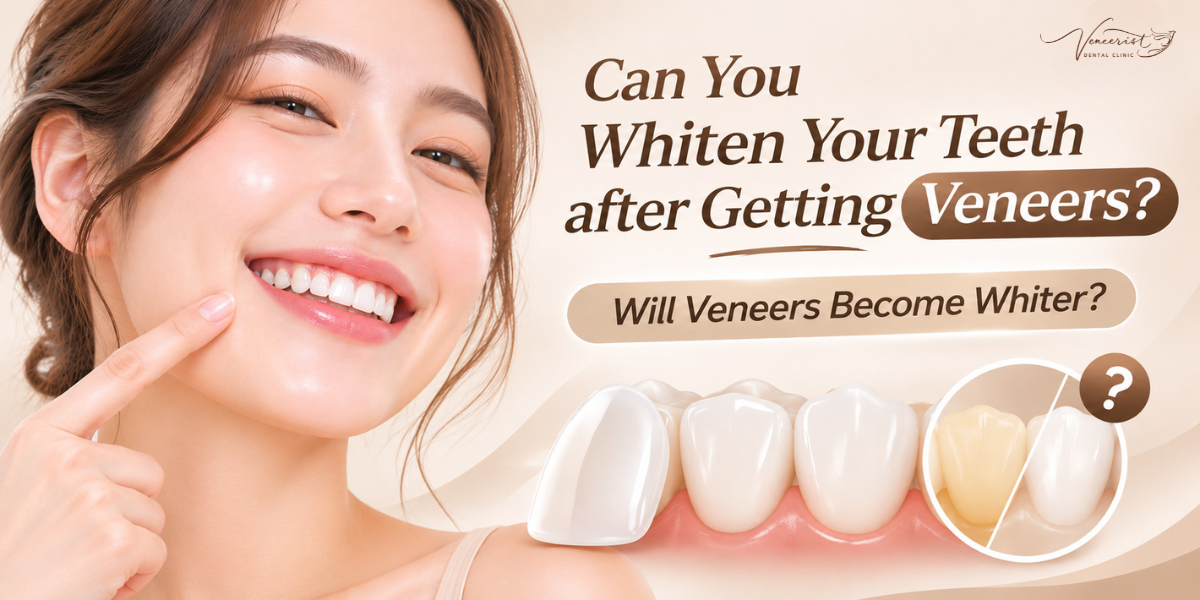
Can You Whiten Your Teeth After Getting Veneers? Should You Have Teeth Whitening Before or After Veneers?
Teeth whitening after veneers is possible for natural teeth, provided that a dentist determines that your oral health is suitable for treatment. However, conventional teeth whitening cannot predictably lighten the shade of dental restorations in the same way as natural teeth.
This limitation applies not only to ceramic and composite veneers but also to dental crowns, bridges, tooth-coloured fillings and implant-supported crowns. These materials have different compositions and properties from natural enamel and dentine, which means they respond differently to whitening agents.
For non-vital teeth or teeth that have previously undergone root canal treatment, conventional external whitening may produce a slight improvement in colour in some cases. However, the results may be limited, particularly when discolouration originates from within the tooth structure. In such situations, single-tooth whitening using an appropriate technique may be considered.
Whether you already have veneers or other dental restorations, or are planning teeth whitening alongside veneer treatment, a dental consultation is important to determine the most suitable approach based on your individual dental condition and aesthetic expectations.
How Does Teeth Whitening Work?
Teeth whitening is a dental procedure designed to lighten the colour of natural teeth. The whitening agents commonly used in dentistry include:
- Hydrogen peroxide
- Carbamide peroxide
These agents can penetrate enamel and dentine and react with coloured compounds within the natural tooth structure, helping the teeth appear brighter.
Teeth whitening is therefore different from professional dental cleaning, scaling or polishing. Rather than simply removing external surface stains, whitening can alter the colour within the natural tooth structure.
Dental restorative materials, such as ceramics and composite resins, have different chemical and physical properties from natural teeth. As a result, they do not respond to whitening agents in the same way.
Why Can Ceramic Veneers Not Be Whitened?
Ceramic veneers are dental restorations manufactured from ceramic materials. Their shade, translucency, opacity and aesthetic characteristics are established during the fabrication process.
The final appearance of a ceramic veneer is influenced by several factors, including:
- The shade of the ceramic material
- The underlying natural tooth colour
- Ceramic thickness
- The translucency and opacity of the ceramic
- The shade of the resin cement
- Surface texture and light reflection
Once ceramic veneers have been bonded to natural teeth, conventional whitening treatments cannot predictably change the intrinsic shade of the ceramic to a lighter shade.
For example, if your existing ceramic veneers were originally designed to match a natural tooth shade, professional teeth whitening cannot subsequently transform the ceramic itself into a significantly brighter bleach shade.
If you wish to change the shade of existing ceramic veneers, your dentist must first assess the reason for the colour concern and discuss the available treatment options. In selected cases, replacing the veneers may be considered.
Can Composite Veneers Be Whitened?
Composite veneers are made from tooth-coloured resin materials applied to the front surfaces of teeth. Their material properties differ from those of ceramic veneers.
Over time, composite materials may develop surface staining, changes in colour or a loss of surface gloss, depending on the material used, dietary habits, oral hygiene and functional wear.
Although certain whitening agents may affect the colour or surface characteristics of composite resin, these changes cannot be controlled or predicted in the same way as the whitening of natural teeth.
Teeth whitening is therefore not considered a reliable method of changing the shade of composite veneers.
If composite veneers become discoloured, the dentist may consider several approaches depending on their condition.
1. Repolishing Composite Veneers
If discolouration is primarily caused by external surface staining, professional cleaning and repolishing may help improve the appearance and restore some of the material’s original surface gloss.
However, polishing does not change the original intrinsic shade of the composite resin to a lighter shade.
2. Repairing or Modifying Existing Composite
Where discolouration or deterioration is limited to a particular area, the dentist may consider repairing or replacing a portion of the existing composite restoration, provided that this is clinically appropriate.
3. Replacing Composite Veneers
If extensive discolouration has developed or the patient wishes to achieve a substantially different overall shade, replacement of the composite veneers may be considered.
Before proceeding, the dentist must assess the condition of the existing restorations, the remaining natural tooth structure and the clinical need for further treatment.
Which Other Dental Restorations Cannot Be Whitened?
The limitations of teeth whitening are not exclusive to veneers. They also apply to patients with other types of dental restorations.
Dental restorations that cannot be predictably lightened through conventional teeth whitening include:
- Ceramic veneers
- Composite veneers
- Dental crowns
- Dental bridges
- Tooth-coloured composite fillings
- Inlays and onlays
- Implant-supported crowns
- Dentures
Although professional cleaning or polishing may remove external stains from certain restorative materials, it does not change their original shade to a lighter one.
For example, a patient may have previously received a tooth-coloured filling on a front tooth that was carefully matched to the surrounding natural enamel.
Following teeth whitening, the natural tooth may become lighter, whilst the existing filling remains close to its original shade. As a result, the difference between the filling and the natural tooth may become more noticeable.
The same principle applies to crowns, bridges and implant-supported crowns located within the visible smile area.
However, having existing dental restorations does not automatically mean that they need to be replaced after whitening.
The dentist must assess the degree of colour mismatch, the condition of the restorations and the health of the underlying natural teeth before recommending additional treatment.
Can Non-vital Teeth or Root-filled Teeth Be Whitened?
Non-vital teeth, sometimes referred to as dead teeth, and teeth that have previously undergone root canal treatment may develop a colour that differs from surrounding natural teeth.
An affected tooth may appear grey, brown or noticeably darker due to changes within its internal structure.
Possible causes of discolouration include:
- Previous dental trauma or injury
- Pulp necrosis
- The breakdown of blood products and internal tissues
- Certain materials used during root canal treatment
- Existing dental restorations or dental posts
Conventional external whitening may produce a slight improvement in the colour of these teeth in some cases. However, their response may differ from that of vital teeth, particularly when discolouration originates from deep within the dentine.
External whitening alone may therefore be insufficient to achieve a satisfactory colour match with neighbouring natural teeth.
In selected cases, the dentist may recommend single-tooth whitening using a technique appropriate to the underlying cause of discolouration.
What Is Single-Tooth Whitening?
Single-tooth whitening, also known as single-tooth bleaching, is an approach for patients who have one or a small number of teeth that differ noticeably in colour from the surrounding teeth.
It may allow the affected tooth to be treated without whitening the entire smile.
The dentist will select an appropriate whitening technique based on the cause of discolouration, the condition of the dental pulp and the overall health of the affected tooth.
For teeth that have previously undergone root canal treatment and have intrinsic discolouration, internal bleaching may be considered where clinically appropriate.
Internal bleaching involves the controlled placement of a whitening agent within the pulp chamber of a root-filled tooth. An appropriate protective barrier is placed above the root canal filling to help prevent the bleaching agent from penetrating areas where it should not be present.
Before recommending treatment, the dentist must assess several factors, including:
- The cause and severity of tooth discolouration
- The condition of the dental pulp
- Root health and the surrounding tissues
- The quality of previous root canal treatment
- The quantity and integrity of remaining natural tooth structure
- Existing dental restorations
- The patient’s expectations regarding tooth colour
If a tooth is non-vital but has not yet received necessary root canal treatment, or if an existing infection requires further management, these concerns must be addressed before internal bleaching is considered.
Internal bleaching also has limitations and potential risks. Discolouration may recur over time, an exact colour match may not be achievable, and there is a risk of external cervical resorption, an uncommon but clinically significant complication.
For these reasons, treatment requires careful assessment, appropriate planning and professional dental supervision.
Single-Tooth Whitening at Veneerist Dental Clinic Krabi
At Veneerist Dental Clinic Krabi, we offer single-tooth whitening for patients who have an individual tooth that differs in colour from the surrounding natural teeth.
Before beginning treatment, patients are required to attend a dental assessment and consultation. The dentist will discuss the cause of discolouration, the patient’s aesthetic concerns, available treatment options and the results that may reasonably be expected based on the individual dental condition.
In selected cases, single-tooth whitening may improve tooth colour without requiring preparation of the external tooth surface for a veneer or crown.
However, if the tooth has structural limitations or whitening alone cannot adequately address the discolouration, the dentist may recommend a veneer, crown or another appropriate restorative treatment.
The priority is to select an approach that considers both the preservation of natural tooth structure and the overall appearance of the smile.
How Do Natural Teeth and Dental Restorations Respond to Teeth Whitening?
| Tooth or Restoration | Response to Whitening | Potential Treatment Approach |
|---|---|---|
| Vital natural teeth | May become lighter following appropriate whitening treatment | Professional or dentist-supervised whitening |
| Untreated non-vital teeth | External whitening may produce some colour change, but underlying dental health must be addressed first | Clinical assessment and necessary dental treatment |
| Root-filled teeth | External whitening may produce limited improvement | Single-tooth whitening using an appropriate technique |
| Ceramic veneers | Conventional whitening cannot predictably lighten the intrinsic ceramic shade | Professional cleaning or replacement where appropriate |
| Composite veneers | Colour changes cannot be reliably controlled through conventional whitening | Repolishing, repair or replacement |
| Tooth-coloured fillings | Do not whiten predictably in the same way as natural teeth | Polishing, repair or replacement where appropriate |
| Dental crowns and bridges | Conventional whitening cannot predictably lighten the restorative material | Cleaning or assessment for replacement |
| Implant-supported crowns | Do not respond to whitening like natural teeth | Assessment of the existing crown’s condition and shade |
| Dentures | Cannot be predictably lightened using conventional natural tooth whitening | Appropriate denture cleaning or assessment for replacement |
These differences highlight the importance of informing your dentist about previous dental treatment and existing restorations before undergoing teeth whitening.
Can You Whiten Your Lower Teeth If You Only Have Upper Veneers?
Yes. Patients who have veneers on their upper teeth may be able to whiten their natural lower teeth, provided that their dentist determines that they are suitable for treatment.
Some patients choose ceramic veneers for their upper front teeth to improve colour, shape and proportions whilst retaining their natural lower teeth.
Over time, natural lower teeth may become darker due to ageing, dietary habits or other factors. This can make the colour difference between upper veneers and lower natural teeth more noticeable.
Whitening the lower teeth may help reduce this difference without necessarily requiring additional veneers solely for aesthetic reasons.
However, the dentist must consider several factors, including:
- The existing shade of the upper veneers
- The underlying colour of the lower natural teeth
- The likely response of the natural teeth to whitening
- The visibility of upper and lower teeth when speaking and smiling
- Tooth and gum health
- The patient’s aesthetic expectations
It is not possible to guarantee that whitening the lower teeth will produce an exact colour match with existing upper veneers, particularly when those veneers have a very bright shade.
The objective should be to achieve a harmonious smile within the limitations of the individual’s natural teeth.
Can You Whiten Other Natural Teeth If You Only Have a Few Veneers?
Whitening other natural teeth may be possible. However, the relationship between the colour of the existing veneers and the surrounding teeth must be carefully considered.
For example, a patient may have four ceramic veneers on the upper front teeth that were originally designed to match the surrounding natural teeth.
If the patient subsequently undergoes teeth whitening, the neighbouring natural teeth may become lighter, whilst the intrinsic shade of the ceramic remains unchanged.
This may result in a more noticeable difference between the existing veneers and the whitened natural teeth.
Conversely, if the natural teeth are initially darker than the existing veneers, whitening may help improve the overall colour harmony.
For this reason, the dentist should assess the purpose of whitening and the relationship between individual tooth shades before recommending treatment.
Should You Have Teeth Whitening Before or After Veneers?
If you are planning teeth whitening alongside veneers or other aesthetic dental restorations, it is generally advisable to consider whitening your natural teeth before selecting the final shade of the restorations.
This is because natural teeth can respond to whitening agents, whereas restorative materials cannot be predictably lightened in the same way.
Scenario 1: You Are Planning Veneers on Selected Front Teeth
If neighbouring natural teeth remain visible when you smile, whitening them beforehand may help the dentist determine an appropriate veneer shade based on the colour of the natural teeth after whitening.
Scenario 2: You Are Planning Upper Veneers Only
If you also wish to improve the colour of your lower natural teeth, whitening the lower teeth before selecting the final upper veneer shade may help the dentist assess the colour relationship between both dental arches.
Scenario 3: You Are Planning a Single Veneer
A single veneer requires careful colour matching with the surrounding natural teeth.
If you also intend to whiten your other teeth, you should discuss this with your dentist before the final veneer shade is selected.
Scenario 4: You Are Planning Crowns, Bridges or Tooth-Coloured Fillings
The same principles apply to crowns, bridges, implant-supported crowns and tooth-coloured fillings, particularly those within the visible smile area.
If whitening is part of your intended treatment plan, discuss the appropriate treatment sequence with your dentist before selecting the final restorative shade.
However, necessary treatment for dental decay, infection or other oral health concerns should not be delayed solely for cosmetic whitening purposes.
Scenario 5: You Are Satisfied With Your Natural Tooth Colour
If you are already satisfied with the shade of your natural teeth, or whitening is unnecessary within your treatment plan, there is no requirement to whiten your teeth before receiving veneers.
Teeth whitening is not a mandatory part of veneer treatment. Its suitability depends on individual dental conditions, treatment objectives and patient preferences.
How Long Should You Wait After Teeth Whitening Before Getting Veneers?
Following teeth whitening, the dentist may recommend allowing a suitable interval before selecting the final restoration shade or bonding veneers to previously whitened natural teeth.
There are two important reasons for this.
1. Allowing Tooth Colour to Stabilise
Immediately after whitening, teeth may appear brighter than their eventual shade due to temporary dehydration and other factors associated with the whitening process.
As the teeth rehydrate and their colour stabilises, the dentist can assess the shade more accurately when designing veneers or other dental restorations.
2. Supporting Suitable Bonding Conditions
Peroxide-based whitening agents may temporarily interfere with the polymerisation of resin-based materials and affect adhesive bond strength to enamel and dentine.
An interval of approximately two weeks is one approach that may be considered when planning adhesive restorative procedures on recently whitened teeth.
However, the appropriate interval depends on several factors, including the whitening agent, its concentration, the treatment technique, the teeth that have been whitened and the adhesive system being used.
For example, if only the lower teeth are whitened before selecting the shade of upper veneers, the main consideration may be colour stabilisation rather than the effect of whitening agents on bonding to upper teeth that have not been whitened.
The dentist should therefore establish the treatment sequence and timing according to the individual clinical circumstances.
Can Teeth Whitening Damage Existing Veneers or Cause Them to Come Off?
Having veneers does not automatically prevent you from whitening other natural teeth. Nor does it mean that whitening will necessarily cause existing veneers to become detached.
However, before whitening treatment, the dentist should assess the condition of existing veneers and the patient’s oral health.
Important considerations include:
- The structural integrity of the veneers
- The condition and adaptation of restoration margins
- Chipping or fractures
- Dental decay around restoration margins
- Gum recession or exposed root surfaces
- Previous tooth sensitivity
- The type of restorative material and proposed whitening agent
If a veneer is damaged, has compromised margins or is associated with underlying dental decay, these concerns may need to be addressed before whitening.
Certain whitening agents may also affect the surface properties of restorative materials, depending on their composition, the concentration of the whitening agent and the duration of exposure.
Selecting an appropriate whitening technique and controlling exposure to the whitening agent are therefore important when existing dental restorations are present.
Why Do Veneers Sometimes Appear Yellow or Darker Over Time?
If your veneers appear to have changed colour, this does not necessarily mean that the restorative material itself has discoloured or that all your veneers need to be replaced.
Several factors may contribute to changes in their appearance.
1. External Surface Staining
Tea, coffee, red wine, tobacco and certain foods may contribute to staining on restorative surfaces or around restoration margins.
If discolouration is caused primarily by external staining, professional cleaning may help improve the appearance.
2. Changes in Composite Resin
Composite veneers may develop discolouration, surface wear or a loss of gloss over time.
Repolishing may improve surface-related concerns. However, deeper discolouration within the material may require repair or replacement where clinically appropriate.
3. Changes in the Natural Tooth Beneath a Veneer
Ceramic veneers have different levels of translucency. Consequently, changes in the colour of the underlying natural tooth may influence the appearance of the veneer.
Previous trauma, changes within the dental pulp or other causes of intrinsic tooth discolouration may affect the overall appearance of the restoration.
In such situations, the underlying dental condition must be investigated before cosmetic treatment is considered.
4. Changes Around Veneer Margins or Bonding Materials
Staining around restoration margins, changes in resin cement or marginal deterioration may cause localised darkening.
A discoloured margin does not automatically indicate dental decay or the need to replace a veneer. A clinical examination is necessary to determine the cause.
5. Changes in the Colour of Neighbouring Teeth
Sometimes, the veneers themselves have not changed colour. Instead, the surrounding natural teeth may have become lighter or darker, making the existing restorations appear less harmonious.
A careful shade assessment can help identify the reason for the perceived colour difference and guide appropriate treatment.
Can Professional Cleaning, Scaling or AIRFLOW Make Veneers Whiter?
Professional dental cleaning, scaling, polishing and AIRFLOW treatment serve different purposes from teeth whitening.
Removing dental plaque, calculus and external surface stains may improve the cleanliness and appearance of natural teeth and dental restorations.
However, these procedures cannot change the original intrinsic shade of ceramic veneers, composite veneers, crowns or other restorative materials to a lighter shade.
For patients with veneers, appropriate instruments, polishing materials and air-polishing powders should be selected according to the type of restoration.
This helps minimise unnecessary surface roughness or loss of gloss.
Professional cleaning should therefore be regarded as part of maintaining dental restorations and oral health rather than a method of changing veneer shade.
Do Veneers Need to Be Replaced If You Want a Brighter Shade?
If a patient wishes to achieve a substantially lighter ceramic veneer shade, replacement may be an option capable of addressing that aesthetic concern.
However, existing veneers should not be replaced solely on the basis of colour preferences without an appropriate assessment of the underlying teeth and restorations.
The dentist must consider factors such as:
- The age and condition of the existing veneers
- The integrity of the underlying natural teeth
- The amount of remaining enamel and dentine
- Gum health and bite
- The potential loss of natural tooth structure during veneer removal
- The difference between the existing and desired shade
Even when existing veneers no longer match a patient’s preferred tooth colour, the benefits of replacement should be carefully weighed against its potential risks, particularly if the restorations remain clinically sound.
For composite veneers, localised modification, repair or partial replacement may be possible in selected cases.
The same principle applies to existing crowns and tooth-coloured fillings. A colour mismatch following whitening does not automatically mean that every restoration needs to be replaced.
Treatment decisions should be guided by individual dental health, the preservation of natural tooth structure and clinical judgement.
Can Natural Teeth Be Whitened to Match Very Bright Veneers?
Natural teeth vary in their underlying colour, enamel thickness and dentine characteristics.
As a result, teeth whitening cannot guarantee that every patient will achieve the same level of brightness or the same tooth shade.
If veneers have been designed using particularly bright ceramic shades, sometimes referred to as bleach shades, it may not be possible to whiten the surrounding natural teeth to an identical shade.
A harmonious smile also depends on more than simply how white the teeth appear.
Important aesthetic characteristics include:
- Brightness or value
- Colour intensity or chroma
- Hue
- Translucency at the incisal edges
- Surface texture and light reflection
- The natural teeth visible when speaking and smiling
Even when teeth have similar shades, differences in their optical characteristics and surface details may still be noticeable.
When selecting a veneer shade, dentists should therefore consider the surrounding natural teeth and overall smile rather than choosing a shade based solely on its brightness.
Can You Use Whitening Toothpaste or Whitening Strips After Getting Veneers?
Different whitening products work in different ways and have their own limitations.
Whitening Toothpaste
Many whitening toothpastes primarily help remove external surface stains. They cannot change the intrinsic shade of ceramic veneers.
Patients with composite veneers should be particularly cautious when using highly abrasive toothpastes, as prolonged use may affect the smoothness and gloss of composite restorations.
Your dentist can advise you on a suitable toothpaste based on the condition of your teeth and existing restorations.
Whitening Strips
Whitening strips may lighten natural teeth, but they cannot predictably change the colour of veneers, crowns or fillings to match the newly whitened teeth.
Using whitening strips without considering the location and shade of existing restorations may therefore result in a more noticeable colour mismatch.
Dentist-Supervised Home Teeth Whitening
Dentist-supervised home whitening may be suitable for patients who wish to improve the colour of their natural teeth whilst retaining existing veneers.
The dentist can assess which teeth require whitening and determine whether customised whitening trays are appropriate.
Patients should not independently increase the concentration of whitening agents or extend treatment beyond professional recommendations in an attempt to match the colour of existing veneers.
Doing so may increase the risk of tooth sensitivity and gum irritation without necessarily achieving the desired colour.
How Does Veneerist Dental Clinic Krabi Plan Teeth Whitening Alongside Veneer Treatment?
At Veneerist Dental Clinic Krabi, treatment planning considers individual oral health, natural tooth colour, existing dental restorations and the overall harmony of the smile.
The assessment and treatment planning process may involve the following stages.
Step 1: Assessing Oral Health
The dentist examines the teeth, gums, existing fillings, crowns and veneers.
Previous root canal treatment, tooth sensitivity and other factors that may affect suitability for whitening are also considered.
Step 2: Discussing Patient Expectations and Assessing Tooth Colour
The dentist discusses the patient’s aesthetic concerns and evaluates the shades of natural teeth and existing restorations, including the teeth visible when speaking and smiling.
Patients are informed about the limitations of whitening, particularly when veneers, crowns or fillings are already present.
Step 3: Selecting an Appropriate Whitening Approach
If the patient wishes to combine teeth whitening with veneer treatment, the dentist considers whether whitening should be completed before selecting the final restoration shade.
For patients with existing veneers, the dentist assesses whether whitening the surrounding natural teeth may improve colour harmony.
If only one or a small number of teeth are noticeably darker, single-tooth whitening may be considered after investigating the underlying cause of discolouration.
Step 4: Reassessing Tooth Colour After Whitening
Where whitening is performed before veneer or restorative treatment, the dentist determines when the tooth colour should be reassessed.
This allows the final restoration shade to be planned with consideration of the stabilised natural tooth colour.
Step 5: Designing or Assessing Dental Restorations
For new veneers, treatment planning considers colour, shape, proportions, translucency and surface characteristics.
Where existing veneers or other restorations no longer harmonise with the natural teeth, the dentist may consider professional cleaning, repolishing, repair or replacement according to the clinical indications.
Patients with similar aesthetic goals may therefore receive different treatment recommendations depending on their individual dental conditions.
How to Maintain the Colour of Natural Teeth and Veneers
Although ceramic veneers generally have good colour stability and resistance to staining, maintaining oral health remains important for the restorations, their margins and the surrounding natural teeth.
Recommended care includes:
- Brushing twice daily with a soft-bristled toothbrush and fluoride toothpaste
- Cleaning between the teeth regularly with dental floss or suitable interdental cleaning aids
- Avoiding unnecessarily abrasive dental products
- Rinsing with water after consuming strongly coloured foods or drinks
- Avoiding tobacco use
- Avoiding unregulated whitening products and corrosive home remedies
- Attending regular dental examinations and professional cleaning as recommended by your dentist
If natural teeth gradually become darker, additional whitening may be considered where appropriate, taking into account oral health and the shade of existing restorations.
There is no universal schedule for repeat whitening that applies to every patient.
If an individual tooth becomes noticeably darker, particularly after an injury, or if discolouration is accompanied by pain, gum swelling or discomfort when biting, arrange a dental assessment before considering whitening.
How Much Does Teeth Whitening Cost If You Already Have Veneers?
The cost of teeth whitening depends on the treatment technique, oral health, the teeth requiring whitening and whether existing restorations need additional care.
Patients who wish to improve the colour of their natural teeth to complement clinically sound veneers may not require replacement of their existing restorations.
For patients considering single-tooth whitening, the cost may differ from conventional whitening because the underlying cause of discolouration, tooth health, appropriate technique and potential additional treatment must be considered.
If existing dental restorations require repolishing, repair or replacement, the overall cost will depend on the individual treatment plan.
A dental consultation is recommended to determine the most appropriate options and provide an individual treatment estimate.
Frequently Asked Questions About Teeth Whitening After Veneers
Can you whiten your teeth after getting veneers?
Yes. Natural teeth may be whitened if your dentist determines that treatment is appropriate. However, whitening cannot predictably lighten the shade of existing veneers in the same way as natural teeth.
Can ceramic veneers be whitened?
Conventional teeth whitening cannot reliably lighten the intrinsic shade of ceramic veneers. If a substantial shade change is desired, replacement may be considered following a clinical assessment.
Can yellow composite veneers be whitened?
Whitening is not a predictable method of changing the shade of composite veneers.
Professional cleaning and repolishing may improve external staining, whilst deeper material discolouration may require repair or replacement.
Can crowns and tooth-coloured fillings be whitened?
No. Conventional whitening cannot predictably lighten crowns or fillings in the same way as natural teeth.
This also applies to bridges, implant-supported crowns and other dental restorative materials.
Will my existing fillings look different after teeth whitening?
They may. Natural teeth can become lighter following whitening, whilst existing fillings may remain close to their original shade.
If the difference becomes noticeable, the dentist can assess whether modification or replacement is appropriate.
Can a dead tooth be whitened using conventional teeth whitening?
External whitening may produce a slight improvement in the colour of a non-vital or root-filled tooth in some cases.
However, the results may be limited, particularly when discolouration originates from within the tooth structure. The underlying cause should be assessed before selecting a whitening technique.
Can you whiten just one dark tooth?
Yes, single-tooth whitening may be possible where clinically appropriate.
Veneerist Dental Clinic Krabi offers single-tooth whitening, subject to an individual dental assessment and consultation before treatment.
Should a root-filled tooth receive single-tooth whitening or a veneer?
This depends on the cause of discolouration, root health and the amount of remaining natural tooth structure.
If the tooth is structurally sound and the concern is primarily related to colour, single-tooth whitening may offer a conservative treatment option.
Where structural or aesthetic limitations are present, a veneer, crown or another restoration may be more appropriate.
Can you whiten lower teeth if you have upper veneers?
Yes, subject to a dental assessment.
Whitening the natural lower teeth may improve colour harmony with upper veneers, although an exact shade match cannot be guaranteed.
Does everyone need teeth whitening before getting veneers?
No. Whitening is not a mandatory step in veneer treatment.
It may be considered when the patient wishes to improve the colour of natural teeth before selecting the final veneer shade.
Can teeth whitening and veneer bonding be performed on the same day?
When veneers are to be bonded to recently whitened teeth, an appropriate waiting period should generally be considered to support suitable bonding conditions and colour stabilisation.
The dentist should determine the timing according to the whitening technique and restorative treatment plan.
Can teeth whitening cause veneers to come off?
Teeth whitening does not automatically cause existing veneers to become detached.
However, the condition of the veneers, their margins and the proposed whitening technique should be assessed before treatment.
Does professional polishing make veneers whiter?
Professional polishing may remove surface stains and improve the appearance of certain restorations.
However, it cannot change the original intrinsic shade of veneers to a lighter shade.
Do all veneers need to be replaced if they no longer match the natural teeth?
Not necessarily. The dentist must first determine the cause of the colour mismatch.
Depending on the findings, options may include whitening the natural teeth, cleaning or polishing existing restorations, modifying composite restorations or replacing selected restorations where appropriate.
Conclusion: Can You Whiten Your Teeth After Getting Veneers?
Patients with existing veneers may be suitable for natural teeth whitening. However, conventional whitening cannot predictably change the shade of dental restorations in the same way as natural teeth.
This limitation applies to ceramic veneers, composite veneers, crowns, bridges, tooth-coloured fillings and implant-supported crowns.
If teeth whitening and restorative treatment are planned together, it is generally advisable to consider whitening the natural teeth before selecting the final shade of the restorations.
For non-vital or previously root-treated teeth, external whitening may offer a slight improvement in colour in some cases. Where intrinsic discolouration is more pronounced, single-tooth whitening using an appropriate technique may be considered following a dental assessment.
Because natural tooth colour, oral health and existing restorations vary between individuals, there is no single whitening approach suitable for every patient.
The objective of treatment is not necessarily to achieve the whitest possible teeth, but to create a harmonious smile whilst maintaining oral health and preserving natural tooth structure where possible.
Consult Veneerist Dental Clinic Krabi About Teeth Whitening and Veneers
If you already have veneers, crowns or fillings and are concerned that their colour no longer matches your natural teeth, or if you have an individual tooth that appears noticeably darker, a professional dental consultation can help you better understand your treatment options.
At Veneerist Dental Clinic Krabi, we offer conventional teeth whitening and single-tooth whitening, alongside individual treatment planning for patients considering veneers and other dental restorations.
Before treatment begins, the dentist will assess your oral health, discuss your aesthetic expectations and explain the available treatment options and their limitations.
Our approach considers natural tooth preservation, dental health and the individual characteristics of your smile.
Because a beautiful smile does not necessarily need to be the whitest. It should feel harmonious and reflect your individuality.
Visit the Veneerist Dental Clinic Krabi website to learn more about our dental services or contact our team to arrange a consultation.
Veneerist Dental Clinic Krabi — Crafting Your Shine
999/9 Maharat Road, Pak Nam, Mueang Krabi, Krabi, Thailand
Advance appointments are recommended.