Why Do Dentists Recommend Dental Implants After Tooth Extraction?
After having a tooth extracted, many people assume that their dental treatment is complete. Once the painful or damaged tooth has been removed, there may seem to be no reason for further treatment, particularly if the missing tooth is at the back of the mouth and is not visible when smiling.
However, your dentist may recommend considering a dental implant after tooth extraction.
Does this mean everyone needs an implant after losing a tooth? What happens if the gap is left untreated? And are dental implants always the best option?
The answer is that not everyone needs a dental implant after tooth extraction. Whether a missing tooth should be replaced depends on its position, the condition of the remaining teeth, your bite, oral health and individual circumstances.
This article explains why dentists may recommend dental implants, what can happen after tooth loss, the risks and limitations of implant treatment, and the alternatives available.
Do You Always Need to Replace a Tooth After Extraction?
No. Not every extracted tooth needs to be replaced.
The decision depends on several factors, including the position of the missing tooth, the number and condition of the remaining teeth, chewing function and the way the upper and lower teeth meet.
For example, wisdom teeth that are removed because they are impacted or causing problems generally do not need to be replaced.
In other situations, particularly when a tooth plays an important role in chewing or maintaining the bite, replacing it may be beneficial.
Depending on the clinical circumstances, your dentist may discuss options such as dental implants, dental bridges or dentures.
The goal is not to replace every missing tooth automatically, but to determine whether replacing it would benefit your oral health, function or appearance.
What Happens If You Do Not Replace a Missing Tooth?
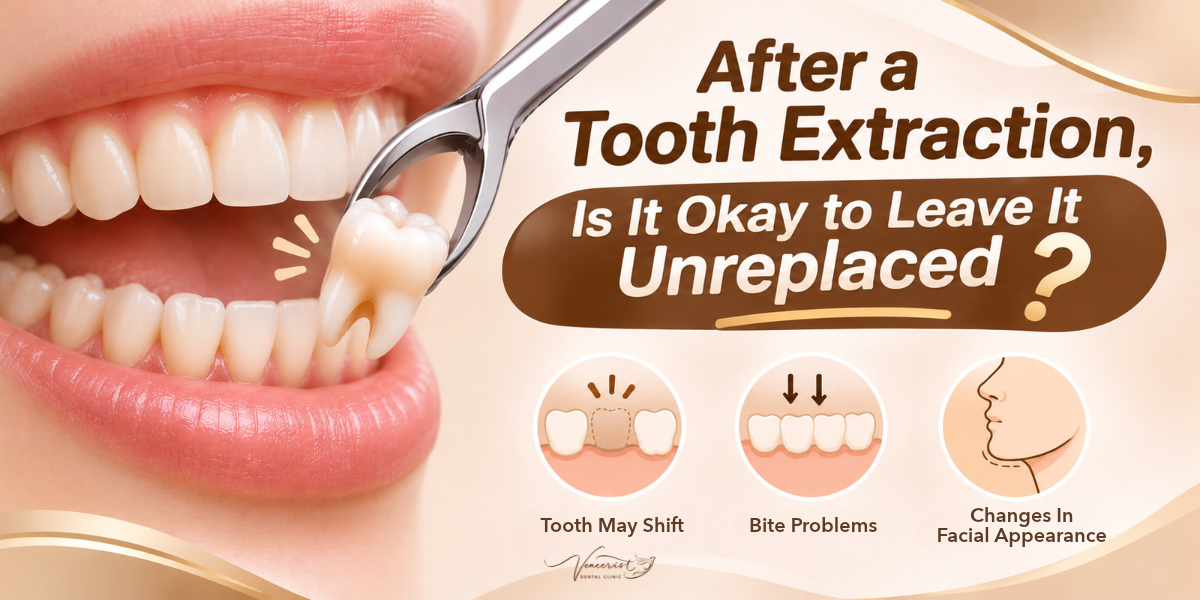
Leaving a gap after tooth extraction does not always cause problems. However, certain changes may occur over time, depending on the location of the missing tooth and the condition of the surrounding teeth and tissues.
1. Neighbouring Teeth May Tilt Into the Gap
Natural teeth maintain their positions partly through contact with neighbouring teeth and their relationship with the opposing teeth.
When a tooth is lost, adjacent teeth may gradually tilt or move towards the empty space.
In some cases, this movement can create areas where food becomes trapped, make cleaning more difficult or alter the bite.
However, the amount of tooth movement varies between individuals, and not everyone will experience significant changes.
2. The Opposing Tooth May Move Into the Empty Space
When an upper and lower tooth normally meet during biting, they help maintain a functional relationship.
If one tooth is removed, the opposing tooth may gradually move further into the space where the missing tooth used to be.
This is known as supraeruption.
For example, if a lower molar is removed, the opposing upper molar may gradually move downwards.
In some cases, this can reduce the space available for a future dental restoration and make treatment more complicated.
3. Jawbone Changes Can Occur After Extraction
The alveolar bone is the part of the jawbone that supports the roots of natural teeth.
Following tooth extraction, the socket undergoes a natural healing and remodelling process. This commonly involves some reduction in bone volume, particularly during the first few months.
Changes in the width and height of the remaining ridge may affect future treatment options.
If a patient decides to have a dental implant later, the dentist must assess whether there is enough bone to support it.
In some cases, additional procedures such as bone grafting may be necessary.
Importantly, placing a dental implant does not completely prevent the natural bone changes that occur after tooth extraction.
4. Chewing Function May Be Affected
Different teeth perform different functions during biting and chewing.
Losing a tooth that contributes significantly to chewing may make eating certain foods more difficult.
Some patients may begin chewing predominantly on the opposite side of their mouth.
The effect depends on which tooth is missing, how many teeth remain and the overall condition of the bite.
5. Appearance and Speech May Be Affected
Losing a front tooth can affect the appearance of a smile and the pronunciation of certain sounds.
Changes in the surrounding gum and bone may also influence the shape of the area where the tooth was lost.
These factors can be particularly important when planning a natural-looking replacement for a front tooth.
Why Might a Dentist Recommend a Dental Implant After Tooth Extraction?
A dental implant is a medical device placed into the jawbone to support a replacement tooth or another dental restoration.
Dental implants are one of several treatment options for replacing missing teeth.
Your dentist may recommend considering an implant for the following reasons.
1. Replacing a Tooth Without Preparing Neighbouring Teeth
For a single missing tooth, an implant-supported crown can often be placed without using the adjacent teeth for support.
This differs from a conventional tooth-supported dental bridge, which commonly requires the neighbouring teeth to be prepared.
An implant may therefore be worth considering when the adjacent teeth are healthy and preserving their existing structure is a priority.
However, the patient must have suitable bone and soft tissue conditions, or be able to undergo any necessary preparatory treatment.
2. Restoring Chewing Function
An implant-supported crown can help restore the chewing surface of a missing tooth.
This may improve chewing comfort and function, particularly when the missing tooth has affected the patient’s ability to eat.
The result depends on the overall bite, the remaining teeth and the design of the restoration.
3. Helping Maintain the Dental Arch
Replacing a missing tooth may help reduce the risk of certain unwanted movements of adjacent or opposing teeth.
However, if significant tooth movement has already occurred, additional treatment may be required before a suitable replacement can be provided.
4. Providing an Alternative to Removable Dentures
Some patients prefer a fixed tooth replacement rather than a removable denture.
An implant-supported restoration may be an option in suitable cases.
Nevertheless, removable dentures remain an appropriate and practical treatment choice for many patients, depending on their oral health, preferences and budget.
5. Transferring Chewing Forces to the Surrounding Bone
Once an implant has integrated with the jawbone and is restored, chewing forces can be transmitted through the implant to the surrounding bone.
However, this should not be interpreted as a guarantee that an implant will prevent all bone loss or changes in the jawbone.
Who May Be Suitable for Dental Implants?
Dental implants can be an effective treatment option for selected patients, but suitability must be assessed individually.
A patient may be a suitable candidate if they:
- Have one or more missing teeth that would benefit from replacement.
- Have healthy gums or periodontal conditions that can be appropriately managed.
- Have sufficient jawbone, or may be suitable for bone augmentation.
- Have a medical history compatible with the proposed surgery and healing process.
- Are able to maintain good oral hygiene and attend follow-up appointments.
- Understand the treatment stages, risks, costs and maintenance requirements.
Suitability cannot be determined from age or the number of missing teeth alone.
A dental examination, relevant medical history and appropriate imaging may be necessary before treatment can be recommended.
Who May Not Be Suitable for Dental Implants?
Dental implants are not the right treatment for everyone.
Certain conditions may increase the risk of complications or require additional treatment before implant placement.
These include:
Active Gum Disease
Patients with active periodontal disease may require treatment to control infection and inflammation before an implant can be considered.
Poorly Controlled Diabetes
Poorly controlled diabetes may affect wound healing and increase the risk of complications.
However, having diabetes does not automatically mean that dental implant treatment is impossible. The level of disease control and other individual factors must be assessed.
Smoking
Smoking is associated with an increased risk of implant-related complications and can negatively affect healing.
Patients who smoke should discuss these risks with their dentist before treatment.
Insufficient Jawbone
Some patients may not have enough bone to support an implant in the desired position.
Bone grafting or other procedures may be considered in selected cases, but these are not always suitable or necessary.
Certain Medical Conditions or Medications
Some medical conditions, previous treatments and medications may affect surgical risk, bone healing or the suitability of implant treatment.
Patients should inform their dentist about their complete medical history, including any medicines they are taking.
Patients Who Prefer to Avoid Surgery
Implant placement involves a surgical procedure.
Patients who do not wish to undergo surgery, cannot commit to the treatment process or have financial limitations may prefer to consider a bridge or removable denture.
These factors do not always mean that implant treatment is permanently unsuitable. In some cases, treatment may become possible after appropriate medical or dental management.
The decision should be based on an individual clinical assessment.
What Are the Risks and Disadvantages of Dental Implants?
Although dental implants are widely used, they have limitations and potential complications that patients should understand before treatment.
1. Implant Placement Requires Surgery
Possible surgical complications include pain, swelling, bleeding, infection and injury to nearby anatomical structures.
2. Treatment May Take Several Months
Implants generally require a healing period during which the surrounding bone integrates with the implant surface.
Some patients may need multiple appointments or additional procedures.
3. Additional Bone Grafting May Be Necessary
If the available bone is insufficient, bone augmentation may be required.
This can increase treatment time, complexity and cost.
4. Implants Can Fail
An implant may fail to integrate with the bone or lose stability after a period of function.
Risk factors vary, and no implant treatment can be guaranteed to succeed.
5. Inflammation Can Develop Around Implants
Although dental implants cannot develop tooth decay like natural teeth, the surrounding gum and bone can become inflamed.
Conditions such as peri-implant mucositis and peri-implantitis may occur and require professional assessment and management.
6. Long-Term Maintenance Is Necessary
Implants require regular cleaning, dental examinations and appropriate maintenance.
The crown or other components may also require repair or replacement over time.
Dental implants are not maintenance-free replacements for natural teeth, and they cannot be guaranteed to last a lifetime.
Can You Have a Dental Implant Immediately After Tooth Extraction?
In selected cases, an implant can be placed into the extraction site during the same appointment as the tooth removal.
This is known as immediate implant placement.
However, immediate placement is not appropriate for every patient.
The dentist must assess factors such as bone availability, the condition of the extraction socket, surrounding tissues, the presence of infection and whether the implant can achieve sufficient initial stability.
It is also important to distinguish between placing an implant immediately and attaching a final tooth restoration immediately.
An implant placed on the day of extraction does not necessarily mean that a permanent crown can be fitted and used normally on the same day.
Other Implant Placement Timings
In some cases, the dentist may recommend waiting for the gum and extraction site to heal before placing the implant.
Other patients may require a longer healing period or additional procedures before implant placement.
There is no single waiting period that is suitable for everyone.
If you know that a tooth needs to be extracted and are considering an implant, discussing replacement options before the extraction may help with treatment planning.
What If You Are Not Ready for a Dental Implant?
Some patients may not be ready for implant treatment because of financial considerations, time constraints, health conditions or personal preferences.
If you may want an implant in the future, it is worth discussing this with your dentist before or soon after extraction.
Depending on the circumstances, your dentist may recommend monitoring the gap, considering a temporary denture or evaluating whether a socket preservation procedure would be beneficial.
Socket preservation is a procedure intended to help reduce certain changes in the bone ridge following tooth extraction.
It is not necessary for every patient and does not guarantee that additional bone grafting will never be needed.
Dental Implants vs Bridges vs Dentures: Which Is Better?
Dental implants are not the only way to replace missing teeth.
The most suitable option depends on the number and position of missing teeth, the condition of the remaining teeth, oral health, treatment preferences and budget.
| Treatment | How It Works | Important Considerations |
|---|---|---|
| Dental implant | An implant fixture is placed in the jawbone to support a replacement tooth | Requires surgery and suitable clinical conditions; may preserve adjacent tooth structure |
| Dental bridge | A fixed restoration is supported by adjacent teeth or implants | Conventional tooth-supported bridges commonly require preparation of supporting teeth |
| Removable denture | A removable appliance replaces one or more missing teeth | Does not necessarily require implant surgery, but retention, comfort and maintenance must be considered |
Explore Your Tooth Replacement Options
If you are considering replacing a missing tooth, you can learn more about dental implant treatment at Veneerist or explore our denture services.
Each option has advantages, disadvantages and different treatment requirements.
A dental examination can help determine which approach may be appropriate for your situation.
How Much Does a Dental Implant Cost?
Cost is an important consideration when deciding whether to have a dental implant.
Implant treatment may involve several stages, rather than a single procedure.
Depending on the clinical circumstances, the overall cost may include:
- Dental examinations and diagnostic imaging
- Implant placement surgery
- The abutment and final dental crown
- Bone grafting or other preparatory procedures, when necessary
- Additional dental treatment required before implant placement
The total cost can therefore vary between patients according to the position of the missing tooth, the available bone, the restoration required and the complexity of treatment.
Before proceeding, patients should ask which procedures are included in their proposed treatment quotation and whether additional costs may arise.
For those with a limited budget, removable dentures or dental bridges may be worth discussing as alternatives.
You can view the clinic’s published fees on our Veneerist Dental Clinic Price List and learn more about our Dental Implant Services.
The decision should consider clinical suitability, treatment costs, long-term maintenance and personal preferences rather than price alone.
Can You Still Have a Dental Implant Years After Tooth Extraction?
Yes, some patients can receive dental implants even several years after losing a tooth.
However, the dentist must assess the available jawbone and the space needed for the replacement tooth.
Over time, the bone ridge may become narrower or lower, while neighbouring or opposing teeth may move.
These changes can affect implant positioning and the design of the final restoration.
Some patients may require bone grafting or other preparatory treatment.
Therefore, having a tooth extracted many years ago does not automatically rule out dental implant treatment, but the treatment plan may be more complex.
Planning Dental Implant Treatment at Veneerist Dental Clinic Krabi
At Veneerist Dental Clinic Krabi, we believe that replacing a missing tooth should begin with a careful assessment of the patient’s oral health and individual needs.
For patients who have lost a tooth or are planning an extraction, our dentists consider factors such as:
- The position of the missing tooth
- Gum and periodontal health
- Jawbone quantity and quality
- Bite alignment and chewing forces
- Medical history and general health
- The patient’s treatment preferences and budget
When clinically indicated, diagnostic imaging such as a panoramic X-ray (OPG) or cone-beam computed tomography (CBCT) may be recommended to assess the bone and surrounding anatomical structures.
Veneerist Dental Clinic uses titanium dental implant fixtures, with different implant systems available for consideration according to the individual treatment plan.
Some patients may be suitable for immediate implant placement after extraction, while others may need a healing period or additional treatment first.
Our dentists will explain the proposed treatment, expected stages, approximate timescale, potential risks and relevant limitations before proceeding.
The aim is to help each patient make an informed decision about their tooth replacement options, rather than assuming that dental implants are necessary for everyone.
Frequently Asked Questions (FAQ)
Do I need a dental implant after every tooth extraction?
No. Not every missing tooth needs to be replaced with an implant. The decision depends on the tooth’s position, chewing function, bite, oral health and individual needs.
What happens if I leave a missing molar untreated?
Some patients may function well without replacing a missing molar, while others may experience changes in chewing function, tooth movement or their bite. A dentist can assess whether replacement would be beneficial.
Can I get a dental implant on the same day as tooth extraction?
Immediate implant placement is possible in selected cases, but it depends on bone and tissue conditions, the extraction site and other clinical factors.
Does the jawbone shrink after tooth extraction?
The bone ridge commonly undergoes natural remodelling after extraction, which can result in some reduction in bone volume. The extent varies between patients.
Are dental implants suitable for people with diabetes?
Some people with diabetes may be suitable candidates, particularly when their condition is well controlled. Poorly controlled diabetes may increase complications, so individual assessment is essential.
Are dental implants better than dentures?
Not necessarily. Implants and dentures have different advantages and limitations. Dentures may be more appropriate for some patients because of health considerations, treatment preferences or cost.
How much does a dental implant cost in Krabi?
The total cost depends on the treatment plan, implant restoration and whether additional procedures are required. You can consult the Veneerist Dental Clinic Price List for published fees and arrange an assessment for an individual quotation.
Can dental implants last forever?
No dental implant can be guaranteed to last a lifetime. Long-term outcomes depend on factors such as oral hygiene, periodontal health, bite forces, general health and regular professional maintenance.
Conclusion: Should You Replace a Tooth After Extraction?
Losing a tooth does not automatically mean that a dental implant is necessary.
However, in some cases, leaving a gap may contribute to changes in chewing function, the position of surrounding teeth and the jawbone.
Dental implants are one option for replacing missing teeth, but they involve surgery, treatment costs, potential complications and ongoing maintenance.
Bridges and dentures may be equally reasonable alternatives depending on the patient’s circumstances.
If a natural tooth can still be predictably treated and retained, preserving it may also be worth considering before deciding on extraction and replacement.
The most appropriate treatment is the one that takes your oral health, clinical needs, preferences and limitations into account.
If you are considering dental implants in Krabi, you can arrange a consultation at Veneerist Dental Clinic Krabi to discuss your options and receive an individual dental assessment.
Contact Veneerist Dental Clinic Krabi
Veneerist Dental Clinic — Crafting Your Shine
Maharat Road, Pak Nam, Mueang Krabi, Krabi, Thailand
Google Maps: https://share.google/KdNUhHfNUknISCF1X
Opening Hours: Monday–Sunday, 10:00 am–8:00 pm (hours may vary; advance appointments are recommended).
References
- U.S. Food and Drug Administration. Dental Implants: What You Should Know.
https://www.fda.gov/medical-devices/dental-devices/dental-implants-what-you-should-know - American Academy of Periodontology. Dental Implants.
https://www.perio.org/for-patients/dental-implants/ - Tan WL, Wong TLT, Wong MCM, Lang NP. A systematic review of post-extractional alveolar hard and soft tissue dimensional changes in humans. Clinical Oral Implants Research. 2012;23(Suppl 5):1–21.
https://doi.org/10.1111/j.1600-0501.2011.02375.x - Hämmerle CHF, Chen ST, Wilson TG Jr. Consensus statements and recommended clinical procedures regarding the placement of implants in extraction sockets. International Journal of Oral & Maxillofacial Implants. 2004;19(Suppl):26–28.
https://pubmed.ncbi.nlm.nih.gov/?term=Consensus+statements+and+recommended+clinical+procedures+regarding+the+placement+of+implants+in+extraction+sockets
Medical Disclaimer: This article is intended for general educational purposes and does not replace an individual dental examination, diagnosis or professional advice. Treatment suitability, procedures, costs, timescales and outcomes vary according to each patient’s clinical circumstances.