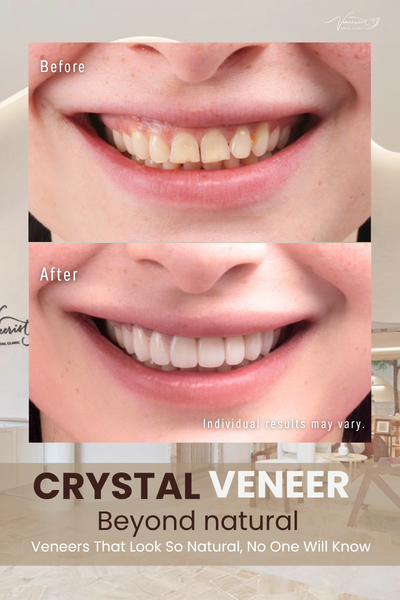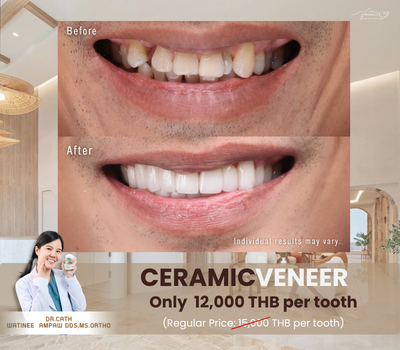
One of the reasons many people choose veneers is to achieve a brighter, more even smile with a tooth shade that can be planned in advance.
But naturally, this raises a few questions:
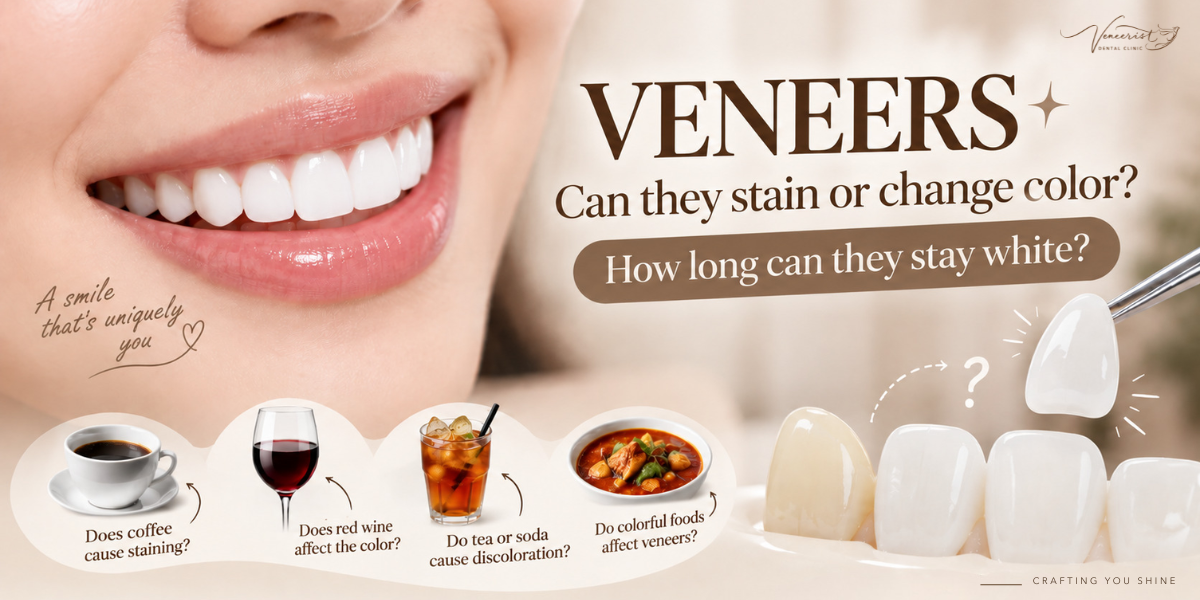
If you drink coffee every day, will your veneers turn yellow?
Can tea, wine, or strongly colored foods stain veneers?
And perhaps most importantly, how long will veneers stay white?
The answer depends partly on whether we are talking about Ceramic Veneers or Composite Veneers, because these materials behave differently when it comes to staining and color stability.
Do Ceramic Veneers Change Color?
In general, Ceramic Veneers have excellent color stability and are much more resistant to staining than composite resin.
A properly fabricated and finished ceramic surface is smooth and does not absorb pigments from foods and beverages in the same way that natural teeth or some resin-based materials can.
This means that the shade of Ceramic Veneers can remain very stable over time when the restorations and the surrounding oral tissues remain healthy and well maintained.
However, “stain resistant” does not mean that your entire smile can never appear different over time.
That is because the appearance of your smile depends on more than the ceramic itself.
Can Coffee, Tea, or Dark-Colored Foods Stain Ceramic Veneers?
The ceramic itself is generally highly resistant to staining from coffee, tea, wine, and other strongly colored foods and drinks.
So having Ceramic Veneers does not necessarily mean you have to give up coffee forever.
However, stains and deposits can still accumulate in other areas, including:
- Around the veneer margins
- Between the teeth
- Along the gumline
- On surrounding natural teeth
- In areas where plaque or calculus accumulates
As these deposits build up, the overall smile may begin to look less bright even though the ceramic itself has not actually changed color.
Why Do Some Veneers Appear More Yellow Over Time?
This is an important distinction because what looks like “discolored veneers” may not necessarily be discoloration of the ceramic itself.
Several other factors can change the appearance of the smile over time.
1. Staining Around the Veneers
Coffee, tea, food pigments, plaque, and other deposits may accumulate around the gumline or between the teeth.
This can make the overall smile appear darker or less clean even when the ceramic remains the same shade.
2. Natural Teeth Can Change Color
If veneers are placed on only some of the visible teeth, the surrounding natural teeth can still change color over time.
This may gradually create a greater contrast between the Ceramic Veneers and the natural teeth.
In this situation, the veneers may look different compared with the rest of the smile even though their actual shade has remained relatively stable.
3. Changes Around the Veneer Margins
The area where the veneer meets the natural tooth also needs long-term care.
Staining, changes in the material around the margin, or problems affecting the underlying natural tooth may alter the appearance of this area.
4. Changes in the Gums
The position and shape of the gums can also change over time.
If more of the natural tooth or the margin of the restoration becomes visible, the smile may look different from the way it appeared immediately after treatment.
For this reason, if veneers appear darker or different in color, it is better to identify the cause first rather than assuming that the ceramic itself has become stained.
Do Composite Veneers Stain?
This is where Composite and Ceramic Veneers differ more noticeably.
Composite Veneers are generally more susceptible to staining and discoloration than Ceramic Veneers.
Because composite resin has different material and surface properties from ceramic, its appearance can change with time.
Changes may include:
- Staining or discoloration
- Reduced surface gloss
- Changes in surface smoothness
These changes may be more noticeable in people who frequently consume strongly colored foods and beverages.
Composite Veneers may therefore require periodic polishing, maintenance, or repair to help restore their surface smoothness and appearance.
When color stability is the main consideration, Ceramic Veneers generally offer greater resistance to staining than Composite Veneers.
Can You Whiten Your Teeth After Getting Ceramic Veneers?
This is an important point to understand before choosing your veneer shade.
Teeth whitening does not whiten Ceramic Veneers in the same way that it whitens natural teeth.
Whitening agents work on natural tooth structure. They do not change the shade of an existing ceramic restoration.
For example, imagine you have Ceramic Veneers on several front teeth and decide to whiten your natural teeth later.
Your natural teeth may become brighter, while the Ceramic Veneers remain approximately the same shade.
This can create a visible color difference between the veneers and the surrounding natural teeth.
For this reason, if you would like your natural teeth to be brighter as part of your smile makeover, teeth whitening is often considered before the final Ceramic Veneer shade is selected and the restorations are fabricated.
The appropriate sequence should be planned with your dentist according to your individual treatment.
How Long Do Ceramic Veneers Stay White?
There are actually two different questions here:
“How long does the color of Ceramic Veneers remain stable?”
and
“How long do Ceramic Veneers last?”
These are not the same thing.
In terms of color, Ceramic Veneers have good long-term color stability. There is no specific point at which ceramic automatically becomes yellow simply because a certain number of years has passed.
For this reason, it would not be accurate to say that Ceramic Veneers will stay white for exactly 5 years, 10 years, or any other fixed period.
If the ceramic surface remains in good condition and the veneers, margins, natural teeth, and gums are properly maintained, the color of the ceramic itself can remain stable for a long time.
The overall lifespan of a veneer is a separate subject and depends on additional factors such as the bite, chewing forces, teeth grinding, habits, the condition of the natural teeth and gums, and how the restorations are maintained.
How Can You Keep Your Veneer Smile Looking Bright?
Even though Ceramic Veneers are highly resistant to staining, keeping the areas around them healthy and clean is still important.
Regular care should include brushing at least twice a day, cleaning between the teeth daily, and paying particular attention to the gumline.
If you regularly drink coffee, tea, or other strongly colored beverages, maintaining good oral hygiene can help reduce staining and deposits around the veneers and surrounding natural teeth.
Regular dental examinations and professional cleaning are also important so that the dentist can evaluate the veneers, margins, natural teeth, and gums over time.
If My Veneers Look Yellow or Dull, Do They Need to Be Replaced?
Not necessarily.
Before replacing a veneer, it is important to determine why the smile appears to have changed color.
If the problem is caused by surface deposits or staining around the restoration, professional cleaning or appropriate surface maintenance may be enough.
If there is a problem with the veneer margin, the natural tooth underneath, damage to the restoration, or another clinical concern, the dentist can then determine whether repair or replacement is necessary.
So, “my veneers do not look as bright as before” does not automatically mean “I need new veneers.”
The cause should be assessed first.
Summary: Do Veneers Stain or Change Color?
When it comes to Ceramic Veneers, the material has excellent color stability and is generally much more resistant to staining from foods and beverages than Composite Veneers.
However, the overall appearance of a smile can still change over time because of staining around the margins, changes in surrounding natural teeth, gum changes, or other conditions around the restorations.
Composite Veneers, on the other hand, are more susceptible to staining, discoloration, loss of surface gloss, and surface changes over time, and may require periodic polishing or maintenance.
Another important point is that teeth whitening cannot make existing Ceramic Veneers whiter. If whitening and veneers are both part of your treatment plan, the timing of whitening and the final veneer shade should therefore be considered before the Ceramic Veneers are fabricated.
At Veneerist Dental Clinic in Krabi, Thailand, selecting the shade of Ceramic Veneers is not simply about choosing the “whitest” shade available. We consider the natural teeth, the number of teeth being treated, facial characteristics, and the overall smile to create a shade that is harmonious with each individual.