
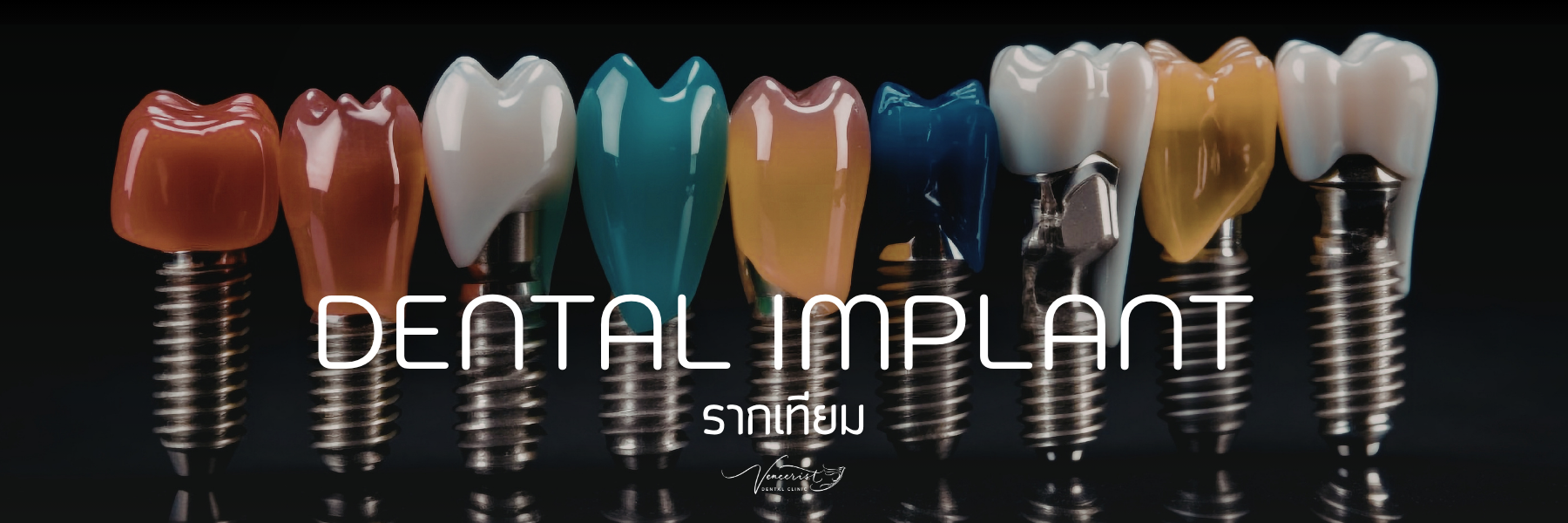
The loss of a natural tooth—whether due to unexpected trauma, deep-seated dental caries, or advanced periodontal disease—strips away far more than just a single tooth; it progressively diminishes your inner self-confidence and compromises your overall masticatory efficiency. If you are seeking a restorative dental option that is "completely natural-looking, permanently fixed, and entirely free from the inconveniences of removable dentures," Dental implants are widely considered one of the most predictable and long-lasting solutions for replacing missing teeth. Dental implants help restore both the appearance and function of your natural smile. At Veneerist Dental Clinic Krabi, our experienced dental team utilizes state-of-the-art technologies to guide you through every step of your treatment journey
Many individuals assume that a single missing tooth, particularly in the posterior (back) zone, requires no immediate attention. However, from an anatomical and clinical standpoint, leaving an empty gap over an extended duration triggers a destructive domino effect throughout the oral cavity:
Adjacent Tooth Drifting: The teeth bounding the empty space will gradually tilt, drift, and lean into the gap. This disrupts occlusion (your bite) and creates intricate interdental spaces that trap plaque, significantly elevating the risks of localized tooth decay and aggressive gum disease.
Opposing Tooth Over-Eruption: A tooth opposite the missing-tooth space may gradually move into the gap, reducing the space available for a replacement tooth and affecting the bite. The extent varies between patients, and treatment depends on a dental assessment. Extraction is not always necessary.
Alveolar Bone Resorption: Without a natural tooth root to transmit vital mechanical chewing forces, the underlying bone tissue lacks biological stimulation. Consequently, the bone progressively resorbs, shrinks, and melts away. Bone loss may gradually affect facial support and alter facial appearance over time, changes in facial contours (smile lines), and visible alterations in facial symmetry.
Gastrointestinal Strain: An incomplete dental arch severely compromises masticatory efficiency. Swallowing poorly chewed food places a heavy chronic burden on the stomach, Reduced chewing efficiency may make it more difficult to properly break down food before swallowing.
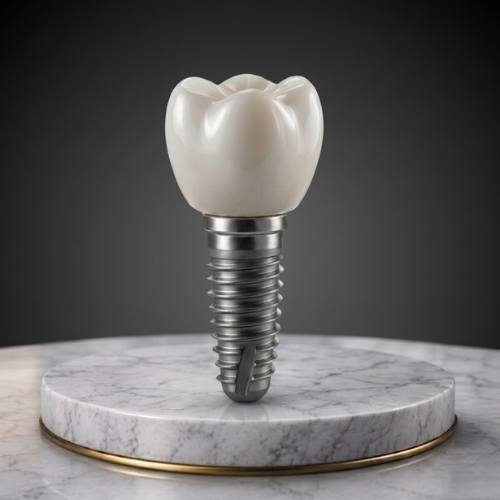
A dental implant is an artificial tooth root, usually made of titanium, that is placed in the jawbone to support a replacement tooth. Titanium is highly biocompatible, and the surrounding bone can integrate with its surface through a process called osseointegration. However, successful integration is not guaranteed, and complications or implant failure can occur.
A comprehensive implant restoration is masterfully integrated through three essential structural components:
Implant Body / Fixture: The titanium screw component that is surgically embedded directly into the alveolar bone, perfectly replicating the function of a natural tooth root beneath the gumline.
Abutment: The high-precision connecting connector made of titanium or ceramic. Once osseointegration is complete, the abutment is securely affixed to the implant fixture to serve as the structural core that supports the final aesthetic crown.
Crown: The visible part of the restoration that is designed to match your natural teeth. Meticulously custom-crafted by elite dental laboratories using premium-grade ceramic or zirconia, it is shaped and shaded to mirror the translucency, contour, and biting strength of your natural teeth flawlessly.
One of the key advantages of dental implants is their ability to help preserve the jawbone in areas where teeth have been lost. This differs from removable dentures or dental bridges.
When a tooth is lost, the natural tooth root that once transmitted chewing forces to the jawbone is also lost. As a result, the bone in that area no longer receives natural stimulation, causing it to gradually resorb over time.
Dental implants function similarly to natural tooth roots by receiving chewing forces and transferring them to the jawbone. This allows the bone to continue receiving functional stimulation, which helps slow down bone resorption and maintain the contour of the alveolar ridge over the long term.
No matter how many teeth have been lost, advanced dental implantology provides a treatment option tailored to your exact anatomical needs:
Single Implant: Engineered for individuals missing a single tooth. This involves placing one titanium implant body to support one bespoke ceramic crown, completely preserving neighboring teeth.
Implant Supported Bridge: An ideal solution for patients missing 3–4 adjacent teeth. Instead of placing an implant for every missing root, our specialists strategically embed just 2 implants (at the endpoints) to securely support a multi-unit dental bridge, offering exceptional stability while optimizing your financial investment.
Implant Overdenture: A removable full-arch denture retained by dental implants to improve stability during chewing and speaking. Patients can remove it themselves for daily cleaning. The number and position of implants depend on the individual treatment plan.
All-on-4: A fixed full-arch restoration supported by four dental implants per arch. Patients cannot remove it themselves; removal, when necessary, must be performed by a dentist. Suitability depends on bone condition, oral health, and bite assessment.
When multiple teeth or all teeth in a jaw are lost, conventional removable dentures can restore appearance, speech, and chewing function to a certain extent.
However, some patients may experience problems such as:
Dental implants can be used as a foundation to support a new set of teeth, helping improve stability and function. Common treatment options for patients who have lost all teeth in a jaw include:
Although all three options use dental implants as their foundation, they differ in terms of function, treatment procedures, patient experience, maintenance, and cost.
Selecting the most appropriate treatment requires a comprehensive oral examination, assessment of bone volume, X-ray imaging, bite analysis, and collaborative treatment planning between the patient, the dentist, and the dental laboratory.
An Implant Overdenture is a removable denture that uses dental implants to provide greater stability than a conventional full denture.
The dental implants act as anchoring points within the mouth, while the inner surface of the denture contains attachment components designed to snap onto the implant attachments.
When the patient places the denture in the correct position and applies gentle pressure, the denture snaps securely onto the attachments, making it more resistant to movement, rocking, or dislodgement.
Although it provides greater stability than a conventional denture, an Implant Overdenture remains removable. Patients can remove it themselves to clean the denture, the attachment components, and the gums surrounding the dental implants.
For Implant Overdenture treatment at Veneerist Dental Clinic, the treatment plan generally involves the placement of approximately four dental implants per arch to provide an appropriate number of support points and distribute functional forces effectively.
The four dental implants serve as anchoring points for the attachment system located inside the denture. Once the denture is properly positioned, it snaps securely onto the attachments, helping reduce movement, dislodgement, and rocking during speaking and chewing.
Using four dental implants improves denture stability, particularly in the posterior region, where rocking may occur more easily during chewing. The additional support points help distribute functional forces more evenly, allowing the denture to function with greater confidence.
However, the position of each implant must be carefully planned based on:
Before treatment begins, the dentist will perform a comprehensive oral examination and evaluate X-ray images to determine the optimal placement of the four dental implants according to each patient’s prosthetic design and functional requirements.
An Implant Overdenture uses an individual attachment system at each implant site. The top of each dental implant is fitted with a small rounded attachment.
The inner surface of the denture contains corresponding attachment components designed to snap securely onto these implant attachments.
When the patient positions the denture correctly and applies gentle pressure, the denture snaps into place, providing greater stability than a conventional removable denture.
This attachment system helps reduce denture movement, rocking, and dislodgement while still allowing patients to remove the denture for routine cleaning.
After prolonged use, patients may notice that the denture no longer snaps into place as firmly as before or becomes easier to remove. This may occur because the internal attachment components have worn through normal use.
This does not necessarily indicate a problem with the dental implants themselves. The dentist will evaluate the attachment system and replace worn components when appropriate.
An Implant Overdenture may be suitable for patients who:
The treatment process may vary depending on each patient’s oral condition and general health. In general, it consists of the following steps.
The dentist will evaluate:
If any natural teeth remain, the dentist will determine which teeth can be preserved and which have a poor prognosis and should be extracted.
Patients should provide the dentist with a complete medical history, including:
Having an underlying medical condition does not necessarily mean that dental implants cannot be placed. However, the patient’s overall health must be carefully evaluated, and any medical conditions should be appropriately controlled before treatment.
Before treatment begins, the dentist will collect the necessary diagnostic information to determine the optimal implant positions and design the denture according to each patient’s individual needs.
For denture cases, the clinic photographs every patient as part of the treatment planning process shared between the dentist and the dental laboratory.
The photographs help evaluate:
These records allow the dentist and dental laboratory to communicate effectively and design a denture that is appropriate for the patient’s facial appearance, function, and individual needs.
The dentist will determine which X-ray examinations are necessary for each individual case, such as:
X-ray images help the dentist evaluate:
Dental impressions or an intraoral scan are used to record the shape of the alveolar ridge, the position of any remaining teeth, and the detailed anatomy of the oral cavity for denture design.
The dentist will evaluate:
All of this information will be analyzed together before the treatment plan is finalized.
Before implant surgery, the oral cavity may need to be prepared by:
The dentist will administer local anesthesia and place the dental implants into the jawbone according to the planned positions.
The duration of surgery depends on:
In some cases, a temporary denture may be worn during the healing period, provided it has been appropriately adjusted to avoid placing excessive pressure or undesirable forces on the surgical site.
After surgery, time is required for the dental implants to integrate with the jawbone through a process known as osseointegration.
The healing period varies depending on:
In general, this process may take several months. The dentist will evaluate whether the implants are ready to support functional loading before proceeding with denture fabrication.
Once the implants have successfully integrated with the bone and achieved adequate stability, the dentist will place the attachment components onto the implants.
The denture fabrication process then begins, including:
Before the final denture is fabricated, a trial arrangement of the teeth may be performed to evaluate:
If any adjustments are required, the dentist will communicate the necessary changes to the dental laboratory before fabrication of the final prosthesis.
When the denture is completed, the dentist will evaluate:
Patients will receive instructions on inserting, removing, cleaning, and using the denture, as well as recommendations regarding eating.
After receiving the new denture, patients may need follow-up appointments to:
Early adjustments are considered a normal part of the denture treatment process.
After a period of use, the following may be required:
All-on-4 is a treatment concept for replacing all teeth in a jaw with a fixed full-arch prosthesis supported by four dental implants.
In general, the anterior implants may be placed in a relatively straight orientation, while the posterior implants may be angled according to the treatment plan to help distribute support for the prosthesis and make optimal use of the available bone.
Angling the posterior implants may help avoid important anatomical structures, such as the maxillary sinus in the upper jaw or the inferior alveolar nerve in the lower jaw.
However, the implant placement design is determined according to each patient’s bone anatomy and oral structures. This does not mean that every patient will have the same implant positions or angulations.
For patients, an All-on-4 prosthesis is considered a fixed restoration. It does not need to be removed daily like a conventional removable denture.
The prosthesis is secured to the dental implants using prosthetic components and screws according to its design.
If inspection, repair, component replacement, or professional deep cleaning is required, the dentist can remove the prosthesis using specialized instruments.
Patients should not attempt to remove the prosthesis themselves.
All-on-4 may be suitable for patients who:
The number of teeth in an All-on-4 prosthesis does not necessarily correspond to the number of natural teeth.
In many cases, the prosthesis may be designed with approximately 10–12 teeth per arch. However, the appropriate number depends on several factors, including:
The dentist will design the number and position of the teeth to optimize strength, function, and long-term maintenance.
The treatment process generally consists of the following steps.
The dentist will evaluate:
If natural teeth remain, the dentist will evaluate the prognosis of each tooth before deciding whether extraction is necessary.
The decision to extract all remaining teeth should not be based solely on convenience. It should be made after carefully comparing all available treatment options and evaluating the prognosis of the existing teeth.
The dentist will review:
Planning an All-on-4 treatment requires comprehensive diagnostic information.
For full-arch rehabilitation cases, the clinic photographs every patient to facilitate treatment planning between the dentist and the dental laboratory.
The photographs help evaluate:
A Panoramic X-ray (OPG) is used to evaluate the overall condition of the teeth, jawbone, and surrounding anatomical structures.
A 3D CT Scan is used to evaluate:
Dental impressions or an intraoral scan are used to record the anatomy of the oral cavity, tooth positions, alveolar ridge, and the space required for prosthetic design.
The dentist will analyze:
All diagnostic information is analyzed together to ensure that implant placement corresponds appropriately with the planned tooth positions.
The dentist will plan:
In some cases, digital planning systems or guided surgery may be used when appropriate.
Preparation may include:
In some cases, tooth extraction and implant placement can be performed on the same day, depending on the condition of the bone and the presence of infection.
The dentist will place the four dental implants according to the treatment plan under local anesthesia.
The duration and complexity of surgery depend on:
After implant placement, the dentist will assess whether the implants have achieved sufficient primary stability to support a temporary prosthesis.
If the implants demonstrate adequate stability and all required criteria are met, a fixed temporary prosthesis may be placed.
If sufficient stability has not been achieved, the implants may be allowed to heal and integrate with the bone before prosthetic loading, or another type of temporary prosthesis may be provided during the healing period.
The temporary prosthesis allows patients to have functional teeth while the surgical site and implants heal.
It also serves to evaluate:
Because the temporary prosthesis has limitations in strength, patients should follow dietary instructions carefully and avoid hard foods.
Following surgery, time is required for the implants to integrate with the jawbone.
During this period, patients should:
Once the implants and surrounding tissues have achieved sufficient stability, fabrication of the definitive prosthesis begins.
This stage may include:
After the definitive prosthesis has been delivered, regular follow-up examinations are necessary to evaluate:
The term “Teeth in a Day” or “Immediate Fixed Teeth” generally refers to the placement of a temporary prosthesis on the day of surgery or within a short period after implant placement.
It does not mean that the entire treatment is completed in a single day, nor does it mean that the patient receives the definitive prosthesis immediately.
Early placement of a temporary prosthesis may be possible when appropriate conditions are met, such as:
If these criteria are not met, the dentist may recommend allowing the implants to heal and integrate with the bone before loading them, thereby providing a more appropriate treatment approach and reducing potential risks.
All-on-6 is a treatment concept that uses six dental implants to support a fixed full-arch prosthesis.
The overall principle is similar to that of All-on-4, but the number of dental implants is increased to six in order to provide additional support points and help distribute functional forces according to the dentist’s treatment plan.
However, All-on-6 is not necessarily better than All-on-4 for every patient.
The decision to increase the number of dental implants depends on factors such as:
All-on-6 may be suitable for patients who:
The primary treatment steps are similar to those of All-on-4, including:
The key difference is the placement of all six dental implants with appropriate positioning and spacing while avoiding important anatomical structures such as nerves and the maxillary sinus, and while maintaining adequate access for oral hygiene.
| Feature | Implant Overdenture | All-on-4 | All-on-6 |
|---|---|---|---|
| Type of Prosthesis | Removable denture | Fixed prosthesis | Fixed prosthesis |
| Number of Dental Implants | Generally approximately 4 implants per arch | 4 implants | 6 implants |
| Can the Patient Remove It? | Yes | No | No |
| Retention System | Snap attachment system | Screw-retained fixed prosthesis | Screw-retained fixed prosthesis |
| Cleaning | Remove the denture for cleaning | Clean around and beneath the prosthesis while in the mouth | Clean around and beneath the prosthesis while in the mouth |
| Stability | Greater than a conventional removable denture | High | High |
| Lip Support | The denture base provides good replacement of lost soft tissue | Depends on the prosthetic design | Depends on the prosthetic design |
| Maintenance | Attachment replacement, denture relining, or denture repair | Repair of prosthetic materials, screw replacement, or professional removal by the dentist | Repair of prosthetic materials, screw replacement, or professional removal by the dentist |
| Cost | Generally lower than a fixed full-arch restoration | Higher than an Implant Overdenture | Generally higher due to the greater number of implants |
| Suitable For | Patients who want a more stable removable denture that can be removed for cleaning | Patients who want a fixed full-arch restoration supported by four dental implants | Patients who want a fixed full-arch restoration and have suitable bone conditions for six dental implants |
There is no single answer as to whether All-on-4 or All-on-6 is the best option for every patient.
The number of dental implants is only one aspect of treatment. The most important factor is placing the implants in positions that are appropriate for the patient’s bone anatomy, occlusion, and the prosthesis being planned.
The dentist will consider factors including:
The available bone must be evaluated to determine how many implants can be placed and whether each implant position can adequately support functional forces.
These important anatomical structures influence the size, length, angulation, and placement of the dental implants.
Differences in jaw size and curvature require different implant distribution patterns.
Patients who grind their teeth or generate high chewing forces require appropriate prosthetic design and material selection.
Bone quality differs between the upper and lower jaws; therefore, the same implant configuration should not be applied to every patient.
Adequate space is required for:
The number and position of the implants should facilitate effective cleaning rather than simply maximizing the number of implants without considering long-term maintenance.
Patients should receive complete information regarding:
Having six dental implants does not guarantee a better outcome than four implants, and four dental implants are not suitable for every patient. The most appropriate treatment depends on each individual’s oral condition, functional requirements, and long-term treatment plan.
A temporary prosthesis is used while the surgical site and dental implants are healing.
It allows both the dentist and the patient to evaluate:
A temporary prosthesis may be less durable than a definitive prosthesis. Patients must avoid hard foods and follow the dentist’s instructions carefully.
A definitive prosthesis is made after the dental implants and surrounding tissues have become more stable.
Its design is developed based on information gathered during the use of the temporary prosthesis, such as:
The term “definitive prosthesis” does not mean that the restoration will never wear, fracture, or require repair.
The prosthesis still requires regular examination and maintenance and may need to be replaced after many years of use.
At Veneerist Dental Clinic, the definitive All-on-4 and All-on-6 prostheses use ceramic teeth. Temporary prostheses used during treatment may be made from different materials according to the treatment plan. Fixed full-arch prostheses can be made from various materials, such as:
Each material differs in terms of:
The dentist will consider chewing forces, implant positions, interarch space, occlusion, aesthetic preferences, and budget.
No single material is suitable for every patient.
Although prosthetic teeth do not develop cavities like natural teeth, plaque can accumulate around the dental implants and beneath the prosthesis.
If oral hygiene is inadequate, inflammation of the gums or bone loss around the dental implants may occur.
The dentist will evaluate:
The frequency of follow-up appointments depends on each patient’s risk level and oral condition.
Dental implant treatment has a high success rate in suitable patients, but there are still risks and possible complications that patients should be aware of.
When problems are detected at an early stage, they are often easier to manage than when left untreated until symptoms become severe.
Patients with the following conditions should receive a thorough evaluation before undergoing dental implant treatment:
The presence of these factors does not necessarily mean that dental implant treatment cannot be performed, but the risks must be carefully assessed and the treatment planned appropriately.
The choice of treatment should not begin with the question, “Which option is the best?”
It should begin with the question:
“Which option is most appropriate for this patient’s oral condition, functional needs, preferences, and long-term maintenance requirements?”
At Veneerist Dental Clinic, we place importance on a systematic assessment before planning full-arch rehabilitation.
The dentist will consider:
For denture and full-arch cases, the clinic takes photographs of every patient to support collaborative treatment planning between the dentist and the dental laboratory.
Panoramic X-rays, three-dimensional X-rays, dental impressions, intraoral scans, and bite registrations may also be used when appropriate.
All information is analyzed together to determine implant positions and design the new prosthesis in a way that supports function, aesthetics, and long-term maintenance.
There is no single number of dental implants or one type of prosthesis that is suitable for every patient. Before treatment begins, the dentist will explain the available options, advantages, limitations, procedures, treatment duration, and costs so that the patient has sufficient information to make a decision.
Treatment outcomes and treatment duration vary depending on the patient’s oral condition, bone volume, overall health, response to treatment, and personal care.
Dental implants are widely recognised as a long-lasting method of tooth replacement. With appropriate treatment planning, consistent oral hygiene, and regular follow-up appointments with the dentist, dental implants can last for many decades and, in some patients, may remain functional for a lifetime.
However, the lifespan of dental implants does not depend solely on the implant itself. It is influenced by several factors working together.
Although dental implants do not develop cavities like natural teeth, the gums and bone surrounding them can still become inflamed if plaque accumulates.
Therefore, brushing, using dental floss or interdental cleaning aids, and attending oral health examinations every six months are important parts of helping dental implants remain functional for as long as possible.
Our upfront pricing reflects our commitment to utilizing premium certified systems, state-of-the-art diagnostics, and elite laboratory engineering:
| Treatment Specification | Investment Fee (THB) |
|---|---|
| Complete Diagnostic Package (1-Sided Surgical Stent Included) | 5,000.- |
| Complete Diagnostic Package (2-Sided Surgical Stent Included) | 7,000.- |
| Complete Premium Implant + Ceramic Crown Package (Single upfront payment) | 45,000.- |
| Titanium Implant Body / Fixture Base | 25,000.- |
| Custom Prosthetic Crown over Implant | 25,000.- |
| Advanced Bone Grafting with Crestal Sinus Floor Elevation | 20,000.- |
| Advanced Bone Grafting with Lateral Window Sinus Lift | 40,000.- |
| Implant Body for Overdenture Stabilization (Per Unit) | 35,000.- |
| Standard Prophylactic Bone Graft Augmentation | 5,000 - 10,000.- |
| Advanced Periodontal Soft-Tissue & Hard-Tissue Plastic Surgery | 8,000 - 20,000.- |
| Anterior Implant + Ceramic Anterior crown (one time payment) | 55,000 |
| Anterior Implant | 30,000 |
| Ceramic Anterior crown | 30,000 |
| Posterior Implant + Ceramic Posterior crown (one time payment) | 45,000 |
| Posterior Implant | 25,000 |
| Ceramic Posterior crown | 25,000 |
| Straumann® Implant + Ceramic crown (one time payment) | 75,000 |
| Straumann® Implant | 40,000 |
| Ceramic Crown on Straumann® Implant | 40,000 |
| Bone graft (small vial) | 10,000 |
| Overdenture on 4 (per arch) | 175,000 |
| All-on-4 (per arch) | 400,000 |
| All-on-6 (per arch) | 500,000 |
Experienced Implant Team: Every case is directly managed by skilled dental professionals specializing in advanced implant dentistry and oral maxillo-facial surgery.
Sterilization and Infection Control: We follow established infection-control protocols, including appropriate instrument sterilization, surface disinfection, and protective measures during treatment.
Quality Implant Materials: We source exclusively authentic, FDA-approved titanium implants and premium zirconia or ceramic crowns to ensure exceptional long-term biocompatibility.
Transparent Treatment Planning: Complete fees and treatment plans are disclosed and locked before your procedure, eliminating hidden fees or surprise surcharges.
FAQ
The procedure is far more comfortable than most patients anticipate. The clinical experience is very similar to a routine tooth extraction because we utilize advanced, high-efficiency local anesthesia. Once the numbing effect subsides, you may feel a mild, dull tension or minor swelling, which can be easily managed with mild over-the-counter analgesics provided by our clinic.
Older adults may be suitable for dental implant treatment; age alone does not determine eligibility. The dentist will assess overall health, medications, bone quantity and quality, gum health, and the ability to maintain oral hygiene. For younger patients, implant placement is generally considered after jaw growth is complete, rather than based on a fixed age alone.
In many cases, yes. Even if the teeth have been missing for several years, the dentist must first evaluate the condition of the jawbone because, without tooth roots, the bone in that area may gradually resorb over time.
The dentist will assess the area through an oral examination together with radiographic imaging, such as a 3D CT Scan, to evaluate the quantity and quality of the bone. If there is sufficient bone, dental implant placement can be planned. If the bone is insufficient, bone grafting or a sinus lift may be considered in some cases to prepare the area before treatment.
An assessment by a dentist is therefore an important step in determining the most appropriate treatment approach for each patient’s individual oral condition.
Yes, If our 3D CBCT diagnostic imaging reveals that your alveolar bone has resorbed or thinned over time, additional procedures such as bone grafting may be recommended or a Sinus Lift (for the upper posterior arch). These treatments help create sufficient bone support to support successful implant placement, with all steps thoroughly discussed during your initial consultation.

Orthodontic Specialist & Smile Design Expert